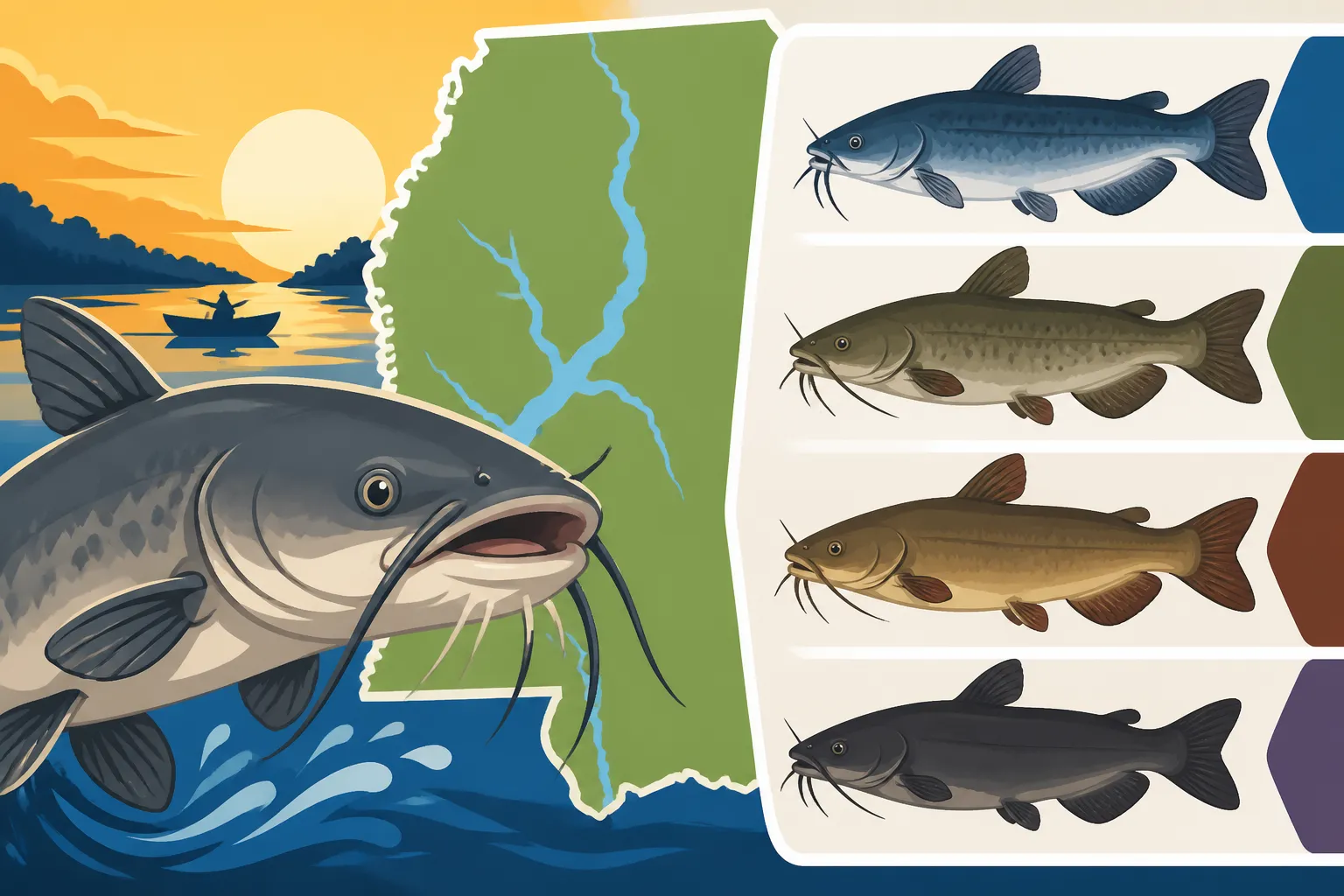
Catfish Identification Chart
There's nothing quite like the thrill of a bent rod and the powerful tug of a catfish pulling hard in Mississippi's abundant waters. But once you land that whiskered warrior, a common question often pops into an angler's mind: "Exactly what kind of catfish did I just catch?" It's a question that can lead to frustration, especially when regulations vary by species. This guide is here to help you confidently identify the various catfish species you'll encounter across the Magnolia State, ensuring you know your channel from your blue, and your flathead from your bullhead.
Why Correct Catfish Identification Matters for Mississippi Anglers
Knowing your catfish isn't just about showing off your angling prowess to your buddies, although that's certainly a perk! There are very practical, important reasons why taking the time to correctly identify your catch is a crucial part of responsible and successful fishing in Mississippi. It directly impacts everything from what you can keep to how you approach your next fishing trip.
Understanding Regulations and Limits
Let's face it, nobody wants to get a ticket or, worse, unknowingly contribute to overfishing. Mississippi has specific regulations in place for different species of catfish. You might find a generous daily limit for channel catfish, but perhaps a stricter slot limit or even a reduced creel limit for blue catfish in certain waters, especially for larger trophy-sized fish. Flathead catfish often have their own unique set of rules. Imagine reeling in a magnificent blue cat, only to realize later that you kept it when it was out of the legal slot, or that you went over the limit because you thought it was a more abundant channel cat. That's a headache you can easily avoid with a little identification know-how. It's truly empowering to know that when you're out on the water, you're fishing within the bounds, respecting the resource, and contributing to sustainable populations for future generations of anglers. Always double-check the current Mississippi Catfish Regulations before heading out.
Tailoring Your Fishing Techniques
Each species of catfish in Mississippi has its own preferred habitat, diet, and behavior patterns. What works like a charm for a channel cat might barely get a sniff from a flathead, and vice versa. Channel catfish, for instance, are often eager biters on a variety of baits, from stink bait to worms, and can be found in a wide range of environments. Blue catfish, being more pelagic and preferring deeper, flowing water, respond well to fresh cut bait in river channels or deep holes. Flatheads, on the other hand, are notoriously picky eaters, almost exclusively preferring live bait, and they love to ambush from dense cover like submerged timber or rock piles. If you can identify the species you're trying to catch, or the species that are prevalent in the water you're fishing, you can dramatically increase your success rate by choosing the right bait, rig, and location. This knowledge transforms a generic "catfish trip" into a targeted mission, making your time on the water much more productive and enjoyable. For more insights, consider checking out articles like Best Bait for Catfish in Mississippi or Catfish Fishing Techniques.
Appreciating Each Species' Unique Qualities
Beyond the practicalities, there's a real joy in understanding and appreciating the distinct characteristics of each catfish species. Knowing you've landed a feisty channel cat that put up a great fight, or a hard-pulling blue cat from a deep river bend, adds another layer to the fishing experience. It allows you to appreciate their ecological roles, their contributions to the fishery, and the specific challenges and rewards they offer to anglers. Each species has its own beauty, its own story, and its own place in Mississippi's rich aquatic tapestry. This deeper appreciation makes every catch more meaningful and enhances your overall connection to the natural world around you.
The Big Three: Channel, Blue, and Flathead Catfish
When most people talk about "catfish" in Mississippi, they're typically referring to one of these three primary species. They're the most sought-after, the biggest, and the most common catches for anglers across the state. While they share some general catfish traits, they also have distinct features that, once you learn them, make identification much easier.
Channel Catfish: The Widespread Favorite
The channel catfish is arguably the most recognizable and widespread catfish species throughout Mississippi, found in almost every body of water from small farm ponds to large reservoirs and rivers. They are often the first catfish species an angler encounters, and they're incredibly popular due to their abundance, willingness to bite, and excellent table fare. You'll find them in lakes, rivers, ponds, and even brackish waters near the coast.
Channel catfish are generally slender-bodied with a deeply forked tail, a feature that immediately distinguishes them from bullheads and flatheads. Their coloration can vary quite a bit depending on their environment; typically, they are olive-brown to grayish-blue on their backs, fading to silvery sides and a white belly. Younger channel cats, and sometimes those from clear water, will display distinct dark spots along their sides, which often fade or disappear entirely as they mature, especially in larger, older fish. They have eight barbels (whiskers) around their mouth: two nasal, two maxillary (the longest ones extending from the corners of their mouth), and four chin barbels. Their dorsal and pectoral fins have sharp, serrated spines, so handle them with care! If you want to learn more about targeting them, check out Channel Catfish Fishing in Mississippi.
Blue Catfish: The River Giants
Blue catfish are the true heavyweights of Mississippi's freshwater systems, renowned for their immense size and incredible fighting power. While they can be found in large reservoirs like Ross Barnett or Pickwick Lake, their preferred habitat is typically the main channels of large rivers, especially the mighty Mississippi River itself. They thrive in strong currents and deep holes, often congregating around structure like fallen trees, rock formations, and ledges. These are the fish that regularly exceed 50 pounds and can even push well over the 100-pound mark in prime conditions.
Distinguishing features of the blue catfish include its distinct bluish-gray coloration, which is usually uniform across its back and sides, fading to a white belly, without the spots characteristic of many channel cats. They also possess a deeply forked tail, similar to the channel catfish, but their body tends to be more robust and heavier-set, especially in larger specimens. A key identifier is their anal fin (the fin on the underside near the tail). Blue catfish have a notably long, straight-edged anal fin with 30-35 rays, which is a significant difference from the channel catfish's shorter, rounded anal fin with 24-29 rays. Their head is also broader and flatter than a channel cat's. Catching a trophy blue cat is a bucket-list item for many, and you can delve deeper into how to catch them with our guide on Blue Catfish Fishing in Mississippi.
Flathead Catfish: The Bottom-Dwelling Ambush Predators
Flathead catfish are unique among the "big three" for their solitary nature, predatory habits, and distinct appearance. Unlike the omnivorous channel and blue catfish, flatheads are almost exclusively piscivorous (fish-eaters) and prefer live prey. They are ambush predators, typically found lurking in areas with heavy cover like logjams, submerged trees, rock piles, or undercut banks in slow to moderately flowing rivers and large streams. They are less common in open lake environments unless significant riverine habitat is present.
Their name, "flathead," is a dead giveaway: they have a noticeably broad, flattened head, especially between their eyes. Their lower jaw protrudes beyond the upper jaw, giving them a distinctive "bulldog" look. Coloration varies but is generally mottled brown, yellow, or olive, with dark spots and blotches over a yellowish or creamy background, providing excellent camouflage against logs and muddy bottoms. This mottled pattern can be quite beautiful. Critically, their tail is not deeply forked; it's either square or only slightly notched. Their anal fin is short and rounded, similar to a channel catfish, but their overall body shape is much more robust and stout, lacking the sleekness of a channel cat. If you're looking to target these elusive giants, understanding their Flathead Catfish Habits and Habitat is key.
Key Identification Features: What to Look For
To make sure you're properly identifying your catch, it's helpful to know exactly which physical attributes to focus on. These features are the tell-tale signs that differentiate one species from another, and with a little practice, they become second nature.
Body Shape and Coloration
The overall silhouette and color patterns of a catfish can provide immediate clues. Channel catfish tend to be the most slender and streamlined of the big three, especially when younger, and they often have those characteristic dark spots that fade with age. Their color is usually a uniform silvery-gray to olive. Blue catfish, while having a similar fork in their tail, generally boast a more robust, powerful body, especially as they grow larger, and their color is a distinct slate blue or gray, without spots. Flathead catfish are the most distinct in shape; they are stout, almost slab-sided, with that famously broad, flattened head and a mottled, camouflaged pattern of yellows, browns, and olives. If you're comparing a fish to pictures, pay close attention to the body's depth relative to its length, and the presence or absence of spots or distinct patterns.
For example, imagine you've just pulled in a catfish and it's long, sleek, and silver-gray with some faint spots. Your first thought should lean towards a channel cat. If it's a deep blue-gray, thicker, and very powerful-looking, especially if caught in a main river channel, then "blue cat" should jump to mind. And if it's broad-headed, mottled yellow and brown, and came out of a brush pile, you've likely got yourself a flathead. These initial impressions based on shape and color can quickly narrow down your options.
Fin Characteristics (Dorsal, Anal, Caudal)
The fins are arguably the most reliable physical markers for catfish identification. Paying close attention to the dorsal (back) fin, anal (bottom rear) fin, and caudal (tail) fin can unlock the mystery of your catch.
- Caudal Fin (Tail): This is often the easiest and most important distinguishing feature.
- Channel Catfish and Blue Catfish both have a deeply forked tail, almost like a "V" shape. This is a primary feature that groups them together and separates them from flatheads and bullheads.
- Flathead Catfish have a square or only slightly notched tail. It's much less pronounced than the channel or blue.
- Bullhead Catfish also have a square or rounded tail, similar to a flathead but usually smaller.
- Anal Fin: This fin, located on the underside of the fish between the anus and the tail, is perhaps the most definitive way to distinguish between channel and blue catfish.
- Channel Catfish have an anal fin that is moderately long and typically rounded or slightly convex at its edge, containing 24-29 rays (the bony supports within the fin).
- Blue Catfish have a notably longer anal fin with a distinctly straight edge, often appearing almost uniform in height, and it contains 30-35 rays. This is the "gold standard" for telling these two apart when they are of similar size or coloration.
- Flathead Catfish have a short, rounded anal fin with fewer rays (14-17), which is another unique characteristic.
- Dorsal Fin: While less critical for distinguishing the big three from each other, all true catfish have a single, prominent dorsal fin with a sharp spine, located on their back. Handle this spine carefully, as it can inflict a painful puncture wound.
Head and Mouth Structure
Don't underestimate the power of a good headshot – of the fish, of course! The shape of the head and the mouth’s alignment offer strong identification cues. As mentioned, the flathead catfish is named for its broad, flattened head, and it’s very pronounced. Its lower jaw also protrudes past the upper jaw, indicating its predatory, upward-striking feeding style. Channel catfish have a more pointed, conical head shape. Blue catfish have a broader, somewhat flatter head than channels, but not nearly as exaggerated as a flathead, and their jaws are typically even or the upper jaw may protrude slightly. These subtle differences become more apparent with practice and comparison. Take a moment to gently open the fish’s mouth and feel the texture inside; some species have rougher pads of teeth.
Whisker (Barbel) Placement and Length
Catfish are defined by their barbels, those sensory "whiskers" around their mouths that give them their name. All Mississippi catfish species will have eight barbels, but their relative length and the coloration of the barbels can sometimes offer clues. For the "big three," the general arrangement is similar, but sometimes the barbels of a channel catfish may have a slightly darker, almost blackish, appearance compared to the often paler barbels of a blue cat. This isn't a definitive ID factor on its own, as coloration can vary, but it's another piece of the puzzle. The maxillary barbels (the long ones at the corners of the mouth) are generally quite prominent in all species, aiding in their low-light foraging.
Beyond the Big Three: Other Catfish Species in Mississippi
While channel, blue, and flathead catfish get most of the angling attention, Mississippi waters are also home to several smaller, but equally interesting, catfish species. These often fall under the "panfish" category for many anglers, providing consistent action and great eating, especially for kids or those looking for a relaxed day on the water.
Bullheads: The Smaller, Hearty Cousins (Black, Yellow, Brown)
Mississippi is home to at least three species of bullhead catfish: the black bullhead, yellow bullhead, and brown bullhead. These fish are much smaller than their channel, blue, and flathead cousins, rarely exceeding a few pounds, though they are incredibly hardy and can tolerate a wide range of water conditions, including low oxygen levels that would kill other fish. They are common in ponds, sluggish streams, ditches, and the shallower, warmer backwaters of larger lakes and rivers.
Bullheads are easily distinguished from the "big three" by their tail fin, which is not forked. Instead, it's either square or slightly rounded. They have a stout body, a somewhat compressed head, and like all catfish, eight barbels.
- Black Bullheads often have a dark, mottled body, sometimes almost black, and their chin barbels are typically dusky or black. A key identifier is the absence of serrations on the posterior (rear) edge of their pectoral spines.
- Yellow Bullheads generally have a yellowish or olive-brown body with a pale, often yellowish, belly. Their most reliable distinguishing feature is that their chin barbels are almost always white or pale. They also possess strong serrations on their pectoral spines.
- Brown Bullheads are typically brown to olive on their back, mottled with darker brown or black, fading to a creamy belly. Their chin barbels are usually dusky. A good identifier is the presence of strong serrations on their pectoral spines, and the fact that their caudal fin usually has a faint, dark band near the edge.
While sometimes overlooked, bullheads offer fantastic fishing opportunities, especially for beginners or those seeking a fry-pan-sized meal.
Madtoms: The Tiny, Often Overlooked Species
Madtoms are the smallest members of the catfish family found in Mississippi, often barely reaching a few inches in length. There are several species of madtoms across the state, and they are generally not targeted by anglers due to their diminutive size. Instead, they play an important ecological role as prey for larger fish and are a fascinating part of the aquatic ecosystem. They are typically found in clear, shallow streams and rivers, often hiding under rocks or in dense vegetation.
Their most distinctive feature, besides their size, is that the adipose fin (a small fleshy fin on the back near the tail) is fused with the caudal (tail) fin, forming a continuous fin membrane. This is a unique characteristic not found in other Mississippi catfish. Madtoms also possess sharp, venomous spines in their dorsal and pectoral fins, which can deliver a painful, though not dangerous, sting if handled carelessly. So, if you're out seining for bait or simply observing stream life, and you encounter a tiny catfish with a fused adipose and caudal fin, you've likely found a madtom! They are a testament to the incredible diversity within the catfish family.
Common Misidentifications and How to Avoid Them
Even experienced anglers can sometimes mix up catfish species, especially when conditions aren't ideal or if they're unfamiliar with a particular body of water. Knowing the most common pitfalls in identification can help you avoid making those mistakes and ensure you're always on the right side of the regulations and maximizing your fishing strategy.
Distinguishing Between Channel and Blue Catfish
This is by far the most frequent and important misidentification in Mississippi. Young blue catfish and large channel catfish can look strikingly similar, particularly if the channel cat has lost its spots or if the blue cat is caught in slightly stained water. Both have that characteristic deeply forked tail, which immediately groups them together.
The key, as we've discussed, lies in the anal fin. Carefully count the rays on the anal fin (the soft rays, not the spine). If it's short and rounded with 24-29 rays, it's a channel catfish. If it's long and straight-edged with 30-35 rays, it's a blue catfish. Another helpful, though less definitive, clue is coloration: channel cats tend to be more silvery-gray, often with spots, while blue cats are a more uniform slate-blue or gray. The head of a blue cat also tends to be broader than a channel cat's, especially in larger fish. Always rely on the anal fin ray count when in doubt, as it's the most consistent morphological difference. This distinction is especially important because Mississippi Fishing Regulations Explained often have different size and creel limits for these two species.
Confusing Flatheads with Other Bottom Dwellers
While the flathead's distinct head and mottled coloration usually make it easy to identify, sometimes in very murky water or in poor light, an angler might momentarily confuse a flathead with other bottom-dwelling fish, particularly large bullheads or even certain types of carp. However, a quick check of the tail fin will almost always clear up any confusion. Flatheads have that square or slightly notched tail, which is significantly different from the deeply forked tails of channel and blue cats, and also different from the typically rounded tails of true bullheads (though some bullheads can have a squarish tail).
Another key differentiator is the mouth: the flathead's protruding lower jaw is very characteristic. Other bottom-dwelling fish might have barbels or similar body shapes, but none will combine the flattened head, mottled coloration, protruding lower jaw, and square tail quite like a flathead. Always remember that flatheads are strong, solitary predators, and their physical attributes reflect that.
Telling Bullheads Apart
Distinguishing between the different species of bullheads (black, yellow, and brown) can be a bit more challenging due to their similar overall appearance and size. However, there are consistent features to look for.
The primary differences often come down to the color of their chin barbels and the serrations on their pectoral spines:
- Yellow Bullhead: Has white or pale chin barbels and strongly serrated pectoral spines (feel for the saw-like edge on the back of the spine).
- Black Bullhead: Has dusky or black chin barbels and no serrations on its pectoral spines (it will feel smooth).
- Brown Bullhead: Has dusky chin barbels and strongly serrated pectoral spines.
If you're unsure, gently lift the fish and carefully examine the barbels under its chin. Then, with extreme caution, run your finger along the back edge of the pectoral fin's spine to feel for serrations. These small details are usually enough to tell them apart. While these species don't always have separate regulations, knowing which bullhead you caught can add to your understanding of the local ecosystem and your fishing success. For example, if you're trying to figure out Is There a Daily Limit on Catfish in Mississippi?, it's important to know which species you have.
Practical Tips for On-the-Water Identification
You're out on the water, rod bent, and you've just brought in a beautiful catfish. Now what? Having a strategy for identification in the field can make all the difference. It's about being prepared, being safe, and being respectful of the fish.
Using a Reference Guide or App
One of the best tools an angler can have in their tackle box (or phone) is a reliable fish identification guide. There are numerous laminated, waterproof field guides specifically for freshwater fish of the Southeastern United States that are perfect for keeping in your boat or fishing vest. These guides often feature clear illustrations or photographs, highlighting the key identification features for each species. You can find a wide variety of excellent field guides on online marketplaces like Amazon, or at your local bait and tackle shop.
Beyond physical guides, modern technology offers a fantastic alternative: smartphone apps. Many fishing and wildlife agencies, as well as independent developers, offer apps that allow you to quickly look up fish species, often with detailed descriptions and multiple images. Some even use AI-powered image recognition, though these can be hit or miss depending on the quality of your photo. Having a good app or a physical guide readily available means you can quickly compare your catch to known species, allowing for immediate and accurate identification right there on the bank or in the boat. This immediate feedback helps solidify your learning and builds your confidence over time.
Safe Handling for Inspection
Before you start poking and prodding a catfish, remember safety first! Catfish have sharp, stiff spines on their dorsal and pectoral fins that can deliver a painful puncture wound if you're not careful. Always handle catfish firmly but gently. A good method is to hold the fish by grasping it over the top of its back, with your thumb and forefinger pressing down on the pectoral spines to keep them from flaring out. If it's a larger fish, a wet rag or fishing glove can provide extra grip and protection.
Once you have a secure grip, you can carefully examine the features:
- Tail: Observe if it's deeply forked, square, or rounded.
- Head: Look at the shape – flattened, pointed, or broad. Check if the lower jaw protrudes.
- Anal Fin: This is critical. Count the rays if possible, and note if the edge is straight or rounded.
- Coloration: Note any spots, mottling, or uniform color.
Always keep the fish wet and return it to the water as quickly and gently as possible if you plan to release it. Prolonged exposure to air or rough handling can stress the fish. A quick identification process means less stress for the fish and more fishing time for you.
Photography for Later Verification
Sometimes, in the excitement of the moment, or if you're simply unsure, the best approach is to snap a few clear photos of your catch before releasing it (or putting it on ice, if legal and within limits). Take pictures from multiple angles: a side profile showing the whole fish, a close-up of the head and mouth, and especially a clear shot of the anal fin.
Once you're back home or have a moment to spare, you can use these photos to cross-reference with a comprehensive guide or even consult with more experienced anglers. Posting a picture to a reputable online fishing forum or social media group dedicated to Mississippi fishing can also yield quick and accurate identification from seasoned pros. Just remember to be patient and provide clear, well-lit images. This practice not only helps you learn but also creates a fantastic log of your catches and fishing adventures. Consider using a common measuring tape or ruler in the photo to give a sense of scale, especially if you're trying to figure out something like Mississippi Statewide Creel Limits which often includes size restrictions.
Catfish Identification Chart: At a Glance
To summarize the key differences, here's a handy chart comparing the main catfish species you'll encounter in Mississippi. Keep this information in mind next time you're on the water!
| Feature | Channel Catfish | Blue Catfish | Flathead Catfish | Bullheads (Black, Yellow, Brown) | Madtoms |
|---|---|---|---|---|---|
| Typical Size | Up to 20-30 lbs (average much smaller) | Often 20-100+ lbs (can be much larger) | Often 10-60 lbs (can be much larger) | Up to 2-3 lbs | Up to 6 inches |
| Caudal Fin (Tail) | Deeply forked | Deeply forked | Square to slightly notched | Square to rounded | Fused with adipose fin |
| Anal Fin Edge | Rounded or slightly convex | Straight, uniform height | Rounded | Rounded | Fused with caudal fin |
| Anal Fin Rays | 24-29 | 30-35 | 14-17 | 17-27 (species-dependent) | Fused |
| Head Shape | Conical, moderately pointed | Broader, somewhat flatter than Channel | Very broad and flattened | Compressed, slightly rounded | Small, somewhat flattened |
| Lower Jaw | Even with or slightly shorter than upper jaw | Even with or slightly shorter than upper jaw | Protrudes beyond upper jaw | Even with or slightly shorter than upper jaw | Even with or slightly shorter than upper jaw |
| Coloration | Silvery-gray to olive, often with dark spots (fade with age) | Uniform slate-blue or gray, no spots | Mottled brown, yellow, or olive with dark blotches | Dark, mottled brown/yellow/black (species-dependent) | Brownish, often mottled |
| Chin Barbels | Usually dusky/blackish | Usually pale/white | Usually pale/white | Varies: Black Bullhead (dusky/black), Yellow Bullhead (white), Brown Bullhead (dusky) | Usually pale |
| Pectoral Spines | Serrated (usually) | Serrated | Serrated | Varies: Black Bullhead (smooth), Yellow/Brown Bullhead (serrated) | Serrated, can be venomous |
| Preferred Habitat | Ponds, lakes, rivers (wide variety) | Large river channels, deep holes, strong currents | Heavy cover (logs, rocks) in rivers/large streams | Ponds, sluggish streams, backwaters | Clear, shallow streams, under rocks |
| Diet | Omnivorous (insects, small fish, detritus) | Omnivorous, prefers fish and invertebrates | Almost exclusively live fish and large invertebrates | Omnivorous | Small insects, larvae |
Disclaimer
This article is for general informational purposes only and does not constitute professional advice. Laws, prices and regulations vary by location and change over time. Consult a qualified professional for guidance on your specific situation.