Bass Identification Guide for Mississippi Anglers
Have you ever landed what you thought was a huge largemouth bass, only for a buddy to confidently declare it a spotted bass? It's a common frustration in Mississippi, where our waters are home to several types of bass that can look incredibly similar, especially to the untrained eye. This guide is here to unravel the mysteries of bass identification, helping you confidently distinguish between largemouth, smallmouth, and spotted bass, so you know exactly what you've reeled in.
Why Accurate Bass Identification Matters for Anglers
For many anglers, a bass is a bass, and if it bites, it's a good day. But in Mississippi, knowing which bass you've caught goes beyond bragging rights or satisfying your curiosity. It ties directly into regulations, conservation efforts, and even how you approach your fishing strategy. Misidentifying a bass can lead to inadvertently breaking creel limits or size restrictions, which vary significantly by species and water body. It also means you might be missing out on understanding a particular fishery better.
Navigating Mississippi's Fishing Regulations
Mississippi has specific rules for different bass species. For instance, the daily limit and size restrictions for largemouth bass might differ from those for spotted bass in the same lake. Imagine you're fishing a tournament, and you accidentally keep a spotted bass that's under the minimum size for largemouth bass, thinking it's a small largemouth. That's a disqualification waiting to happen, or worse, a fine from a game warden. Understanding the nuances ensures you're a responsible angler and helps preserve our fisheries for future generations. Knowing your target species means you're adhering to the spirit of conservation, not just the letter of the law. You'll find a lot of useful information about these kinds of rules in our Mississippi Fishing Regulations Explained and Mississippi Fishing License Guide resources.
Enhancing Your Fishing Strategy and Conservation Efforts
Beyond legalities, proper identification sharpens your angling skills. Each bass species has its preferred habitat, diet, and behavior patterns. If you consistently catch "bass" in rocky, clear water with current, and you learn to identify them as smallmouth bass, you'll start seeking out those specific conditions. Conversely, if you're targeting largemouth in a weed-choked cove, knowing the subtle differences helps you confirm you're in the right spot for your desired catch. This detailed knowledge empowers you to adjust your bait, retrieve, and location more effectively. Furthermore, accurate reporting of catches to local wildlife agencies (even informal observations) helps them monitor populations and make informed management decisions. It’s a small but significant way we can all contribute to the health of Mississippi's incredible fishing heritage.
The Big Three: Largemouth, Smallmouth, and Spotted Bass in Mississippi
Mississippi's diverse waterways provide a home for three primary bass species that anglers frequently encounter: the ever-popular largemouth, the tenacious smallmouth, and the often-confused spotted bass. Each has distinct characteristics, preferred habitats, and fighting styles, making them unique challenges and rewards for fishermen across the state. Understanding these "big three" is foundational to becoming a more knowledgeable and successful Mississippi angler.
Largemouth Bass: The Green Dream
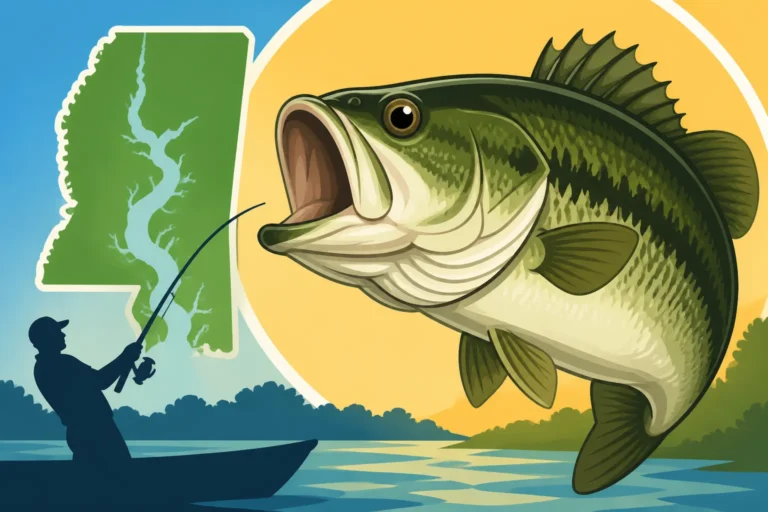
The largemouth bass ( Micropterus salmoides) is arguably the most iconic freshwater game fish in North America, and it certainly holds that title in Mississippi. This is the bass that graces magazine covers and tournament weigh-ins. They are often described as the quintessential "bucketmouth" due to their impressively large maw.
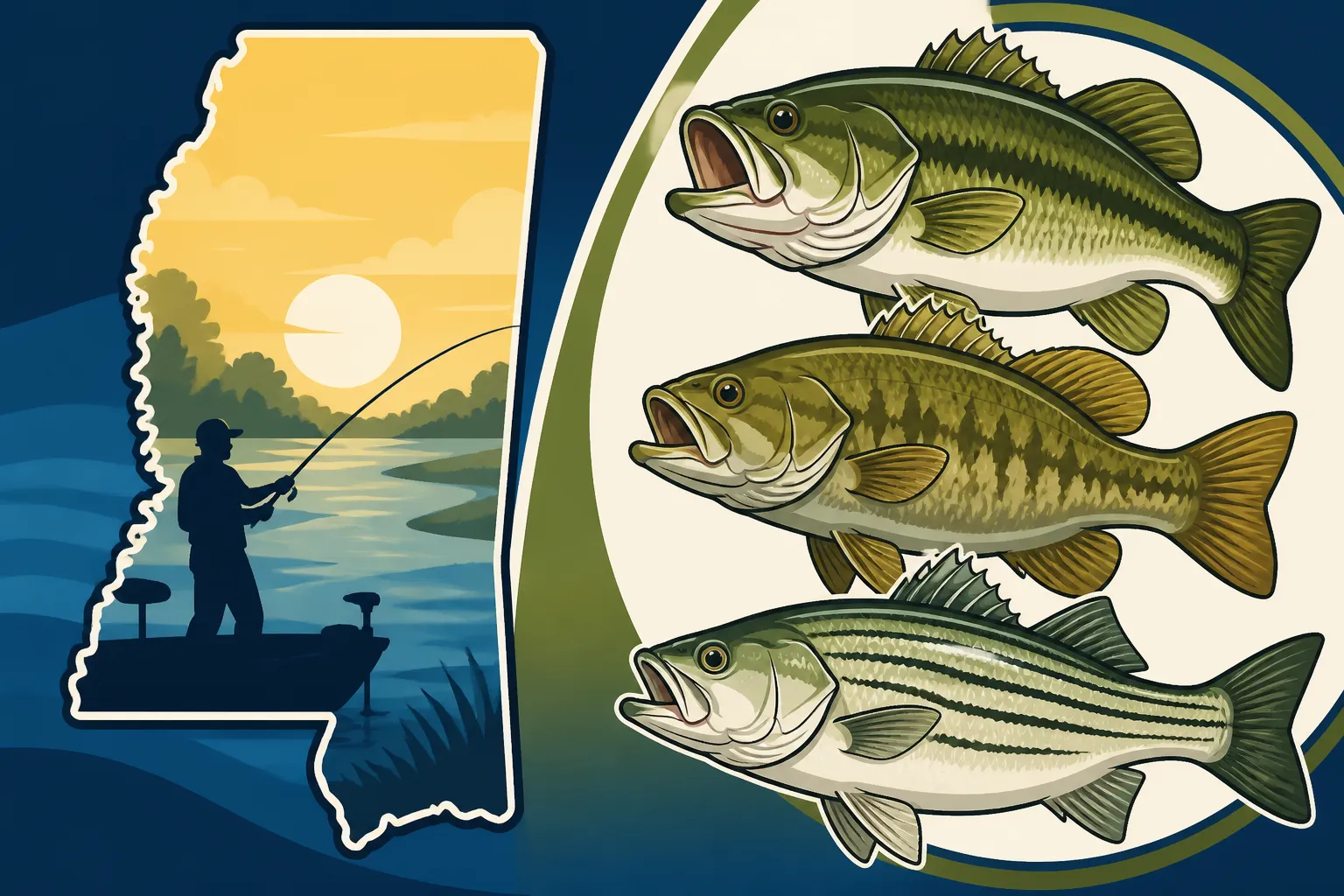
A classic largemouth typically boasts a dark green back that fades into lighter green sides, often adorned with a prominent, irregular dark lateral stripe or blotches running horizontally along its body. Their belly is usually white or cream-colored. What truly sets them apart, however, is their jawline. If you close the largemouth's mouth, the hinge of its jaw will extend beyond the back of its eye. These fish are habitat generalists, thriving in warmer, shallower waters with abundant vegetation, submerged timber, or other structure. Think of lily pads, hydrilla beds, and fallen trees in reservoirs like Ross Barnett or Lake Washington. They are ambush predators, often hiding in cover and lunging out at unsuspecting prey. Their average size in Mississippi can vary greatly depending on the water body, but catching one in the 3-5 pound range is common, with trophy-sized fish reaching into the double digits. For more details on these magnificent fish, check out our guide on Largemouth Bass Fishing in Mississippi.
Smallmouth Bass: The Brown Bomber
While not as widespread as the largemouth in Mississippi, the smallmouth bass (Micropterus dolomieu) is a prized catch for anglers who seek them out in the specific cool, clear, rocky waters they prefer. They're often called "bronze-backs" for their distinctive coloration.
Smallmouth bass typically have a brownish-green or bronze body, often with vertical bars or blotches along their sides rather than a distinct horizontal stripe. Their eyes tend to be reddish. The most definitive feature for identification is their jaw: when the smallmouth's mouth is closed, the hinge of its jaw does not extend beyond the back of its eye. They also have a more streamlined, torpedo-shaped body compared to the largemouth. In Mississippi, you're most likely to encounter smallmouth bass in the colder, rockier sections of reservoirs, particularly in the northeastern part of the state, such as Pickwick Lake and its tailwaters. They prefer clear water with rocky bottoms, gravel, and current, making them a fantastic target for river anglers. Smallmouth are renowned for their aggressive fights, often jumping clear out of the water multiple times once hooked. A typical smallmouth in Mississippi might range from 1 to 3 pounds, though larger specimens are certainly caught. Want to target these feisty fighters? Our article Smallmouth Bass Fishing in Mississippi has a lot of helpful tips.
Spotted Bass: The Jekyll and Hyde of Bass
The spotted bass (Micropterus punctulatus) is perhaps the most frequently misidentified bass in Mississippi, often mistaken for a largemouth due to its similar appearance. This "spotty" bass can be a challenging fish to distinguish, but knowing its key features will make all the difference.
Spotted bass share the green-to-bronze coloration of largemouth, with a prominent lateral stripe that can sometimes be broken into splotches. However, the tell-tale sign is usually on their belly: they have rows of distinct black spots running below their lateral line, which give them their common name. Another critical feature is the jawline, which, like the smallmouth, typically does not extend past the back of the eye when closed. Additionally, many spotted bass have a patch of small teeth on their tongue, which you can feel with your finger (carefully!). Their body shape is often described as intermediate between the largemouth and smallmouth. In Mississippi, spotted bass are widespread and adaptable, found in both rivers and reservoirs, often preferring slightly deeper, clearer waters with some current and rocky or gravel bottoms, but they can also tolerate areas with some vegetation. They are common in systems like the Tennessee-Tombigbee Waterway and the Pearl River. They typically range from 1 to 3 pounds, though larger fish are caught, and they offer a robust fight, often staying deep and pulling hard. For a deeper dive into these fascinating fish, check out Spotted Bass Identification and Range.
Key Identification Features: A Head-to-Tail Guide
When you've got a fish in hand, a quick but thorough inspection of a few key anatomical features can help you confidently identify whether you're holding a largemouth, smallmouth, or spotted bass. It's like being a detective, looking for specific clues that lead you to the right answer. These distinguishing marks are generally consistent across populations, making them reliable indicators.
The Jawline: The Most Reliable Indicator
Without a doubt, the most common and often easiest way to tell these three bass apart is by examining their jawline relative to their eye. This is a game-changer for quick identification, especially when the fish are kicking around in the bottom of your boat or if you're practicing catch and release.
For the largemouth bass, close its mouth. If the corner (or hinge) of its jaw extends past the back edge of its eye, you've almost certainly got a largemouth. This oversized mouth is precisely where they get their "largemouth" moniker. It allows them to engulf surprisingly large prey, from shiners to frogs and even small ducks! This characteristic is usually very distinct and visible at a glance, even on smaller fish.
In contrast, both the smallmouth bass and the spotted bass will have a shorter jaw. When their mouths are closed, the hinge of their jaw typically does not extend past the back edge of the eye. For many anglers, this is the first thing they check. It might take a moment to get a feel for it, but once you've compared a few fish, it becomes second nature. This anatomical difference reflects their feeding habits; while still predatory, their slightly smaller mouths are better suited for pursuing smaller prey in more open water or along rocky structures.
Body Markings and Coloration
While jaw length is king, body markings and overall coloration provide excellent secondary clues. These can sometimes vary depending on the water clarity, depth, and even the fish's mood, but general patterns hold true.
The largemouth bass typically exhibits a distinct, often broken or irregular, horizontal dark stripe along its lateral line. The background color is usually a vibrant green, fading to a white belly. While some individual largemouth might have faint spots or mottling, the strong horizontal band is key.
The smallmouth bass, often called "bronze-backs," have a more uniform brownish-green or bronze color. Instead of a horizontal stripe, they tend to have vertical bars or blotches along their sides. These bars can sometimes be subtle or even absent in very large or very stressed fish, but they are a common feature. Their eyes might also have a reddish tint.
The spotted bass truly earns its name. While they too have a lateral stripe (which can resemble a largemouth's), the most definitive marking is the rows of dark spots or speckles on their lower flanks and belly. These spots are usually distinct and present, even if the lateral stripe is faded. If you catch what looks like a largemouth but has those little "pepper spots" on its belly, it's almost certainly a spotted bass. This is a crucial distinction, as highlighted in our guide Largemouth Bass vs Spotted Bass Differences.
Dorsal Fin and Tongue Patch
Two other features can offer conclusive evidence, especially when you're still uncertain after checking the jaw and body markings. These require a closer look but are definitive.
All three species have two dorsal fins that are technically connected, but the degree of connection can differ. For largemouth bass, the spiny dorsal fin (the front one) and the soft-rayed dorsal fin (the back one) are almost completely separated, with a deep notch between them. You can almost lay the spiny fin flat without moving the soft fin.
For smallmouth bass, the two dorsal fins are connected by a much shallower notch, making them appear more continuous.
The spotted bass often presents an intermediate notch, sometimes resembling a smallmouth more than a largemouth in this regard, though it can vary. However, a unique characteristic that often clinches the deal for spotted bass is the presence of a tooth patch on their tongue. If you can gently open the fish's mouth and run your finger across its tongue, you'll feel a rough patch of small teeth if it's a spotted bass. Largemouth and smallmouth bass typically have smooth tongues. This is a feature often missed but incredibly useful. For those wondering about the more subtle differences between bass, particularly the spotted bass, the article How to Identify a Spotted Bass offers more granular detail.
Here's a quick comparison table to help keep these features straight:
| Feature | Largemouth Bass | Smallmouth Bass | Spotted Bass |
|---|---|---|---|
| Jawline | Extends past the back of the eye | Does not extend past the back of the eye | Does not extend past the back of the eye |
| Body Markings | Prominent, often broken, horizontal dark stripe | Vertical bars or blotches, bronze/brown coloration | Horizontal stripe plus distinct spots on lower flanks/belly |
| Dorsal Fin | Deep notch between spiny and soft dorsal fins | Shallow notch, fins appear more continuous | Intermediate notch, may resemble smallmouth |
| Tongue | Smooth | Smooth | Often has a rough, tooth patch on the tongue |
| Overall Shape | Stout, deepest body relative to length | Streamlined, torpedo-shaped | Intermediate, sometimes appearing thicker than smallmouth |
Habitat and Range: Where Each Bass Species Thrives in Mississippi
Understanding where each bass species typically lives in Mississippi is another excellent way to narrow down your identification, even before you cast a line. While there's always overlap, and bass are adaptable, each species has a strong preference for certain types of water bodies and environmental conditions. Knowing these preferences helps you target the right fish and makes on-the-water identification quicker.
Largemouth Bass: Masters of Warm, Vegetated Waters
The largemouth bass is the king of versatility in Mississippi's warmer, often nutrient-rich waters. If you're fishing in a lake, pond, or slow-moving river with abundant vegetation, submerged timber, or docks, you're almost certainly in largemouth territory. They thrive in water temperatures that would be too warm for smallmouth and are perfectly adapted to hiding in dense cover.
Think of Mississippi's iconic reservoirs like Ross Barnett Reservoir Fishing Guide, Grenada Lake, or Sardis Lake. These expansive bodies of water, with their sprawling shallow flats, countless coves, and dense weed beds, are prime largemouth habitat. They use hydrilla, lily pads, standing timber, and brush piles as ambush points, waiting for baitfish, crawfish, or even small frogs to swim by. Even smaller oxbow lakes and private farm ponds across the state are typically dominated by largemouth. This affinity for cover means that presentations like Texas-rigged plastics, jig-and-pig combos, and topwater frogs are incredibly effective when targeting largemouth. They are truly the ubiquitous bass of Mississippi's warm, fertile waters, making them a common catch for most anglers.
Smallmouth Bass: Rock Lovers in Clear, Moving Water
The smallmouth bass in Mississippi is a much more specialized resident, primarily found in the cooler, clearer, and often rockier waters with some current. They are less tolerant of warm, stagnant, or heavily vegetated environments. If you're on a deep, rocky reservoir or a clear-flowing river, your chances of encountering a smallmouth significantly increase.
In Mississippi, the absolute hotspot for smallmouth bass is the northeastern corner of the state, particularly Pickwick Lake and the Tennessee-Tombigbee Waterway. These waters offer the perfect blend of clear, cool water, deep rocky structure, gravel bottoms, and currents that smallmouth adore. They relate strongly to current breaks, bluff walls, rip-rap, and rocky points, where they can ambush baitfish or crawfish. You might also find them in the tailraces below dams, where oxygenated water and turbulent flow create ideal conditions. When targeting smallmouth, anglers often opt for baits that imitate crawfish or shad, fished along the bottom or near structure, such as tube jigs, crankbaits, or Ned rigs. Catching a smallmouth in Mississippi is often considered a trophy experience precisely because of their limited range and fierce fighting spirit.
Spotted Bass: The Adaptable Middle Ground
The spotted bass occupies a fascinating middle ground in terms of habitat preference, making them incredibly widespread and adaptable across Mississippi. They often thrive in areas where largemouth and smallmouth might overlap, or in environments that aren't quite ideal for either of the other two.
Spotted bass are comfortable in both riverine and reservoir environments. They typically prefer clear to moderately turbid water with some current, and they gravitate towards rocky structures, bluff walls, and points, similar to smallmouth. However, they can also tolerate areas with some scattered vegetation, unlike smallmouth, making them more adaptable than their bronze-backed cousins. Many of Mississippi's larger river systems, such as the Pearl River and segments of the Mississippi River's tributaries, hold healthy populations of spotted bass. They are also very common in reservoirs that feature both open water and structured areas, often schooling in deeper water or around humps and ledges. For instance, anglers fishing the Mississippi Delta region might encounter spotted bass more frequently than smallmouth in some of the larger bayous and rivers. When you’re fishing a new body of water, and you find bass in areas that are a mix of what you’d expect for largemouth and smallmouth – maybe a deep rocky point with some scattered brush – there’s a good chance you’re fishing over spotted bass. This adaptability is part of what makes them such a fun and often surprising catch.
Similarities and Confusing Factors
Despite their distinct identifying features, there are legitimate reasons why anglers sometimes struggle to tell these bass species apart. Nature isn't always neat and tidy, and a combination of environmental factors, individual variation, and even hybridization can make identification a real head-scratcher. It's not just a beginner's problem; even seasoned pros can pause when a tricky fish comes aboard.
The Overlap in Appearance and Habitat
One of the biggest culprits for confusion is the visual overlap, especially between largemouth and spotted bass. Both species are predominantly green, and both can have a lateral stripe. Juvenile bass of all species can look especially similar before their distinct markings fully develop. A smaller largemouth might not have as pronounced a jawline extension, making it harder to differentiate from a spotted bass without checking other features. Similarly, a spotted bass from very clear water might have faded belly spots, leading it to be mistaken for a largemouth.
Habitat overlap also plays a role. While smallmouth prefer clear, rocky, cool water, and largemouth love warm, vegetated, shallow water, spotted bass are often found in areas that bridge these two extremes. You might catch a spotted bass on a rocky point where you'd expect a smallmouth, or from a brush pile that screams largemouth. This means you can't solely rely on where you caught the fish for identification, especially in large, diverse water bodies like the Tennessee-Tombigbee Waterway or some of the larger flood control reservoirs. For example, in a place like Pickwick Lake, you might genuinely catch all three species in different parts of the lake, or even in similar areas, depending on the specific conditions. This is why knowing the subtle differences, like those explored in Largemouth Bass vs Smallmouth Bass Differences, is so crucial.
Environmental Factors and Individual Variation
Fish coloration and markings can change significantly based on their environment. Bass caught from dark, tannic water might appear much darker than bass of the same species caught from clear, sandy-bottomed lakes. Water clarity, sunlight penetration, and the type of cover they inhabit can all influence their appearance. A largemouth living in a dark, log-filled creek might have almost black markings, while one from a bright, sandy flat might be pale green. This makes relying solely on a single feature like overall color risky.
Furthermore, just like people, individual fish within a species can have variations. Some largemouth might have fainter lateral lines, or some spotted bass might have less prominent belly spots than the "textbook" example. These natural variations can challenge even the most experienced angler. It's when you encounter these "oddball" individuals that you need to fall back on multiple identification markers, like the jawline and the presence of a tongue patch, to make a confident call. Having a reliable field guide or even an app on your phone can be a big help in these situations.
The Mystery of Hybrids
While less common, hybridization can occur between different bass species, especially between spotted bass and largemouth bass, creating fish that are truly difficult to classify. These hybrids can exhibit a mix of characteristics from both parent species, leading to confusing combinations of jaw length, body markings, and even dorsal fin notches. While rare, encountering a hybrid can throw a wrench into even the most diligent identification efforts.
If you suspect you've caught a hybrid, it's often best to photograph it, note its characteristics, and perhaps release it if you're uncertain about regulations. For the purposes of general fishing, focusing on the three main species and their primary distinguishing features will cover 99% of your catches. Remember, the goal isn't always perfect scientific classification, but rather informed recreational angling. Sometimes, even with all the knowledge in the world, a fish can keep its secrets.
Practical Tips for On-the-Water Identification
When you’ve just landed a beautiful bass, the last thing you want to do is spend five minutes agonizing over what species it is while it’s out of the water. Quick, accurate identification is key, especially if you’re practicing catch and release. Having a mental checklist and knowing what to look for at a glance will make you a confident bass identifier.
The Quick Visual Check: Jawline First!
When you get a bass into your hands, the very first thing to instinctively check should be the jawline. It's the most consistent and definitive difference among the three species. Gently close the fish's mouth and observe where the hinge of the jaw ends relative to the back of its eye.
If the jaw hinge extends significantly past the back of the eye, you're almost certainly holding a largemouth bass. It's usually a very clear demarcation. If it stops before the back of the eye, then you know you're looking at either a smallmouth or a spotted bass, and you can move on to the next set of clues. This quick check can eliminate one-third of the possibilities in seconds. It’s a great practice to adopt, much like checking the hook set. You can find many anglers on YouTube demonstrating this technique, and it's a skill easily mastered with a little practice. For those just starting, carrying a small, waterproof field guide or even a diagram printed from a resource like Mississippi Freshwater Fish Species Guide can be incredibly helpful.
Spot Check: Belly and Body Markings
Once you've narrowed it down based on the jaw, your next step is to quickly scan the fish's body for its distinctive markings. This is where the "spot check" comes in, literally.
If the jaw did not extend past the eye, look for those tell-tale spots on the belly and lower flanks. If you see distinct rows of small black spots below the lateral line, extending towards the tail, congratulations—you've got a spotted bass. These spots are usually quite noticeable, like someone peppered the fish's underside. If the belly is clean, without those spots, and the fish has more of a bronze or brownish hue with vertical bars or blotches on its sides, then you're holding a smallmouth bass. The smallmouth will also typically have a more streamlined, "torpedo" shape compared to the stockier build of a largemouth or even a spotted bass. Learning to quickly differentiate between these two, as detailed in Largemouth Bass vs Smallmouth Bass Differences, will serve you well.
The Tongue Test and Dorsal Fin Details (If Still Unsure)
If, after checking the jaw and body markings, you're still a bit stumped—perhaps the spots on a spotted bass are faint, or the vertical bars on a smallmouth are indistinct—then it's time for the final two verification steps: the tongue test and the dorsal fin examination. These are a little more involved but provide definitive answers.
Gently open the fish's mouth and run your finger carefully across its tongue. If you feel a rough, sandpaper-like patch of small teeth, it's a spotted bass. Largemouth and smallmouth typically have smooth tongues. This is a crucial "tie-breaker" if the belly spots are ambiguous. For the dorsal fin, look at the notch between the spiny front portion and the soft-rayed back portion. A largemouth bass will have a very deep, almost complete separation. A smallmouth bass will have a much shallower, more continuous connection. The spotted bass often falls somewhere in between, but if you've already checked for tongue teeth, the dorsal fin might just confirm your smallmouth diagnosis.
Remember to handle all fish with care, especially if you plan to release them. Wet your hands before touching them, support their body horizontally, and get your identification done quickly to minimize stress. Carrying a small, portable fish scale that you can clip on your belt or vest, perhaps from a brand you trust like OSP (or even one you found on Amazon), can also help you quickly weigh your catch before release, adding another data point to your fishing log. Mastering these quick identification techniques will not only make you a more confident angler but also ensure you're always compliant with Mississippi's specific regulations for each incredible bass species.
Disclaimer
This article is for general informational purposes only and does not constitute professional advice. Laws, prices and regulations vary by location and change over time. Consult a qualified professional for guidance on your specific situation.