Largemouth Bass vs Smallmouth Bass Differences
It can be incredibly frustrating to be out on the water, reeling in a feisty bass, and wonder if you’ve caught a Largemouth or its equally spirited cousin, the Smallmouth. While both offer a thrilling fight and are highly prized game fish in Mississippi, they have distinct characteristics that tell them apart and, crucially, influence where and how you might try to catch them. This guide will help you confidently identify the differences between Largemouth Bass and Smallmouth Bass, making your next fishing trip more informed and, hopefully, more successful.
The Core Visual Differences: Mouth, Body, and Fins
When you've got a bass in hand, sometimes it feels like they all look similar when they’re flopping around. But with a closer look at a few key features, you'll find that Largemouth and Smallmouth bass are actually quite different in their physical makeup. These visual cues are often the quickest way to tell them apart, especially when you're making a quick assessment before releasing a fish or putting it in the livewell.
Jawline Tells the Tale
Perhaps the most definitive and easiest way to distinguish between a Largemouth and a Smallmouth bass is by examining its jaw. This isn't just a subtle difference; it's usually quite pronounced once you know what to look for. Think of it as their signature trait, the first thing any experienced angler will check.
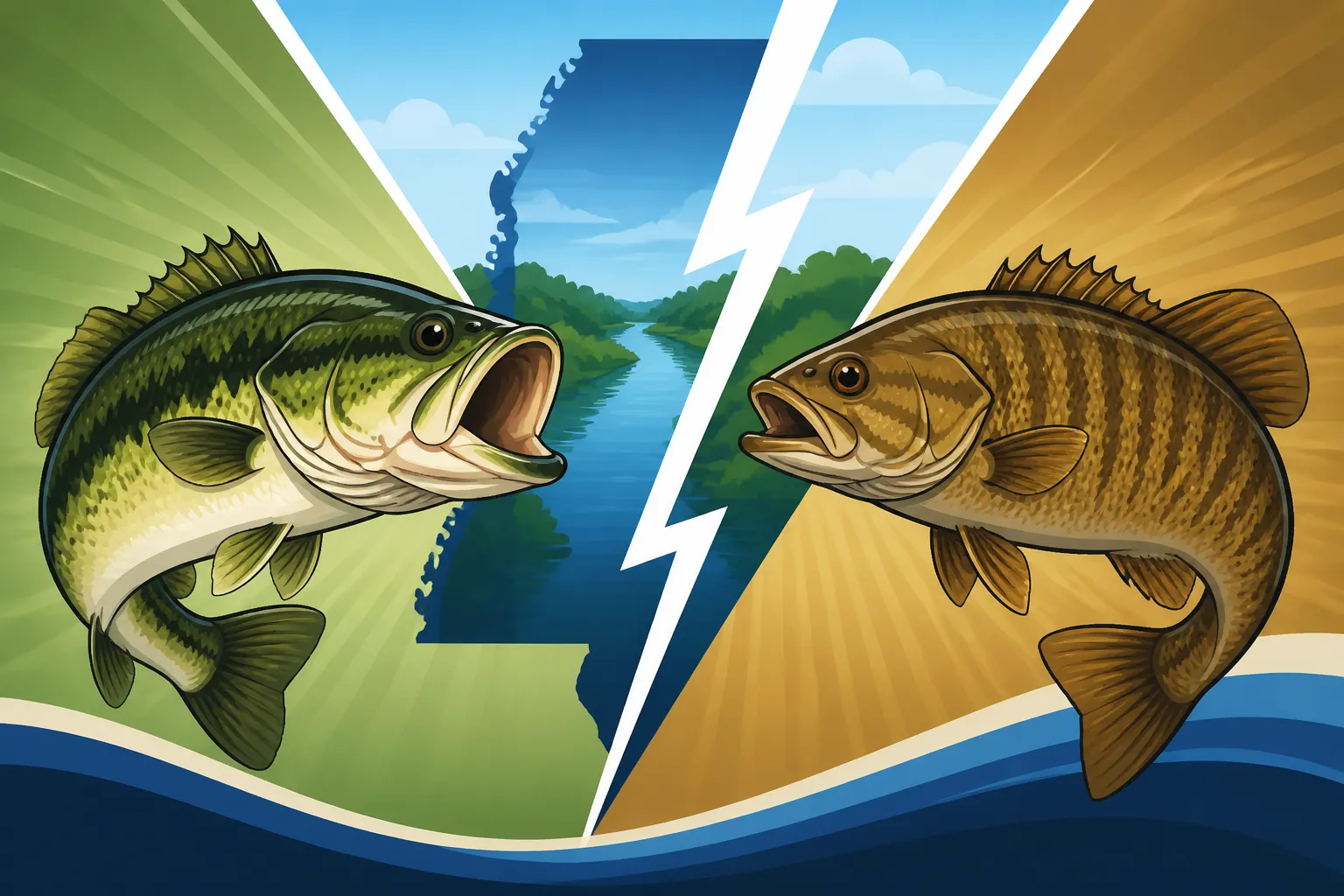
For the Largemouth Bass, true to its name, the jaw extends noticeably beyond the rear edge of its eye when its mouth is closed. Imagine a straight line dropped vertically from the back of the eye; the corner of the Largemouth's mouth will typically fall well past that line. This gives the Largemouth a very characteristic "big mouth" appearance that’s hard to miss once you’re aware of it. This larger mouth is a clue to its feeding habits, allowing it to gulp down larger prey items, from baitfish to frogs and even small birds or mammals if the opportunity arises. It’s why you often see anglers throwing big, bulky baits when targeting these fish. You can learn more about these powerful fish in Largemouth Bass Fishing in Mississippi.
In stark contrast, the Smallmouth Bass has a much more modest jawline. When its mouth is closed, the corner of its jaw generally aligns with or falls before the middle of its eye. It doesn't extend nearly as far back as its Largemouth cousin. This gives the Smallmouth a more compact, almost streamlined head profile. While its mouth might be smaller, don't mistake that for a lack of aggression or ability to eat; Smallmouth are still formidable predators. They simply have a different foraging strategy, often relying on smaller prey like crayfish and minnows, which also dictates the types of lures and baits that are most effective for them. Getting familiar with this jaw difference is probably the single most important tip for distinguishing the two species on the fly.
Body Shape and Coloration Clues
Beyond the jaw, the overall body shape and coloration offer additional, though sometimes more variable, clues. Water clarity, diet, and even the fish's mood can affect color, but general patterns still hold true. Many anglers, especially those just starting out, often assume a green fish is a Largemouth, and while that's often true, it's not always the whole story.
Largemouth Bass typically possess a more elongated, somewhat cylindrical body shape. Their coloration is usually a distinct dark green to olive green on their back, fading to lighter green or white on their belly. The most prominent feature on their flanks is often a horizontal, irregular dark stripe or series of blotches running from their head to their tail. This stripe can be very prominent in some fish, almost like a solid black line, while in others, especially those from very clear water, it might be faint or even broken into individual splotches. They often have dark markings on their cheeks and gill plates as well. This camouflage helps them blend into the weedy, often stained waters they prefer, allowing them to ambush prey effectively.
Smallmouth Bass, on the other hand, tend to have a more compact, muscular, and somewhat deeper body. Their color palette leans more towards bronze, brown, or even golden-green on their backs, transitioning to a lighter, often yellowish or creamy belly. Instead of a horizontal stripe, Smallmouth usually exhibit a series of dark vertical bars or blotches on their sides. These bars can be quite pronounced, giving them a "tiger stripe" appearance, especially in clearer water. In some stained or turbid waters, these markings might be less obvious, making identification a bit trickier, but the overall bronze hue is often a giveaway. The head can also have radiating dark streaks from the eyes. These colors help them disappear into rocky, gravelly environments, where they hunt their prey.
Dorsal Fin Distinction
While perhaps not as obvious as the jaw or body markings, the dorsal fin can also provide a helpful hint, particularly if you're still uncertain after checking the other features. It's a subtle anatomical difference that speaks to their evolutionary paths.
The Largemouth Bass has a dorsal fin that is distinctly separated into two parts. You'll notice a clear, deep notch or even a complete division between the spiny, anterior (front) portion of the dorsal fin and the soft-rayed, posterior (rear) portion. It looks almost like two separate fins fused at the base. This separation is a characteristic shared by many members of the sunfish family, to which bass belong. When the fish flares its fins, this separation becomes very evident, like a valley between two peaks.
The Smallmouth Bass, conversely, has a dorsal fin that appears more continuous. While it still has a spiny front part and a soft-rayed back part, the division between them is much shallower, often just a slight indentation rather than a deep notch. It looks like one long fin that simply changes texture along its length. This more continuous dorsal fin contributes to its streamlined profile, which is well-suited to the faster-moving or current-swept waters they often inhabit. If you're trying to quickly identify a fish, a glance at the dorsal fin can sometimes confirm what the jawline and body color are already telling you.
Habitat and Preferred Environment: Where You'll Find Them
Knowing where each type of bass prefers to live is another huge piece of the identification puzzle, and it’s also crucial for understanding how to target them. If you’re fishing a particular body of water in Mississippi, knowing the general habitat can give you a strong indication of which bass species you’re most likely to encounter. Understanding these preferences also helps anglers abide by Mississippi Freshwater Fishing Rules which may have species-specific regulations.
Largemouth's Love for Structure
The Largemouth Bass is truly a creature of cover and comfort. In Mississippi, these fish are abundant in just about every lake, pond, river, and reservoir, making them the most popular freshwater game fish in the state. They thrive in warmer, often slower-moving or still waters, and they absolutely adore aquatic vegetation. If you’re looking for a Largemouth, think about places where they can ambush prey from hiding.
You'll find Largemouth congregated around thick stands of lily pads, submerged timber, fallen trees, brush piles, boat docks, and dense beds of hydrilla or other aquatic grasses. These structures provide both excellent ambush points for feeding and crucial cover from predators and harsh sunlight. Lakes like the Ross Barnett Reservoir, Sardis Lake, and Grenada Lake are prime Largemouth territory, boasting vast areas of suitable habitat. They prefer the slightly stained or greenish waters that often come with these environments, which offer them good camouflage. When you cast your line into a weedy cove on a hot summer day, you're almost certainly targeting a Largemouth. Knowing the best places to find them is key, and our Best Bass Fishing Lakes in Mississippi guide can point you in the right direction.
Smallmouth's Rocky Domain
Smallmouth Bass, on the other hand, are often called "bronze backs" or "brown bass" not just for their color but for their preference for cooler, clearer water with rocky or gravelly bottoms. While Largemouth dominate most of Mississippi's waters, Smallmouth are far less common throughout the state, making them a highly sought-after trophy for anglers who manage to find them. They are generally found in the northern parts of Mississippi, particularly in the Tennessee River system.
The most notable location in Mississippi where Smallmouth are consistently caught is Pickwick Lake. Here, the conditions are perfect: cooler water, rocky ledges, gravel bars, and areas with current, especially below dams. Smallmouth are more open-water oriented than Largemouth, often chasing schools of baitfish in deeper water, but they will relate to rock piles, submerged humps, and current breaks. They are less fond of dense vegetation and prefer hard-bottomed areas. Catching a Smallmouth in Mississippi is often considered a special achievement due to their more limited range. If you're planning a trip to the northern state lines, especially to places like Pickwick Lake Fishing Guide, understanding their habitat preferences will drastically improve your chances of success. They love to roam and hunt, so looking for schooling baitfish near structure can be a winning strategy.
Behavior and Fighting Style: What to Expect on the Line
Beyond their looks and preferred hangouts, Largemouth and Smallmouth bass exhibit distinct behaviors both in how they feed and, most excitingly, how they fight once hooked. This is where the real fun begins and where you truly appreciate the unique spirit of each species. Knowing what to expect can help you prepare your gear and your technique for a more successful battle.
Largemouth's Power Jumps and Head Shakes
When you hook into a Largemouth Bass, be prepared for an immediate, often violent, reaction. Largemouth are known for their powerful, explosive fights, characterized by two primary moves: dramatic surface jumps and relentless head shakes. As soon as they feel the hook, they tend to make a beeline for the nearest cover – be it a weed bed, a submerged log, or a dock pilings. This initial burst of power is often accompanied by spectacular aerial acrobatics, where they'll jump completely out of the water, shaking their broad head violently in an attempt to throw the hook.
These jumps and head shakes are often very aggressive and can quickly dislodge a loosely set hook. Your job as an angler is to keep the line tight and try to steer them away from snags. If they get into heavy cover, it's often game over, as they'll wrap your line and break you off. They fight with a heavy, thumping feel on the line, using their broad, powerful tail to dig in and pull. This kind of fight demands a sturdy rod, strong line, and quick reflexes. For more insights on how to handle these fights and land more bass, check out Bass Fishing Techniques for Mississippi Anglers. Their fighting style is a pure test of strength and quick thinking.
Smallmouth's Acrobatic Fights
Smallmouth Bass, while perhaps not as explosively powerful in their initial burst as a Largemouth, are renowned for their incredible stamina and acrobatic, relentless fighting style. Many anglers consider the Smallmouth to be pound-for-pound one of the hardest fighting freshwater fish. Instead of brute force and short, powerful runs into cover, Smallmouth often engage in longer, more sustained battles.
When hooked, a Smallmouth will typically make several fast, powerful runs, often punctuated by multiple, breathtaking jumps. Unlike the Largemouth's head-shaking jumps, a Smallmouth's leap often involves a "tail walk" – they'll stay upright on their tail, thrashing violently, almost like a miniature marlin, trying to shed the hook. They are incredibly agile and will change direction suddenly, darting and diving, making it tough to keep them on a consistent trajectory. This continuous, unpredictable fight makes them an absolute blast to catch. You won't often feel the same heavy thumping as a Largemouth; instead, it's a series of sharp tugs and quick dashes, demanding a sensitive rod and smooth drag. They don't typically try to bury themselves in cover but will use the current and open water to their advantage, making their fights exhilarating and memorable.
Fishing Techniques and Baits: Tailoring Your Approach
Given their distinct habitats and behaviors, it stands to reason that the most effective ways to catch Largemouth and Smallmouth bass will differ significantly. Using the right lure or bait, presented in the right way, is crucial for success, whether you're chasing the green bass in a lily pad field or the bronze back on a rocky point. Many of these techniques can be learned, and specialized gear for each is readily available on platforms like Amazon.
Lures for Largemouth
Targeting Largemouth Bass often means focusing on lures that can penetrate or be worked effectively around heavy cover, and that imitate the larger prey items they favor. They are typically ambush predators, so baits that draw attention and trigger a reaction strike are often very effective.
Soft plastic worms, rigged Texas-style or Carolina-style, are perennial favorites, allowing anglers to probe thick cover without snagging. Spinnerbaits and chatterbaits are excellent for covering water and eliciting aggressive strikes, especially when fish are active. For topwater action, frogs and hollow-bodied lures that can be walked over matted vegetation are incredibly exciting. When fish are deeper or less active, crankbaits that mimic baitfish or crawfish are highly effective, especially those that deflect off submerged timber. Jigs with various trailers are also a staple, worked slowly along the bottom or flipped into tight spots. You can find a fantastic array of these specific lures for Largemouth on Amazon, which can truly make a difference in your catch rate. For more detailed advice, read our guide on the Best Lures for Largemouth Bass. The key is often to get your bait right where they're hiding and give them a reason to strike.
Baits for Smallmouth
Smallmouth Bass, with their smaller mouths and preference for clear, rocky environments, often respond best to finesse presentations and lures that mimic their typical forage of crayfish, minnows, and aquatic insects. Precision and subtle action are often more important than brute force.
Small crankbaits, especially those with a crawfish pattern, are excellent for bumping off rocks and stimulating strikes. Jerkbaits, worked with a stop-and-go retrieve, are fantastic for imitating injured baitfish in clear water. For deeper fish or those holding tight to structure, drop shots and Ned rigs, rigged with small soft plastic baits like tubes or small worms, are incredibly effective finesse presentations. Hair jigs and small grub tails, fished slowly along the bottom, can also be deadly. Live bait, particularly minnows or crayfish, can be irresistible to Smallmouth. Unlike Largemouth, who often gulp their prey, Smallmouth tend to be more deliberate, often "pecking" at a bait before fully committing. This means a more sensitive rod can be beneficial for detecting those subtle bites. You can certainly find high-quality tubes, jerkbaits, and finesse tackle for Smallmouth fishing through retailers like Amazon, helping you gear up for those challenging but rewarding battles.
Here's a quick reference table to help summarize the key differences:
| Feature | Largemouth Bass | Smallmouth Bass |
|---|---|---|
| Jaw Extends | Past the rear edge of the eye | To or before the middle of the eye |
| Body Shape | More elongated, somewhat cylindrical, broader | More compact, muscular, typically deeper |
| Coloration | Dark green to olive green, horizontal dark stripe | Bronze, brown, or golden-green, vertical bars |
| Dorsal Fin | Deeply notched or clearly separated into two parts | Shallow notch, appearing more continuous |
| Preferred Habitat | Warm, still or slow water; heavy cover, weeds, timber, docks | Cooler, clear water; rocky bottoms, gravel, current |
| Typical Fight | Explosive power, strong head shakes, dramatic jumps | Acrobatic, sustained fight, multiple jumps, tail walks |
| Common Lures | Plastic worms, spinnerbaits, crankbaits, topwaters, jigs | Tubes, small crankbaits, jerkbaits, drop shots, hair jigs |
Understanding the distinct characteristics of Largemouth and Smallmouth bass not only helps you identify your catch but also equips you with the knowledge to refine your fishing strategies. Whether you're casting into a lily pad field hoping for a green giant or exploring rocky ledges for a bronze back, knowing the differences will make you a more versatile and successful angler. Each species offers a unique challenge and thrill, contributing to the rich fishing experience that Mississippi has to offer. So next time you hook into a bass, take a moment to observe its features – you'll be able to tell which one it is, and perhaps even appreciate its unique traits even more.
Disclaimer
This article is for general informational purposes only and does not constitute professional advice. Laws, prices and regulations vary by location and change over time. Consult a qualified professional for guidance on your specific situation.