Hybrid Striped Bass Fishing in Mississippi
There's a special kind of thrill that comes from hooking into a fish that fights with all its might, pulling hard and making your reel sing. If you've been chasing that adrenaline rush and a delicious meal to boot, then you've likely got your sights set on hybrid striped bass in Mississippi. These powerful fish offer an incredible challenge and reward, but figuring out where to find them and how to entice a bite can feel like a mystery. This guide is designed to cut through that confusion, giving you the real-world insights and practical strategies you need to successfully target hybrid stripers across our great state.
Understanding the Hybrid Striper: The Best of Both Worlds
Hybrid striped bass, often simply called "hybrids" or "wipers," are a fantastic angling opportunity in Mississippi. They’re essentially a cross between a pure-strain striped bass and a white bass, created through a specific breeding program. This intentional cross results in a fish that often grows faster and larger than a white bass, is hardier and more adaptable than a pure striper in many freshwater environments, and retains the aggressive, hard-fighting nature that anglers love. They're a testament to thoughtful fisheries management, providing a unique challenge and excellent table fare.
These hybrids were introduced into many of Mississippi's larger reservoirs specifically to fill a niche – offering a robust, schooling predator that could thrive in waters where pure stripers might struggle. They feed voraciously on baitfish, growing quickly and providing a fantastic sportfishing experience. For many anglers, the fight of a hybrid striper is second to none, a true test of tackle and skill.
How to Tell a Hybrid from its Cousins
One of the first challenges for anglers is correctly identifying a hybrid striped bass, especially when they share waters with their parent species: the pure striped bass and the white bass. Misidentification isn't just a matter of bragging rights; it's important for adhering to specific regulations that might apply to one species but not another. Luckily, there are some pretty reliable visual cues once you know what to look for.
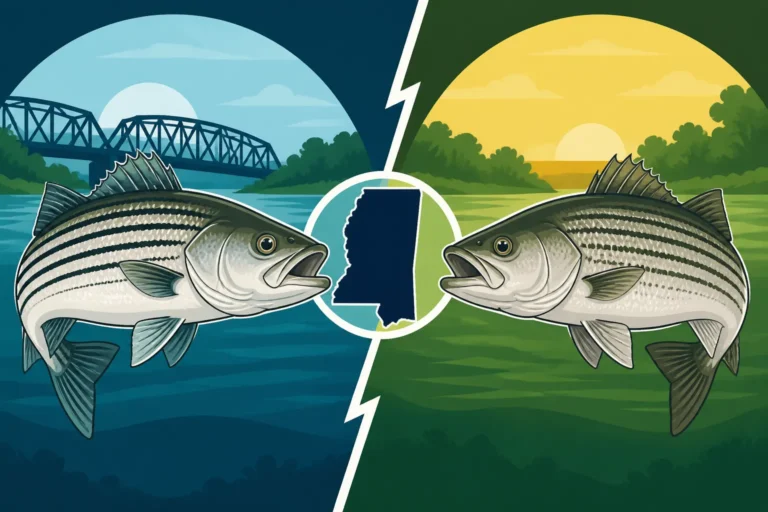
The most common characteristic people look for on a hybrid striper is their lateral lines. While pure striped bass typically have seven or eight distinct, unbroken horizontal lines running from gill plate to tail, and white bass have fainter, often broken lines, the hybrid tends to have a mix. Most notably, the lines on a hybrid striper are usually distinct but will often be broken or interrupted below the lateral line, especially towards the tail section. Imagine someone drew a solid line and then erased a few segments – that's often what you'll see. The lines may also appear more blurred or wavy compared to the sharp, straight lines of a pure striper.
Beyond the lines, consider the body shape. White bass tend to have a deeper, more compressed body profile, almost disc-like when mature. Pure striped bass are generally more torpedo-shaped, especially the larger ocean-run fish or those in expansive freshwater impoundments. Hybrids fall somewhere in between, often possessing a more streamlined body than a white bass but usually a bit deeper-bodied than a pure striper of similar length. When you hold one, you’ll notice a substantial heft for its length. Always cross-reference multiple features, and if you’re ever in doubt, it’s best to assume it’s the most restrictive regulated species to stay on the right side of the law.
| Feature | Hybrid Striper | Pure Striped Bass | White Bass |
|---|---|---|---|
| Lateral Lines | 7-8 lines, often broken or interrupted below the lateral line. May appear wavy. | 7-8 distinct, solid, unbroken lines. | 1-7 faint lines, often broken above or below lateral line. |
| Body Shape | Moderately deep, somewhat robust. | Streamlined, torpedo-shaped. | Deeper, more compressed, often "pot-bellied." |
| Mouth | Moderate size, lower jaw slightly protrudes. | Large mouth, lower jaw noticeably protrudes. | Small mouth, jaws typically equal. |
| Dorsal Fins | Two distinct dorsal fins, anterior fin shorter. | Two distinct dorsal fins, anterior fin shorter. | Two distinct dorsal fins, anterior fin shorter. |
Where Hybrid Stripers Call Home in Mississippi
Hybrid stripers aren't just found anywhere; they thrive in specific environments that cater to their predatory nature and require the right conditions. In Mississippi, their primary homes are large reservoirs and associated river systems, particularly in areas below major dams. These expansive bodies of water offer the vast open spaces they prefer, along with ample baitfish populations, which are critical to their diet.
The Mississippi Department of Wildlife, Fisheries, and Parks (MDWFP) often stocks these fish, strategically placing them in lakes where they're most likely to succeed and provide excellent sportfishing. You'll typically find them in the larger impoundments known for robust forage bases like gizzard and threadfin shad. These lakes provide the space for hybrids to school up and chase bait, often in open water or along prominent underwater structures like points, humps, and creek channels.
Furthermore, water conditions play a huge role. Hybrids prefer cooler, well-oxygenated water, which is why tailwaters directly below dams can be phenomenal spots. The turbulent, aerated water exiting a dam creates a highly oxygenated environment that attracts both the hybrids and their prey. While they are adaptable, extreme heat and low oxygen can limit their range in certain areas, pushing them into deeper, more stable thermal refuges during the hottest parts of summer. Knowing their preferred habitat is the first step in narrowing down your search, setting you up for success even before you cast a line.
Top Mississippi Waters for Hybrid Striper Action
When it comes to hybrid striped bass, Mississippi boasts several premier destinations that consistently produce fantastic catches. These large impoundments and river systems offer diverse fishing opportunities, whether you prefer trolling the open water or casting to schooling fish. Knowing which lakes are prime for hybrids can save you a lot of time and boost your chances of landing one of these powerful fighters.
Reservoir Hotbeds: Ross Barnett, Grenada, and More
Without a doubt, some of Mississippi's largest reservoirs are the undisputed champions for hybrid striper fishing. The sheer size and abundant forage in these waters create ideal conditions for hybrids to thrive and grow to impressive sizes.
Ross Barnett Reservoir near Jackson stands out as a top contender. This sprawling lake is well-known for its excellent fishing, and hybrid stripers are a significant part of that reputation. Anglers often find success targeting hybrids in the main lake basin, especially around prominent points, humps, and the deeper creek channels that wind through the reservoir. The spillway area, particularly during periods of generation, can also be a magnet for hybrids as they gather to ambush baitfish flushed through the gates. Whether you're trolling large crankbaits or casting jigs to schooling fish, Ross Barnett offers consistent action. If you're planning a trip, definitely check out our Ross Barnett Reservoir Fishing Guide for more detailed insights on this popular spot.
Further north, Grenada Lake, famous for its world-class crappie fishing, also holds a healthy population of hybrid stripers. While many anglers focus on the crappie, those targeting hybrids often find them in similar deep-water structures, especially when shad are abundant. Look for them around the main lake channel, deeper points, and large flats where baitfish congregate. Again, the tailwaters below the dam can be incredibly productive, drawing in hungry hybrids eager for an easy meal. Our Grenada Lake Fishing Guide provides more information that can be adapted for hybrid striper pursuits.
Up in the northeastern corner of the state, Pickwick Lake offers another fantastic hybrid striper fishery. With its rocky bluffs, deep channels, and abundant schooling baitfish, Pickwick provides an excellent environment for these powerful fish. Anglers often target them by trolling crankbaits or live bait in the main lake, particularly in areas with current or significant depth changes. Pickwick Lake Fishing Guide can offer additional context for navigating this beautiful lake. While Sardis and Enid lakes are renowned for crappie, they also occasionally produce hybrids, especially in areas with deep, open water and healthy shad populations. These larger reservoirs are consistently stocked and managed for hybrid stripers, making them reliable choices for your next fishing adventure.
River Systems and Tailwater Fisheries
While reservoirs are prime real estate for hybrid stripers, don't overlook Mississippi's dynamic river systems and the highly productive tailwaters below dams. These environments, though different from the expansive lakes, can offer incredible, often overlooked, opportunities for targeting hybrids.
The Mississippi River itself, a massive waterway known more for its colossal catfish, can also hold hybrid stripers, particularly in its side channels, oxbow lakes, and the mouths of tributaries that feed into it. While not as consistently targeted for hybrids as the major reservoirs, these areas can offer surprises, especially where current brings in abundant baitfish. It's a different kind of challenge, often requiring a more river-specific approach to find and catch them. For a broader understanding of fishing this mighty river, our Mississippi River Fishing Guide can be a useful resource.
However, it's the tailwaters directly below major dams that truly shine as riverine hybrid hotspots. When water is released from a reservoir, it creates strong currents and highly oxygenated conditions downstream. This turbulent water churns up nutrients and disorients baitfish, creating a veritable buffet for predatory species like hybrid stripers. These areas are magnets for hybrids, which will position themselves in current breaks, eddies, or directly in the swift water to ambush unsuspecting prey. Fishing tailwaters often requires heavier tackle and a careful approach due to the strong currents, but the rewards can be phenomenal. Always exercise extreme caution in these areas, as water levels and current can change rapidly with dam operations. Pay attention to warning signs and be aware of your surroundings for safety.
Gearing Up for the Fight: Hybrid Striper Tackle
Catching a hybrid striped bass is an exhilarating experience, but to truly enjoy the fight and consistently land these powerful fish, you need the right gear. They're not delicate biters, and they fight dirty, making long, powerful runs. Having tackle that can stand up to that challenge is paramount.
Rods, Reels, and Line: Built for Battle
When it comes to rods, think power and sensitivity. A medium-heavy to heavy action casting or spinning rod, typically between 7 and 8 feet in length, is ideal. The longer rod provides better casting distance, crucial for reaching schooling fish, and helps absorb the shock of their powerful runs. A fast tip is beneficial for detecting subtle bites (though hybrid bites are rarely subtle!) and for setting the hook firmly into their tough mouths, while a strong backbone is essential for muscling them away from structure and bringing them to the boat. Brands like Ugly Stik, Shimano, and Daiwa all offer excellent rods in this category that can handle the abuse these fish dish out.
For reels, you'll need something robust with a smooth, reliable drag system and good line capacity. A 4000 to 6000 series spinning reel or a medium to heavy baitcasting reel with a strong gear ratio and a high-quality carbon drag washer system are excellent choices. That smooth drag is crucial for letting the fish run when it needs to, preventing snapped lines or pulled hooks. Again, look for reputable brands known for durability and performance.
Line choice is also critical. Many hybrid striper anglers opt for braided line ranging from 20 to 50 lb test. Braid offers superior strength for its diameter, incredible sensitivity to detect bites, and no stretch, which aids in powerful hooksets. Because braid is so visible, it's almost always a good idea to tie on a fluorocarbon leader of 15-30 lb test. Fluorocarbon is nearly invisible underwater, more abrasion-resistant than mono, and provides a little stretch to absorb shock, acting as a buffer between the no-stretch braid and the fish. The choice of line strength often depends on the size of fish you expect and the cover you're fishing around.
Lures and Baits That Hybrids Can't Resist
Hybrid striped bass are aggressive predators, and they're not particularly picky when they're in a feeding mood. However, certain baits and lures consistently out-perform others due to their ability to mimic the hybrids' natural forage or provoke an instinctual strike. Stocking your tackle box with these essentials will significantly increase your success rate.
Live bait is, without a doubt, one of the most effective ways to catch hybrid stripers, especially when they're finicky or suspended deep. Their favorite meal is often large shad – specifically gizzard shad and threadfin shad. Shiners are also a good option if shad are hard to come by. Presenting a lively baitfish on a simple kahle hook (like a 4/0 or 5/0) with or without a small weight, depending on the depth, is often irresistible. Anglers typically catch their own bait with cast nets or purchase them from local bait shops. Keeping them alive in a well-aerated livewell is crucial, as fresh, lively bait makes all the difference.
When it comes to artificial lures, you'll want a versatile selection.
- Topwater lures like "walking baits" (e.g., Heddon Super Spook) or large poppers can create explosive strikes when hybrids are actively chasing bait on the surface, especially during early morning or late evening feeding frenzies.
- Deep diving crankbaits in shad patterns (chrome/blue, white, or chartreuse) are excellent for trolling or casting to fish suspended in open water or along deep structure. Match the size of the crankbait to the predominant baitfish in the lake.
- Jigs are incredibly versatile. Heavy jigging spoons (1/2 oz to 1.5 oz) are deadly when vertically jigged below schooling fish or over submerged structure. Bucktail jigs (1/2 oz to 1 oz) with a curly tail trailer or a soft plastic swimbait rigged on a heavy jig head (1/4 oz to 3/4 oz) can be cast and retrieved or fished vertically. The flash and vibration of these lures perfectly imitate fleeing baitfish. You can find a fantastic selection of these lures, along with tackle boxes and other accessories, readily available online at retailers like Amazon.
Essential Accessories and Boat Setup
Beyond your basic rod, reel, and line, a few key accessories and a properly set up boat can make a world of difference in your hybrid striper fishing success. These tools help you locate fish, present your baits effectively, and safely handle your catch.
Electronics are, arguably, the most critical piece of modern hybrid striper fishing gear. A good fish finder with capabilities like 2D sonar, Down Imaging, and Side Imaging is invaluable. These systems allow you to identify schools of baitfish, mark individual hybrids, and locate submerged structures like humps, ledges, and creek channels where fish are likely to congregate. Being able to "see" the fish before you cast dramatically increases your efficiency and reduces guesswork, especially when hybrids are suspended in open water.
For boaters, a reliable trolling motor is a game-changer for stealthily approaching schooling fish, precisely following contour lines, or holding your position in current. If you're planning to troll, rod holders are essential for keeping multiple lines in the water at varying depths and distances from the boat. A sturdy anchor is also important for holding your position in key spots or in flowing tailwaters. Don't forget a large cooler to keep your catch fresh, and all necessary safety gear like life jackets, throw cushions, and a first-aid kit. Finally, a well-organized tackle box filled with extra hooks, weights, and a variety of lures, as mentioned in the previous section, ensures you're ready for any situation you might encounter on the water.
Mastering the Techniques for Hybrid Striper Success
Hybrid striped bass are strong, aggressive, and highly adaptable, but they also follow predictable patterns based on baitfish movements and seasonal changes. Employing the right techniques at the right time is the key to consistent success. Whether you prefer the subtle art of live bait or the active pursuit of artificial lures, there's a strategy that will work for you.
Live Bait Strategies: The Hybrid's Favorite Meal
When hybrids are present and feeding, it's hard to beat the effectiveness of live bait, especially fresh shad. Their natural action and scent are often irresistible to these opportunistic predators. One common and highly effective method is freelining or using a float. If you see hybrids breaking the surface, or your electronics show them suspended near bait, simply cast a lively shad out with minimal or no weight, allowing it to swim naturally into the strike zone. A slip float can be added to control depth if the fish are holding at a specific level. This natural presentation is often what triggers the most aggressive strikes.
For hybrids holding deeper or near the bottom, bottom fishing with a Carolina rig or a similar setup can be deadly. Rig a live shad on a stout hook (4/0-6/0 kahle or circle hook), then slide a swivel up your line, followed by a weight (1/2 oz to 1 oz or more, depending on current and depth). This setup keeps your bait near the bottom but allows it to swim freely on a short leader, mimicking a vulnerable bottom-dwelling baitfish. This is particularly effective in creek channels or along deep ledges.
Finally, trolling live bait is an excellent way to cover large expanses of water and find scattered fish. You can slow troll with the main engine or a trolling motor, using planer boards to spread out your lines or downriggers to precisely control the depth of your bait. This method is fantastic for targeting suspended fish in open water. While our Trolling for Crappie on Mississippi Reservoirs guide focuses on different species, many of the principles of covering water and depth control apply. The importance of lively bait cannot be overstated; dying bait is rarely effective. Our guide on Live Bait vs Artificial Lures for Mississippi Crappie also offers insights into the pros and cons of live bait that hold true for hybrids.
Casting and Jigging for Active Fish
While live bait often shines, there are many situations where artificial lures are not only effective but also incredibly exciting to fish. Casting and jigging techniques allow for a more active and dynamic fishing experience, perfect for targeting aggressive hybrid stripers.
When you see hybrids "schooling" or "boiling" on the surface, actively chasing baitfish, it's one of the most thrilling moments in fishing. This is the time for casting topwater lures like walking baits (e.g., Zara Spook, Super Spook) or poppers. Cast beyond the school and work the lure back through the chaos. The explosive surface strikes are unforgettable. Similarly, fast-retrieved crankbaits in shad patterns can be cast into these boils, mimicking a fleeing baitfish and often eliciting a violent reaction strike. Speed is key here; these fish are actively hunting.
For fish located on structure, such as humps, ledges, or submerged brush piles, or those suspended in the water column, vertical jigging is a highly effective tactic. Heavy jigging spoons (like a Hopkins spoon or a Kastmaster) dropped directly down to the fish and then aggressively ripped upward create flash and vibration that can trigger a feeding frenzy. Similarly, bucktail jigs or heavy soft plastic swimbaits on jig heads can be vertically jigged. The key is to watch your electronics, drop your lure precisely to the depth of the fish, and experiment with different retrieval speeds and jigging motions until you find what triggers a strike. Sometimes a subtle lift is all it takes, other times an aggressive rip is needed.
Even for anglers fishing from the bank, especially in tailwater areas or accessible points on reservoirs, casting can be effective. Long casts with heavy spoons, swimbaits, or even large spinnerbaits can reach active fish, though boat access often provides more versatility in targeting scattered schools.
Seasonal Adjustments and Weather Wisdom
Hybrid striped bass, like all fish, are creatures of habit influenced by the seasons and prevailing weather conditions. Understanding these patterns and adjusting your approach accordingly is crucial for consistent success throughout the year. Ignoring these factors can lead to frustrating, fishless days.
Spring fishing for hybrids often revolves around baitfish movements. As water temperatures rise, shad move into shallower coves and creek arms to spawn. Hybrids will follow, becoming very active in these areas. Look for them along channel swings, main lake points, and the mouths of creeks. This is a great time for casting crankbaits, swimbaits, or even topwater lures as fish become more aggressive. Our Mississippi Spring Fishing Guide provides a broader look at spring angling, much of which can be applied to hybrid pursuits.
During the summer, as Mississippi's waters heat up, hybrids will often move to deeper, cooler, and more oxygenated water. They might be found around the thermocline (the layer where water temperature changes rapidly), or in the deepest parts of the main lake basin, especially early in the morning or late in the evening. Trolling deep-diving crankbaits or presenting live bait on downriggers becomes highly effective. Look for them near dams, deep creek channels, and the deepest humps. Be prepared for early starts or late finishes to avoid the midday heat. Our Mississippi Summer Fishing Guide offers more general strategies for hot weather fishing.
Fall brings a fantastic period for hybrid fishing. As water temperatures begin to cool, shad become incredibly active, often schooling up in massive numbers in preparation for winter. This is the famed "shad run" when hybrids will actively chase and bust bait on the surface. Look for birds diving, which often indicates schooling bait and feeding hybrids below. Topwater lures, fast-retrieved crankbaits, and casting heavy spoons into the feeding frenzy are all highly productive. Our Mississippi Fall Fishing Guide elaborates on this exciting season. In winter, hybrids tend to school up tightly in deeper, more stable water, often near the main lake channel or deep humps. Vertical jigging spoons or slow-trolling live bait become the most effective methods. Finding one fish often means finding a whole school. Mississippi Winter Fishing Guide can help you adapt your techniques for colder conditions. Always check the Mississippi Fishing Seasons Calendar before you head out, as seasonal patterns can shift from year to year based on weather.
Regulations and Responsible Hybrid Striper Angling
Fishing for hybrid striped bass in Mississippi is a privilege, and like all privileges, it comes with responsibilities. Understanding and adhering to the state's fishing regulations is not just about avoiding fines; it's about ensuring a healthy and sustainable fishery for future generations. Responsible angling practices play a crucial role in conservation.
Understanding Mississippi's Hybrid Striper Limits
Before you even think about casting a line, it is absolutely imperative to familiarize yourself with the current fishing regulations for hybrid striped bass in Mississippi. These regulations are set by the Mississippi Department of Wildlife, Fisheries, and Parks (MDWFP) and are designed to manage fish populations, allowing them to thrive while still providing ample recreational opportunities for anglers. Ignoring these rules can lead to significant penalties, including fines and the loss of fishing privileges.
Typically, hybrid striped bass will have specific daily creel limits, which dictate how many fish you can keep per day. There may also be size limits, requiring fish to be within a certain length range (e.g., minimum length, slot limits, or maximum length) to be legally harvested. These limits can vary by lake or region within the state, so always check the most current MDWFP fishing guide for the specific body of water you plan to fish. For example, some lakes might have a more restrictive limit than others, based on local population dynamics. Our specific guide on Mississippi Hybrid Striped Bass Limit can provide up-to-date details on these crucial numbers. It's also wise to understand how these limits might differ from those for pure striped bass, as misidentification can lead to inadvertently violating the rules. Our Mississippi Striped Bass Regulations article offers more context on the distinctions. Always remember that conservation starts with compliance.
The Art of Catch and Release
While catching and keeping hybrid stripers for their delicious meat is a popular pursuit, practicing responsible catch and release is an essential part of being a conscientious angler, especially if you're targeting larger trophy fish or if you've already met your creel limit. Releasing fish properly helps maintain healthy populations and ensures that these powerful predators continue to provide sport for years to come.
When practicing catch and release, speed and gentle handling are paramount. Try to minimize the time the fish is out of the water. If possible, unhook the fish while it's still in the water or in a net. Use wet hands when handling the fish to avoid removing its protective slime layer, which acts as a barrier against disease. Avoid squeezing the fish, particularly around its belly, and support its full weight horizontally if you need to lift it for a quick photo.
Choose barbless hooks or pinch down the barbs on your hooks to make unhooking easier and less stressful for the fish. If a fish is deeply hooked, it's often better to cut the line as close to the hook as possible rather than attempting to rip the hook out, which can cause internal damage. When releasing, gently hold the fish upright in the water until it regains its strength and can swim away on its own. Sometimes, a gentle forward and backward motion of the fish in the water can help force water over its gills, aiding in its revival. By following these practices, you significantly increase the chances of the released fish surviving and thriving.
Conservation: Protecting Mississippi's Hybrid Fishery
The vibrant hybrid striped bass fishery in Mississippi doesn't happen by accident; it's the result of dedicated efforts by fisheries biologists and the support of responsible anglers. Our collective actions play a direct role in protecting these exciting fish and ensuring their availability for future generations. Understanding the conservation aspect is more than just following rules; it's about being a steward of our natural resources.
The MDWFP plays a critical role through its stocking programs, regularly introducing hybrid stripers into key reservoirs to supplement natural populations (which don't reproduce effectively on their own) and maintain a robust sport fishery. These stocking efforts are carefully planned and funded, often directly or indirectly, by fishing license sales. Therefore, purchasing your Mississippi Fishing License Guide is a direct contribution to these conservation initiatives.
As anglers, our responsibility extends beyond just following creel and size limits. It includes practicing ethical angling at all times. This means using appropriate gear that minimizes harm to fish (like using strong enough line to land fish quickly, as discussed in How Many Fishing Poles Can You Use in Mississippi?), never wasting caught fish, and properly disposing of trash to keep our waterways clean. Reporting any suspicious activity, such as poaching or environmental concerns, to the MDWFP helps protect the resource. By embracing these principles of conservation, we ensure that the thrilling fight and delicious reward of hybrid striped bass fishing remain a hallmark of Mississippi's angling scene for many years to come.
Disclaimer
This article is for general informational purposes only and does not constitute professional advice. Laws, prices and regulations vary by location and change over time. Consult a qualified professional for guidance on your specific situation.