How to Identify a Buffalo Fish
Ever found yourself staring at a fish you've just reeled in, scratching your head and wondering, "What in the world is this thing?" It's a common scenario, especially when you're targeting bottom feeders in Mississippi's rich waters. Anglers frequently mistake one species for another, particularly when it comes to the often-misunderstood buffalo fish. This comprehensive guide is here to clear up that confusion, providing you with the definitive characteristics to accurately identify a buffalo fish, helping you respect local regulations and truly appreciate your catch.
Why Accurate Buffalo Fish Identification Matters
It might seem like a minor detail to some, but correctly identifying the fish you catch isn't just about bragging rights. In the diverse aquatic ecosystems of Mississippi, precise identification plays a crucial role in understanding regulations, appreciating ecological differences, and even recognizing culinary potential. Mistaking a buffalo fish for a carp, or vice-versa, can lead to confusion about creel limits, size restrictions, and even whether you want to take it home for dinner.
Understanding Species-Specific Regulations
Mississippi fishing regulations are designed to protect fish populations and ensure sustainable angling for everyone. These rules often vary significantly from one species to another. For example, while some species might have a generous daily limit, others could be strictly catch-and-release, or have minimum and maximum size restrictions. If you misidentify a buffalo fish as another species, you could inadvertently violate these regulations, leading to potential fines or penalties. Knowing what you've caught means you can quickly check the Mississippi Fishing Regulations Explained or consult your Mississippi Freshwater Fishing Rules guide to ensure you're fishing responsibly.
Imagine reeling in a particularly large fish. Your first thought might be "trophy!" but your second should always be "what is it, and what are the rules?" Buffalo fish, while often lumped in with carp by casual observers, are distinct native species with their own set of guidelines. Being able to tell them apart on the spot saves you from guesswork and keeps you on the right side of the law, making your fishing experience much more enjoyable and stress-free.
Appreciating Ecological Roles and Table Fare
Beyond regulations, proper identification helps us understand the ecological role each species plays in Mississippi's waterways. Buffalo fish are native suckers, important for their role in the food web and their contribution to the health of the ecosystem. Carp, on the other hand, are an introduced species, and while they can provide fun angling, their ecological impact is different. Knowing the difference fosters a deeper appreciation for the biodiversity around us.
Then there's the dinner plate! Many anglers dismiss "sucker" fish, but buffalo fish can be excellent table fare when prepared correctly. They have flaky, white meat that, unlike some carp species, is not oily or overly "muddy" tasting if caught from clean water. The texture and flavor are quite different from the common carp, which many find less appealing. If you've never tried a buffalo fish because you thought it was a carp and decided against it, you might be missing out on a delicious meal. Learning how to identify them precisely opens up new culinary avenues and lets you explore the true bounty of Mississippi's waters. For tips on preparing them, you might want to look up Is Buffalo Fish Good to Eat?.
Key Physical Characteristics of Buffalo Fish
When you're trying to figure out if that fish on your line is a buffalo or something else, there are a few tell-tale signs to look for. These aren't just subtle differences; once you know what to focus on, buffalo fish become quite distinct.
Mouth Structure and Barbels
One of the absolute quickest ways to distinguish a buffalo fish from a common carp (their most frequent misidentification twin) is by examining their mouth and the area around it.
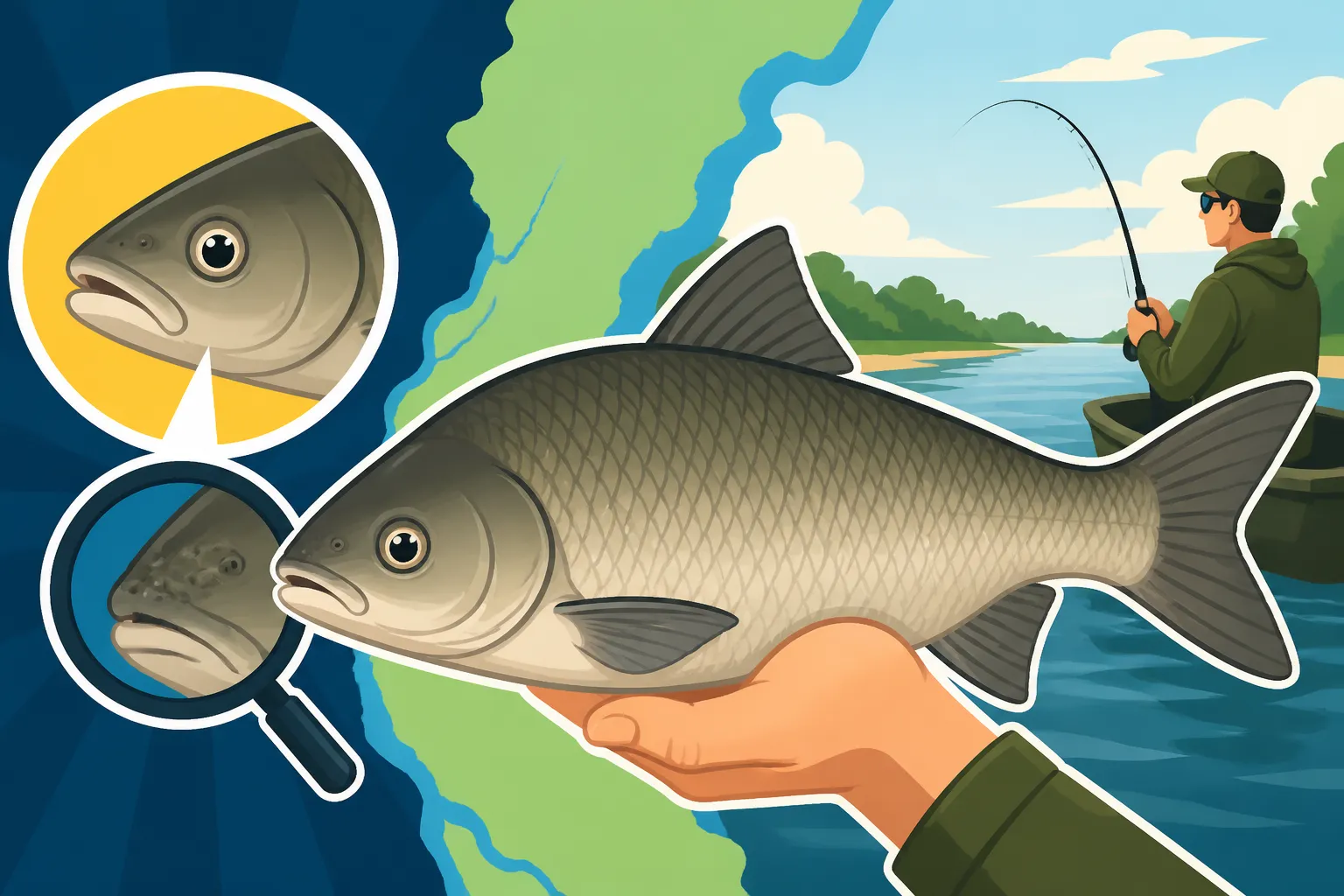
A buffalo fish has a subterminal mouth. What does that mean in plain English? It means its mouth is positioned on the underside of its head, kind of like a vacuum cleaner nozzle. It points downwards, perfectly adapted for sucking up food from the bottom of lakes and rivers. If you look at the snout, the mouth doesn't extend to the very front; there's a bit of fleshy snout extending beyond the upper lip. This downward-facing mouth is a classic sucker characteristic.
Crucially, buffalo fish do NOT have barbels. Barbels are those whisker-like fleshy projections around the mouth that many bottom-feeding fish use to "taste" and feel for food in murky water. Common carp, in contrast, have two prominent pairs of barbels, one pair shorter at the corner of the mouth and another longer pair further back. If your fish has whiskers, it's not a buffalo fish, plain and simple. This is often the first thing experienced anglers check when making an identification. You can even find specialized fishing guides on Amazon that highlight these visual cues for different species.
Body Shape and Scale Size
Next, let's talk about the overall silhouette and the texture of the fish. Buffalo fish generally have a more streamlined, somewhat football-shaped body when compared to the often chunkier, deeper-bodied common carp. They can still get very large and thick, but their profile tends to be more elongated and less "humped" behind the head.
The scales on a buffalo fish are typically large and cycloid, giving them a smooth feel. They are usually uniformly sized across the body. The color can vary quite a bit depending on the water clarity and diet, ranging from a dark bronze or olive on the back, fading to lighter bronze or silvery sides and a white belly. Some can appear quite dark, almost black, while others are a coppery brown.
Common carp, while also having large scales, can sometimes have a more irregular pattern, especially in certain genetic strains like mirror carp, which have very few, very large scales. But even the fully scaled common carp often present a body that is deeper from back to belly, with a more pronounced dorsal hump. Looking at the overall shape, from head to tail, will give you good clues. A good visual guide or a waterproof fish identification chart from Amazon can be a handy tool right on the boat or bank.
Dorsal Fin Characteristics
The dorsal fin is another key differentiator. Both buffalo fish and common carp have a single, long dorsal fin running along most of their back, but there's a critical difference in its structure.
Buffalo fish have a dorsal fin that is ray-soft throughout. This means it's composed entirely of soft rays, without any hard, serrated spines at the front. The fin will feel pliable and flexible from end to end. The front of the dorsal fin often begins with a taller lobe that then tapers down towards the tail.
Common carp, however, possess a single, strong, serrated spine at the front of their dorsal fin. This spine is stiff and often has a rough, saw-like edge when felt. It's a very noticeable feature once you know to look for it. If you gently feel the leading edge of the dorsal fin and encounter a sharp, rigid spine, you're almost certainly looking at a common carp, not a buffalo. This spine is a definitive characteristic of the carp family (Cyprinidae) that buffalo fish (Catostomidae, or suckers) simply do not share.
Distinguishing Buffalo Fish from Similar Species
Because they often share the same habitats and feeding grounds, buffalo fish are most commonly confused with carp. However, there are also other "sucker" family members or even large minnows that might cause a momentary pause. Let's break down the main comparisons.
Buffalo Fish vs. Common Carp
This is the big one, the most frequent point of confusion for anglers. As we touched on earlier, the barbels and dorsal fin spine are your primary identifiers.
Buffalo Fish (Genus Ictiobus)
- Mouth: Subterminal (underside of head), points downwards.
- Barbels: ABSENT. No whiskers around the mouth.
- Dorsal Fin: Long, with only soft rays; no hard spine at the front.
- Body Shape: Generally more streamlined, somewhat football-shaped.
- Tail: Deeply forked.
- Eyes: Typically smaller relative to head size.
Common Carp (Cyprinus carpio)
- Mouth: Protrusible (can extend forward), typically terminal or subterminal, but can point forward more directly.
- Barbels: PRESENT. Two distinct pairs of whisker-like projections around the mouth.
- Dorsal Fin: Long, with a distinctive, serrated, hard spine at the front.
- Body Shape: Often deeper-bodied, sometimes with a noticeable hump behind the head.
- Tail: Slightly forked, not as deep as a buffalo's.
- Eyes: Usually larger relative to head size.
This table provides a quick visual reference for the key differences:
| Feature | Buffalo Fish | Common Carp |
|---|---|---|
| Mouth Position | Subterminal (points downwards) | Protrusible (can extend forward) |
| Barbels | Absent | Present (2 pairs, whisker-like) |
| Dorsal Fin | Soft-rayed, no hard spine | Has a single, serrated hard spine at the front |
| Body Shape | More streamlined, football-shaped | Often deeper-bodied, sometimes a dorsal hump |
| Tail Fork | Deeply forked | Slightly forked |
| Eyes | Smaller | Larger |
For a deeper dive into these differences, you might find Buffalo Fish vs Carp Differences incredibly helpful. Understanding these distinctions is crucial not just for identification but for making sure you're following local fishing guidelines, which can differ for these two species.
Buffalo Fish vs. Grass Carp
While less commonly confused than with common carp, grass carp (Ctenopharyngodon idella) are another large, torpedo-shaped fish sometimes found in similar waters. They are primarily herbivorous, used often for aquatic weed control, and they look quite different from a buffalo fish once you know what to look for.
Grass carp have a more cylindrical, torpedo-shaped body and are generally silver in color, without the bronze or brassy tones of many buffalo fish. Their mouth is terminal (at the very front of the head) and lacks barbels. Their dorsal fin is much shorter than a buffalo's, and like the common carp, it also has a hard spine, though it might be less pronounced than on a common carp. Their scales are very large and prominent.
The primary visual keys here are the overall slim, silver body, the shorter dorsal fin with a spine, and the forward-facing mouth. If you see a fish that looks like a giant silvery hotdog with a relatively small dorsal fin, it's likely a grass carp, not a buffalo.
Buffalo Fish vs. Other Mississippi Suckers
Mississippi is home to several species of suckers, all belonging to the Catostomidae family, just like the buffalo fish. These can sometimes be confused with juvenile buffalo fish or by anglers who aren't familiar with the nuances of the family. Common examples include river carpsuckers, spotted suckers, and quillback carpsuckers.
The key to distinguishing buffalo fish from other suckers often lies in their mouth shape and overall body depth. Buffalo fish (especially the Bigmouth Buffalo, which is the most common one sought by anglers) have a relatively large mouth compared to other suckers, with thin lips and no cartilaginous chewing surfaces. Other suckers might have smaller, more protractile mouths with thicker, fleshy lips designed for scraping algae or picking small invertebrates.
For instance, the quillback carpsucker has a very deep, laterally compressed body, and its dorsal fin is very tall at the front, with a distinctive long, whip-like ray. Its mouth is also very small and subterminal. The river carpsucker has a small mouth with a prominent knob at the tip of the lower jaw.
While these subtle differences might take a keen eye and some practice, the main takeaway is that if it's a "sucker" with a soft-rayed dorsal fin and no barbels, it's almost certainly a native sucker species, and likely a buffalo fish if it's large and robust. For more on the variety of fish you might encounter, check out the Mississippi Freshwater Fish Species Guide.
Habitat, Behavior, and Other Clues
Sometimes, simply looking at the fish isn't enough, especially if it's thrashing in the net or you only get a quick glimpse. Knowing where and how buffalo fish typically behave can offer additional clues to help confirm your identification.
Preferred Habitats in Mississippi
Buffalo fish are predominantly bottom dwellers that thrive in slow-moving or still waters with muddy or silty bottoms. They love the rich, fertile environments of large reservoirs, oxbow lakes, and the slower sections of big rivers throughout Mississippi. You'll find them in places like Ross Barnett Reservoir, Grenada Lake, Sardis Lake, and the Mississippi River. They prefer areas with plenty of submerged vegetation, brush piles, and other cover where they can forage for food.
If you're fishing a clear, fast-flowing creek over rocky bottoms, it's less likely you'll encounter a buffalo fish. Conversely, if you're pulling fish from the silty flats of a large reservoir or a backwater slough, the chances of encountering a buffalo significantly increase. Understanding these habitat preferences can help you mentally narrow down the possibilities before you even get a good look at your catch. Many anglers targeting catfish in these areas often hook into buffalo, as they share similar feeding grounds and techniques. Learning about Catfish Fishing Techniques could indirectly help you locate buffalo.
Feeding Habits and Bait Preferences
Buffalo fish are filter feeders and detritivores. This means their diet primarily consists of zooplankton, small insect larvae, algae, and organic detritus (decaying plant and animal matter) they filter from the bottom. They are not predatory fish. This feeding habit ties directly into the types of bait that are most effective for catching them.
Anglers targeting buffalo fish typically use baits that appeal to their bottom-feeding nature. Think dough balls, corn, worms, or even specially prepared "stink baits" (though these are more commonly used for catfish). They often bite gently, sometimes just a slight tap or steady pull on the line, rather than an aggressive strike. If you're consistently catching fish on these types of baits, from the bottom, and they're showing the signs of a sucker, it's a strong indicator you've hooked a buffalo. You can find a wide array of specialized baits and attractants on Amazon that are perfect for bottom feeders, or check out Best Bait for Catfish in Mississippi for ideas that often work for buffalo too.
Sound and Behavior During the Fight
While not always a definitive identification method, how a fish behaves on the line can sometimes give you a hint. Buffalo fish are notoriously strong fighters, especially the larger ones. They tend to make long, powerful runs, often staying deep and using their broad, flat sides to create resistance. They're not usually jumpers or head-shakers; their fight is more of a sustained, brute force pull. Many anglers are surprised by the power of a large buffalo.
Common carp also fight hard, but their fight can sometimes feel a bit more erratic, with more head shakes near the surface. While this isn't a hard and fast rule, a deep, steady, powerful pull that feels like you're reeling in a log often points to a big buffalo. If you're looking for more general fishing season information, checking out Mississippi Fishing Season Dates and Limits might give you an idea of when these powerful fish are most active.
By combining visual identification with knowledge of their habitat, feeding, and fighting characteristics, you'll be well on your way to confidently identifying that impressive buffalo fish the next time you reel one in from Mississippi's waters.
Disclaimer
This article is for general informational purposes only and does not constitute professional advice. Laws, prices and regulations vary by location and change over time. Consult a qualified professional for guidance on your specific situation.