Best Rod and Reel Setup for Beginners
Stepping into the world of fishing for the first time can feel incredibly overwhelming, especially when you walk into a tackle shop or browse online and see walls of rods, reels, and gear. It's easy to get lost in the jargon of "power," "action," "gear ratio," and "spool size," leaving you wondering where on earth to begin. But don't you worry, because this guide is designed to cut through all that confusion and help you confidently choose the best rod and reel setup to get you started on the beautiful waters of Mississippi, without feeling like you need a fishing degree.
Understanding the Basics: Rod and Reel Types for Beginners
When you're just starting out, the sheer variety of fishing gear can be intimidating. You'll hear talk of baitcasters, fly rods, surf rods, and more. But for a true beginner looking to simply catch some fish and enjoy the experience, two types of rod and reel combinations truly stand out as the most accessible and effective entry points: spinning combos and spincast combos. Understanding their differences will be your first big step.
Spinning Rod and Reel Combos: The Go-To Choice
For most budding anglers, a spinning rod and reel combo is the absolute sweet spot. It's by far the most versatile and user-friendly setup that still offers a good degree of control and feel. The reel sits underneath the rod, and the line comes off the spool freely, which makes casting surprisingly smooth once you get the hang of it. This design significantly reduces the chances of frustrating tangles, often called "bird's nests," that are notorious with more advanced reel types.
The beauty of a spinning setup lies in its versatility. With one good medium-light to medium power spinning combo, you can effectively target a huge array of fish species right here in Mississippi. Think about chasing panfish like bluegill and bream in a quiet farm pond, reeling in feisty crappie from your favorite lake, or even tackling some smaller bass in a local reservoir. Many anglers also find that a slightly heavier spinning combo works wonderfully for light inshore saltwater fishing along our Gulf Coast, perfect for speckled trout and smaller redfish. It's the kind of setup that grows with you, allowing you to learn various techniques without needing to buy new gear right away.
Spincast Combos: The Simplest Start
If you're looking for the absolute simplest, most straightforward way to cast a line, especially for very young children or those who struggle with fine motor skills, a spincast combo is the answer. These reels are designed with a push-button release that makes casting incredibly intuitive. The line is enclosed within a cone-shaped cover, which further minimizes tangles and snags, providing a virtually frustration-free experience for learning the very basics of casting and retrieving.
While spincast setups are wonderfully simple, they do have their limitations. They typically don't offer the same casting distance or accuracy as a spinning reel, and their drag systems (which help fight bigger fish) are often less robust. This means while they're fantastic for catching smaller panfish, they might feel a bit underpowered if you hook into a really strong bass or catfish. Think of a spincast setup as your fishing tricycle—great for learning to pedal, but you'll eventually want to upgrade to a two-wheeler for more speed and control. However, for that very first introduction to fishing, particularly with kids, it's an excellent, low-stress option.
When to Consider Baitcasting Later On
As you gain experience and perhaps decide to specialize in certain types of fishing, you might start hearing about baitcasting reels. These reels sit on top of the rod and are known for their precision casting, power, and ability to handle heavier lines and lures. Serious bass anglers and those targeting trophy catfish or larger saltwater species often gravitate towards baitcasting setups because they offer superior control and torque for fighting big fish and placing lures exactly where you want them.
However, baitcasters have a steeper learning curve. They require a delicate touch with your thumb to control the spool rotation during the cast, preventing those infamous "bird's nests" that can halt a fishing trip in its tracks. For this reason, a baitcasting setup is generally not recommended as your very first rod and reel. It's something you might explore once you're comfortable with a spinning setup and are looking to expand your skills and tackle bigger challenges. For now, focus on mastering the basics with a spinning or spincast combo, and know that the baitcaster option is there for when you're ready to level up your game.
Key Considerations for Your First Setup
Now that we've covered the basic types, let's talk about how to choose a setup that's right for you and the kind of fishing you'll be doing in Mississippi. It's not just about picking any rod and reel; it's about choosing one that matches your intentions and where you plan to cast your line.
Matching Your Target Fish in Mississippi
One of the most important factors in choosing your first setup is deciding what fish you actually want to catch. Are you dreaming of pulling in feisty largemouth bass, known for their aggressive strikes? Or are you hoping for a cooler full of delicious crappie and bream? Maybe the thought of a big blue catfish tugging your line is what gets your heart pumping, or perhaps you're planning a trip to the Mississippi Gulf Coast for speckled trout and redfish.
Different fish require different gear. For smaller species like bluegill, a lightweight rod and reel with light line are perfect—you'll feel every nibble and enjoy the fight. For larger fish like bass or catfish, you'll need a setup with more "backbone" (power) to handle their strength and heavier lines. If you're going for inshore saltwater species, you'll also want gear designed to resist corrosion from the salty air and water. Think about your primary goal. If it's just general fun and catching whatever bites, a medium-light to medium spinning combo is truly your best friend.
Rod Length and Action: What You Need to Know
The fishing rod itself has two key characteristics you'll hear about: length and action. Don't let these terms scare you; they're quite simple once you break them down.
-
Rod Length: This is pretty straightforward—how long the rod is. Shorter rods (around 5 to 6 feet) are great for casting in tight spaces, like under overhanging trees or from a small boat where accuracy is key. They also make it easier to fight smaller fish with precision. Longer rods (6.5 to 7.5 feet or more) excel at casting farther, which is ideal when you need to cover a lot of water from the bank or when you're fishing a large open reservoir. For a beginner, a rod in the 6-foot 6-inch to 7-foot range is a fantastic compromise, offering good casting distance without being too unwieldy.
-
Rod Action: This describes where the rod bends when pressure is applied.
- Fast Action rods bend mostly in the tip. They're sensitive, great for feeling subtle bites, and provide quick, powerful hook sets. However, they can be less forgiving for beginners if you set the hook too hard.
- Moderate (or Medium) Action rods bend more towards the middle. These are excellent for beginners because they offer a good balance of sensitivity and flexibility, making them more forgiving when fighting fish and preventing hooks from tearing out.
- Slow Action rods bend almost all the way down to the handle. They're usually for very light tackle or specific applications like trolling.
For your very first rod, a medium-fast or moderate action rod is generally the most recommended. It provides enough sensitivity to feel bites while still offering a forgiving bend that helps you land fish without pulling the hook.
Reel Size and Line Capacity
Just like rods, reels come in different sizes, and it's important to match the reel to your rod and target species. Reel sizes are often denoted by numbers (e.g., 1000, 2500, 3000, 4000 for spinning reels).
- Smaller Reels (1000-2000 series): These are ideal for ultra-light fishing, targeting tiny panfish or trout with very light line.
- Mid-Size Reels (2500-3500 series): This range is perfect for general freshwater fishing in Mississippi—crappie, bass, medium catfish. They hold enough line, have a decent drag, and balance well with a 6-7 foot rod. This is where most beginners should start.
- Larger Reels (4000+ series): You'll move into these for heavier applications, like substantial saltwater fishing, larger catfish, or heavy bass techniques.
The "line capacity" tells you how much fishing line of a certain strength (test) the reel can hold. You want enough line to handle long casts and strong runs from a hooked fish. Don't forget the drag system either! This is the mechanism on the reel that allows line to be pulled out under tension, preventing your line from breaking when a fish pulls hard. Make sure your chosen reel has a smooth, adjustable drag. You'll thank yourself later when you're fighting a nice fish.
| Feature | Spinning Combo | Spincast Combo |
|---|---|---|
| Ease of Use | Very good, easy to learn casting | Excellent, most beginner-friendly casting |
| Casting Control | Good accuracy and distance once learned | Limited accuracy and distance |
| Versatility | High, suitable for many freshwater & light saltwater | Low, best for panfish and very small fish |
| Line Management | Open spool, generally tangle-free with practice | Enclosed spool, virtually tangle-free |
| Sensitivity | Good, can feel subtle bites | Moderate, harder to feel light bites |
| Drag System | Generally smooth and adjustable | Often basic, less powerful |
| Ideal User | General beginners, adults, teens, serious kids | Young children, absolute beginners, casual fishing |
| Typical Cost | Entry-level to high-end | Generally very budget-friendly |
Recommended Beginner Setups for Mississippi Fishing
Alright, armed with a little more knowledge, let's talk about specific recommendations for getting your hands on a setup that will bring you success and enjoyment on the water. Remember, you don't need the most expensive gear to start catching fish!
All-Around Freshwater Starter Kit
For most aspiring anglers in Mississippi, especially those eyeing our incredible lakes and rivers for popular species, an all-around freshwater spinning combo is truly the best place to begin. Think of this as your Swiss Army knife of fishing gear.
A great starting point would be a 6-foot 6-inch to 7-foot spinning rod with a medium power and a fast or moderate-fast action. This rod length gives you good casting distance for bank fishing or from a boat, while the medium power is strong enough to handle everything from panfish up to decent-sized bass and catfish without feeling like you're fighting them with a noodle. The fast or moderate-fast action provides enough backbone for good hook sets and sensitivity to feel those subtle bites. Pair this rod with a 2500 or 3000 series spinning reel. This size reel offers a good balance, holding enough line and having a smooth enough drag system to handle most freshwater encounters. When it comes to line, a good 8-10 pound monofilament (mono) line is very forgiving for beginners due to its stretch and ease of handling. Alternatively, you could spool with 15-20 pound braided line and tie on an 8-10 pound fluorocarbon or monofilament leader for added sensitivity and abrasion resistance. Many reputable brands offer excellent combos in this range, providing a perfectly matched rod and reel right out of the box, which takes the guesswork out of pairing components. You can often find fantastic deals on platforms like Amazon, which makes getting started accessible and easy.
With this setup, you'll be well-equipped to enjoy various fishing experiences across the state. Whether you're fishing for Mississippi Crappie Regulations by Lake or trying your hand at catching a channel cat, this versatile combo will serve you well. You'll be able to cast a bobber and a live minnow for crappie, throw a spinnerbait for bass, or drift a piece of cut bait for catfish. This single setup opens up a world of possibilities without requiring a huge investment.
Entry-Level Saltwater Setup for the Gulf Coast
If your heart is set on the salty air and brackish waters of the Mississippi Gulf Coast, you'll want to adjust your gear slightly. Saltwater is much harsher on equipment than freshwater, so corrosion resistance becomes a key factor. While a freshwater setup can technically catch saltwater fish, it won't last long without proper care, and you might be undergunned for some of the tougher species.
For entry-level saltwater fishing, targeting popular inshore species like Speckled Trout Fishing on the Mississippi Coast and Redfish Fishing on the Mississippi Coast, consider stepping up to a 7-foot medium-heavy power spinning rod with a fast action. This provides more power to cast heavier lures against the wind and handle stronger, often faster-running saltwater fish. Pair this with a 3000 or 4000 series spinning reel that explicitly states it has saltwater features or corrosion resistance. Look for terms like "sealed drag" or "corrosion-resistant bearings." For line, a 15-20 pound braided line is highly recommended for saltwater due to its incredible strength-to-diameter ratio and sensitivity, allowing you to feel subtle bites even in choppy water. Always add a 20-30 pound fluorocarbon leader to the end of your braid; it's nearly invisible to fish and much more abrasion-resistant against oyster shells and barnacles. Many brands offer great saltwater-specific combos that are designed to withstand the marine environment without breaking the bank.
This slightly beefier setup will give you the confidence to cast along the jetties, fish the bayous, or wade the flats without worrying your gear can't handle the challenge. It’s also crucial to rinse your saltwater gear thoroughly with fresh water after every outing to prolong its life, even if it's rated for saltwater use. Salt is unforgiving!
Budget-Friendly Options and Where to Look
One of the biggest misconceptions about getting into fishing is that you need to spend a fortune on high-end gear. This simply isn't true, especially for beginners! Many manufacturers recognize the need for affordable, reliable entry-level equipment, and there are plenty of excellent options that won't empty your wallet. You can often find quality rod and reel combos for beginners at very reasonable prices, proving that getting out on the water doesn't have to be an expensive hobby.
When you're looking for your first setup, start by exploring a few key places. Big box stores that carry sporting goods usually have a wide selection of beginner-friendly rod and reel combos, often pre-spooled with line. This is a great way to physically hold different setups and get a feel for them. Your local tackle shop is another invaluable resource; the staff there are usually seasoned anglers who can offer personalized advice based on local fishing conditions and your specific interests. And, of course, online retailers like Amazon offer an enormous selection, competitive pricing, and the convenience of having gear delivered right to your door. You can read reviews from other beginners and often find combos from well-known brands that balance quality and cost effectively. Remember, the goal is to get a functional, comfortable setup that allows you to learn and enjoy the sport, not to win a casting competition on your first day. A solid, inexpensive combo will catch just as many fish as a fancy one in the hands of a beginner.
Setting Up Your Gear and Getting Started
You've got your shiny new rod and reel! That's a huge step. But before you rush out to your favorite fishing spot, there are a few more crucial steps to ensure your setup is ready to go. Proper preparation means more fishing and less frustration.
Spooling Your Reel: Don't Skip This Step!
If your rod and reel combo didn't come pre-spooled (some do, especially spincast models), then this is your next task. Spooling your reel correctly is absolutely vital to preventing line twists, tangles, and frustrating casting issues down the line. It's not difficult, but it requires a bit of attention. For spinning reels, lay the new spool of fishing line on the floor with the label facing up, or place a pencil through the spool and have a friend hold it while you reel. As you crank the reel handle, ensure the line is coming off the factory spool in the same direction it's going onto your reel's spool. This helps prevent twist. Fill the reel spool until it's about 1/8 to 1/4 inch from the lip—don't overfill it, or you'll get tangles!
When choosing your line, for freshwater beginners, monofilament (mono) line is often recommended first. It's affordable, has good stretch (which is forgiving for hook sets), and is easy to tie knots with. As you advance, you might consider braided line, which is incredibly strong, very sensitive, and casts far, but it has no stretch and can be a bit more challenging to tie knots with initially. Whichever you choose, ensure the line weight (e.g., 8-pound test) matches the recommendations on your reel and rod. Knowing How Many Fishing Poles Can You Use in Mississippi? might also factor into your line choices if you plan to rig multiple rods for different species.
Essential Knots and Basic Rigging
Don't let knots intimidate you! You don't need to know a dozen complicated knots to start. For beginners, mastering just two or three reliable knots will get you far. The Improved Clinch Knot is excellent for tying line directly to lures, hooks, and swivels. It's strong and relatively easy to learn. Another great option is the Palomar Knot, known for its incredible strength and simplicity, especially for braided line. Practice these at home a few times before you get to the water; it's much easier without the pressure of fish biting!
Once you've got your knots down, you'll want to learn a few basic rigs.
- Bobber and Hook Rig: This is perhaps the simplest and most iconic setup, perfect for panfish, crappie, and even small catfish. You simply tie a hook to your line, add a sinker a few inches above the hook, and then attach a bobber a foot or two above that. Put on a live bait like a worm or minnow, and watch the bobber for a bite!
- Carolina Rig: Great for bottom-feeding fish like catfish or for presenting a plastic worm to bass. It involves a weight sliding freely on your main line, followed by a bead (to protect the knot), a swivel, and then a leader (a separate piece of line) tied to your hook. This allows your bait to move naturally while the weight holds it near the bottom.
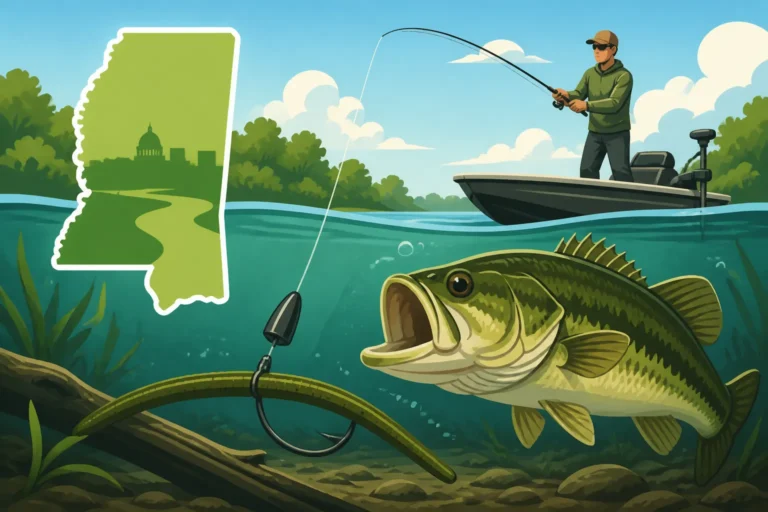
- Texas Rig: A classic for bass fishing with soft plastic worms. You run the hook point through the tip of the worm, then turn it and embed the point back into the body of the worm, making it weedless. You can add a bullet weight in front of it to help it sink and get through cover.
Learning just these few basic rigs will allow you to fish effectively for a wide variety of species you'll find throughout Mississippi. You can find excellent guides on Best Bait for Crappie in Mississippi, Best Lures for Largemouth Bass, and Best Bait for Catfish in Mississippi to help you pick what to put on these rigs.
Practice Makes Perfect: Casting and Retrieving
You've got your gear, it's spooled, and you know a few knots. Now, it's time to actually use it! The best way to build confidence is to practice. Head to an open area like a backyard, a park, or even an empty field. Tie on a practice plug (a small, weightless rubber plug designed for casting practice) or simply an old sinker, and just cast away. Focus on a smooth, controlled motion. For a spinning reel, open the bail, use your index finger to hold the line, bring the rod back to about 10 or 11 o'clock, then sweep it forward, releasing your finger as the rod comes to about 1 or 2 o'clock.
Pay attention to your retrieve as well. Try reeling at different speeds—slow, steady, fast. Notice how the lure (or just the sinker) moves through the water. Learning to cast accurately and retrieve smoothly are fundamental skills that will serve you well for years to come. Don't get discouraged if your first few casts aren't perfect; everyone starts somewhere! The more you practice, the more natural it will feel. Soon enough, you'll be confidently casting towards those promising fishing spots you've read about in guides like Bank Fishing Tips for Beginners and enjoying the peaceful rhythm of a day on the water, perhaps even trying to determine the Best Time of Year to Fish in Mississippi for your target species. Just remember to check the Mississippi Fishing License Guide and Mississippi Freshwater Fishing Rules before you hit the water for real!
Disclaimer
This article is for general informational purposes only and does not constitute professional advice. Laws, prices and regulations vary by location and change over time. Consult a qualified professional for guidance on your specific situation.