Jug Fishing and Trotline Setup
There’s nothing quite like the anticipation of letting the water do some of the work for you, especially when you’re hoping to reel in a mess of catfish or a big hauler. But for many anglers, the world of jug fishing and trotlines in Mississippi can feel a bit like a tangled mess itself, full of confusing regulations and uncertain setup techniques. This comprehensive guide is here to untangle all that, walking you through everything you need to know to safely, legally, and effectively set up and use these popular passive fishing methods in our beautiful Mississippi waters.
Understanding Jug Fishing and Trotlines
Jug fishing and trotlining are traditional and highly effective methods for catching fish, particularly species like catfish, that are often found on the bottom or in deep channels. Unlike actively casting and retrieving, these techniques allow you to set your gear and let it sit, attracting fish over time. They are fantastic for anglers who want to maximize their catch efficiency, especially when targeting multiple fish simultaneously, or for those who simply enjoy a more relaxed approach to fishing.
The Art of Jug Fishing
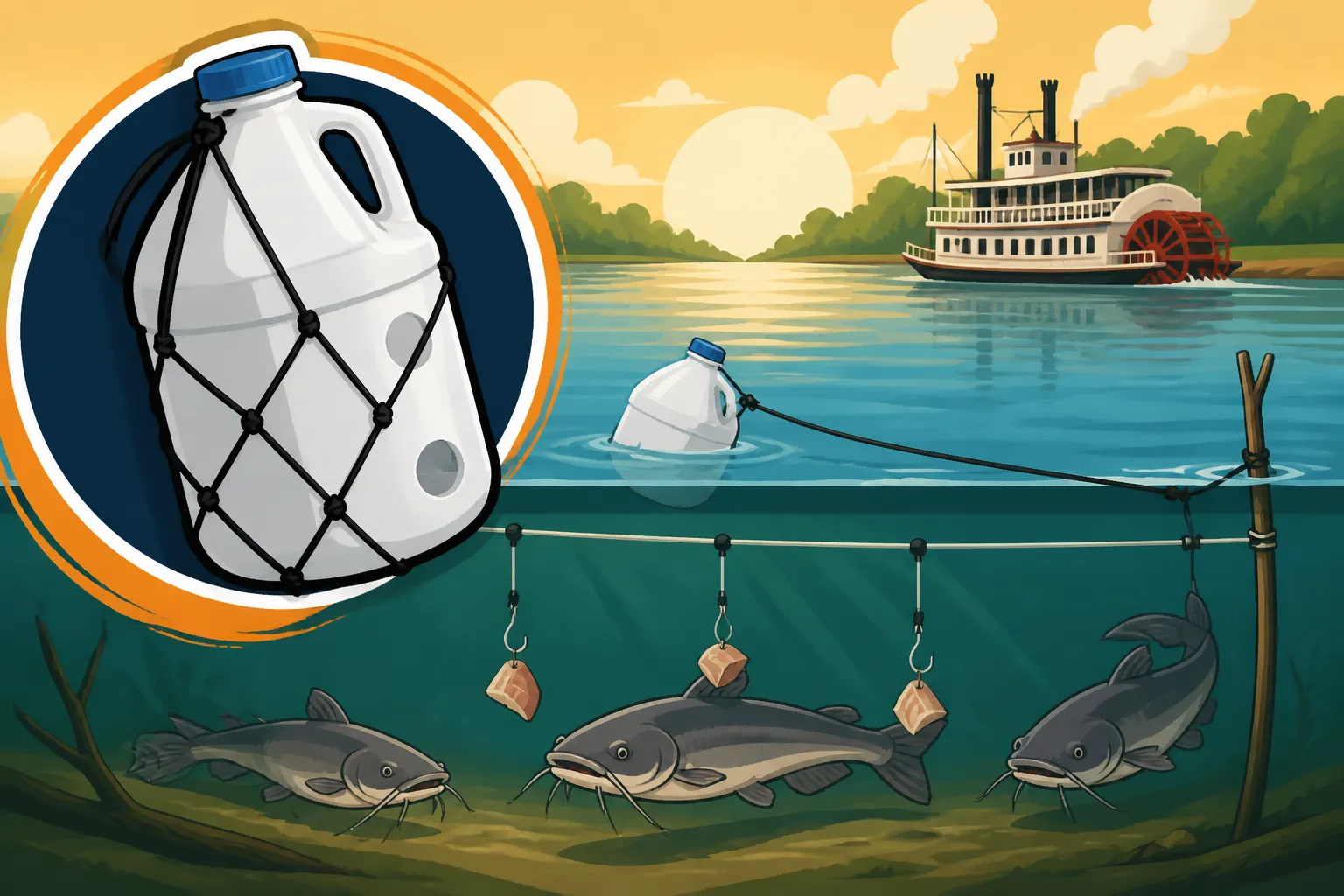
Jug fishing involves using individual, buoyant devices – the "jugs" – each rigged with a line, hook, and weight. The beauty of jug fishing lies in its simplicity and mobility. You can deploy multiple jugs across a wide area, letting them drift with the current or anchoring them in specific spots. When a fish bites, the jug will move or dip, signaling a catch. This method is incredibly visual and can be a lot of fun, especially when you have several jugs bouncing around, indicating a busy day on the water.
Often, you'll see folks using old plastic milk jugs, soda bottles, or even brightly colored pool noodles as their buoyant device. The choice of jug material often comes down to personal preference, visibility, and durability. A good jug needs to be able to support the weight of a fish without sinking, and it needs to be easily identifiable, especially if you're spreading out a dozen or more of them. The line attached to the jug will vary in length depending on the water depth and target species, with a hook and often a sinker at the business end to keep the bait in the strike zone.
The Efficiency of Trotlines
A trotline, on the other hand, is a single main line with multiple baited hooks attached at intervals along its length, typically anchored at both ends. Think of it as a long fishing line that you set up and leave overnight or for several hours. This method is exceptionally efficient for catching numerous fish, especially bottom dwellers like catfish, because it presents many baits in a continuous spread. It's a method that requires a bit more setup initially, often involving a boat to deploy and retrieve, but the payoff can be substantial.
Trotlines are usually set in rivers, large lakes, or reservoirs where currents can carry the scent of the bait over a wide area, attracting fish from afar. The main line needs to be strong enough to hold multiple active fish, and the smaller lines that branch off to the hooks (often called "snoods" or "stagings") should be robust enough to withstand the fight. Properly setting and checking a trotline is key to its success, ensuring it's anchored securely and that fish aren't left on the line for too long, which can be detrimental to their health and the quality of the meat.
Mississippi Regulations for Jug Fishing and Trotlines
Before you even think about buying a single hook or cutting your first piece of line, it is absolutely paramount to understand and adhere to Mississippi's specific regulations for jug fishing and trotlines. The Mississippi Department of Wildlife, Fisheries, and Parks (MDWFP) has clear rules in place to ensure fair chase, prevent overfishing, and protect our aquatic resources. Violating these rules can lead to significant fines and the confiscation of your gear, which is a headache no one wants to deal with after a relaxing day of fishing. Remember, ignorance of the law is no excuse, and these passive methods are often under closer scrutiny than traditional rod-and-reel fishing. You can find comprehensive details in the official Mississippi Fishing Regulations Explained.
Legal Requirements for Jug Fishing
Mississippi allows jug fishing, but with specific limitations. First and foremost, each jug must be tagged with the angler's name and address or a MDWFP customer ID number. This ensures accountability and helps wildlife officers identify legal gear. Losing a jug without proper identification is not only a loss for you but also creates potential ghost fishing hazards. These tags need to be durable and legible, capable of withstanding prolonged exposure to water and sun.
Furthermore, there are restrictions on the number of jugs you can deploy. Currently, an individual is typically limited to 50 jugs. Exceeding this limit is a violation. Also, specific lakes and areas might have additional restrictions or prohibitions on jug fishing, so always double-check the local rules for your chosen fishing spot. For instance, some smaller state fishing lakes might not permit jugs at all. The size and type of hook are also regulated; generally, treble hooks are prohibited for these methods in most freshwater bodies, emphasizing single-point hooks.
Trotline Rules and Restrictions
Trotlines in Mississippi are also subject to strict guidelines. Similar to jugs, every trotline must be clearly tagged with the angler's name and address or MDWFP customer ID. This tag must be placed conspicuously, often near one of the anchor points, and again, needs to be robust enough to remain legible. The length of your trotline is often regulated, preventing anglers from deploying excessively long lines that could monopolize vast areas of water or pose navigation hazards.
A critical rule for trotlines concerns the number of hooks. Typically, trotlines are limited to 100 hooks per line, and the hooks must be spaced at least two feet apart. This spacing is important for minimizing entanglement and giving each fish enough room. Just like with jug fishing, treble hooks are generally not allowed on trotlines in freshwater. Additionally, there are specific depth requirements; often, trotlines must be set in water at least three feet deep to prevent hazards to boats and swimmers in shallower areas. Understanding these Mississippi Freshwater Fishing Rules is crucial for avoiding issues.
| Feature | Jug Fishing | Trotline Fishing |
|---|---|---|
| Setup Time | Quick, individual deployment | Moderate, requires anchoring and multiple hooks |
| Mobility | Highly mobile, can drift or be anchored | Fixed location, anchored at both ends |
| Effort | Low-to-moderate, depends on number of jugs | Low-to-moderate, depends on length and checks |
| Number of Devices | Up to 50 individual jugs | Up to 1 trotline |
| Hooks per Device | 1 hook per jug | Up to 100 hooks per line |
| Hook Spacing | N/A (single hook per jug) | Minimum 2 feet apart |
| Tagging | Each jug must be tagged | Each trotline must be tagged |
| Target Species | Primarily catfish, some crappie, white bass | Primarily catfish, some carp, non-game fish |
| Visibility | High (floating jugs visible) | Low (mainline submerged, marked by floats) |
| Deployment | Can be done from bank or boat | Typically requires a boat |
Setting Up for Jug Fishing
Jug fishing is an accessible and enjoyable method, but a successful setup requires attention to detail. It's not just about tossing a baited hook into the water; it's about creating a system that is effective, durable, and compliant with regulations. Think of each jug as its own mini-fishing system, designed to attract, hook, and hold a fish until you can retrieve it. The right materials and a systematic approach will make all the difference, transforming a collection of random items into a productive fishing tool.
Essential Jug Fishing Materials
The foundation of any good jug fishing setup starts with the right buoyant device. While repurposed milk jugs are classic, many anglers now opt for brightly colored pool noodles or PVC pipe sections sealed at both ends. These options offer better durability and visibility. For example, a 1-foot section of a large diameter pool noodle, brightly colored in orange or yellow, is easy to spot from a distance and can typically support a hefty catfish. You can find bulk packs of these on Amazon, making it easy to outfit yourself with a dozen or more.
Next, you need strong fishing line, typically monofilament or braided, with a test strength suitable for your target species. For big Mississippi Catfish, a 50-80 lb test line is often recommended. The length of the line should be appropriate for the water depth you're fishing, allowing your bait to sit near the bottom without excessive slack that could snag or tangle. A good rule of thumb is to have line that's 1.5 to 2 times the maximum depth you expect to fish. Swivels are also essential to prevent line twist, especially from a struggling fish. For hooks, durable, sharp circle hooks in sizes 5/0 to 9/0 are popular choices for catfish, as they are effective at hooking fish in the corner of the mouth, reducing gut-hooking and making release easier if desired. Finally, you’ll need some weights, like egg sinkers or bell sinkers, to get your bait down to the desired depth, typically ranging from 1/2 ounce to 2 ounces depending on current and bait size.
Step-by-Step Jug Rigging
Rigging a jug is straightforward once you have your materials. Start by cutting your fishing line to the desired length. For a buoyant jug like a pool noodle, you'll want to run the main line through the center of the noodle. This prevents the line from slipping off and creating tangles. Secure one end of the line to itself with a strong knot (like a Palomar knot or improved clinch knot) to create a loop or a secure attachment point to the noodle itself. Ensure the line is long enough to reach the bottom plus some extra.
On the other end of the line, attach a heavy-duty swivel. This is where your leader line will connect. For the leader, use a slightly lighter test line than your main line (e.g., 40 lb test if your main line is 60 lb). This way, if you get snagged, you might only lose the hook and leader, not the whole setup. Attach your hook to one end of the leader and the swivel to the other. Just above the swivel on the main line, you'll want to place a small bead and then tie on your sinker. The bead protects the knot from the sinker, and the sinker helps keep your bait at the desired depth. Don't forget to securely attach your MDWFP compliant tag to each jug before deployment. Repeat this process for all your jugs, and you'll have a fleet ready for action.
Setting Up a Trotline
While jug fishing offers mobility, trotlining is about presenting a wide array of baits in a fixed location. A properly deployed trotline can be incredibly productive, but it requires careful planning and a robust setup to handle multiple fish and the forces of the water. Thinking through the logistics of deployment, anchoring, and retrieval will save you a lot of headaches later on.
Essential Trotline Components
The main line is the backbone of your trotline. It needs to be incredibly strong and abrasion-resistant, often a braided nylon or tarred trotline cord. A common choice is a #18 to #36 braided nylon, capable of 100-300 lb test, depending on the expected size of your catch and the forces of the current. You don't want a trophy catfish to snap your main line. The length will vary, but remember that Mississippi regulations might have limits on maximum trotline length.
Next are the snoods, also known as stagings or droppers. These are the shorter lines that connect your hooks to the main line. Many anglers use a slightly lighter test line for snoods (e.g., 60-80 lb mono) so that if a snood gets snagged or breaks, you don't lose the entire trotline. Snoods are typically 12-24 inches long. Hooks, again, should be sturdy circle hooks, sizes 5/0 to 9/0, for similar reasons as in jug fishing. For anchors, you'll need something substantial to keep your trotline in place, especially in moving water. Window sash weights, old engine blocks, or even heavy bricks can work. Finally, you'll need buoys to mark the ends of your trotline. These should be brightly colored and large enough to be easily visible, especially to other boaters, and this is where your MDWFP tags will be attached. Many people opt for commercial trotline buoys, or even repurposed large plastic bottles, which you can easily find in bulk on Amazon for a decent price.
Step-by-Step Trotline Deployment
Deploying a trotline safely and effectively usually requires a boat, though some smaller lines can be set from the bank in specific scenarios. Start by selecting your location, considering current, depth, and potential fish habitat. Begin by securing one end of your main line to a heavy anchor. Make sure to attach your MDWFP identification tag to the buoy that will mark this end of the line. Drop the anchor in your desired starting spot, making sure the buoy floats freely and visibly.
As you slowly move your boat along the planned path of your trotline, begin attaching your baited snoods to the main line at the regulated intervals (typically at least two feet apart). Using a "piggin' string" knot or a small brass clip designed for trotlines will make this process efficient and secure. As you continue, pay out the main line, keeping it taut to prevent tangles. Once all your snoods are attached and baited, secure the other end of the main line to a second heavy anchor and drop it, again ensuring a visible buoy with your tag marks this end. It’s important to ensure the trotline is tight enough to prevent sagging but not so tight that it strains the anchors or makes it difficult to retrieve. Allow the line to soak for several hours or overnight before checking it, being mindful of changing weather or current conditions.
Best Baits and Locations for Passive Fishing
The effectiveness of jug fishing and trotlines hinges not just on proper setup, but critically, on the bait you choose and where you decide to deploy your gear. These methods are most productive when targeting bottom-dwelling species that rely heavily on scent to locate food, and certain habitats are naturally more conducive to successful passive fishing. Choosing the right combination can dramatically increase your chances of a bountiful catch.
Top Baits for Mississippi Catfish and More
When it comes to passive fishing methods like jugs and trotlines, catfish are often the primary target, and they are notoriously scent-driven. Therefore, your bait strategy needs to lean heavily on strong, appealing odors. Cut bait is a perennial favorite; fresh shad, skipjack herring, or even commercially prepared frozen baits like chicken livers work wonders. The oilier the fish, the better, as the scent trail will travel further in the water, drawing in fish from a wider area. You can find excellent resources on the Best Bait for Catfish in Mississippi, which often highlights these same tried-and-true options.
Another excellent choice for attracting catfish, particularly blues and channels, is prepared stink baits or dough baits. Brands like Catfish Charlie or Uncle Josh's often have a potent aroma that catfish can't resist. For those targeting blue catfish, fresh cut bait from oily fish like shad or even pieces of carp can be incredibly effective. Don't overlook unconventional options either; soap (Irish Spring is a surprisingly common choice), hot dogs, or even shrimp can entice a bite. For Mississippi Non-Game Fish Rules Explained, you might find that certain species like buffalo or carp can also be targeted with trotlines using baits like corn or dough balls, though regulations for these species are important to know.
Ideal Locations for Deployment
The success of your jug lines or trotlines heavily depends on selecting the right location. For rivers and large channels, look for deep holes, outside bends, or areas near submerged structure like log jams and brush piles. Catfish often congregate in these spots, seeking both food and cover. The Mississippi River Fishing Guide is an invaluable resource for identifying such prime areas along the river itself, which is a fantastic spot for trotlining. In reservoirs and large lakes, target creek channels, submerged roadbeds, or the edges of flats that drop off into deeper water. These underwater highways and transition zones are where fish often travel and feed.
When deploying jug lines, consider the current. If you want your jugs to drift, launch them upstream of a promising area and let them move naturally through fish-holding water. If you want them to stay put, anchor them in a specific spot known for fish activity. For trotlines, choose areas with relatively clear bottom to minimize snagging, but still close enough to structure or depth changes that hold fish. Setting a trotline across a creek channel or along a deep contour line can be incredibly productive. Always remember to consider other boaters and recreational users when choosing your location; avoid high-traffic areas or navigation channels to prevent accidents.
Advantages and Disadvantages of Passive Fishing
While jug fishing and trotlining can be incredibly effective, they come with their own set of pros and cons. It’s important to weigh these before committing to these methods, ensuring they align with your fishing goals, ethical considerations, and time constraints. For many, the allure of letting their gear do the hard work is strong, but it's not without its challenges.
The Benefits of Hands-Off Angling
One of the biggest advantages of jug fishing and trotlining is the sheer efficiency and ability to catch multiple fish without constant active participation. Imagine setting a dozen jugs or a 50-hook trotline, then being able to attend to other camp duties, relax with family, or even fish with a traditional rod and reel elsewhere. These methods allow you to cover a vast amount of water and present numerous baits simultaneously, dramatically increasing your odds of a successful harvest. This can be particularly rewarding for those looking to fill a freezer with fresh Mississippi Catfish Regulations compliant fish.
Furthermore, passive fishing can be a great way to target larger, wary fish that might be less inclined to strike an actively presented lure. Big catfish, in particular, are often caught on trotlines and jug lines because the bait sits patiently in their feeding zones for extended periods. It’s also an excellent option for anglers with physical limitations who might find constant casting and retrieving challenging. The initial setup takes some effort, but once deployed, the work is minimal until retrieval. For many, it's a nostalgic method, connecting them to generations of anglers who used similar techniques to put food on the table.
Potential Drawbacks and Challenges
Despite the benefits, there are several disadvantages and challenges associated with jug fishing and trotlines. The primary concern for many is the risk of "ghost fishing." If a jug or trotline breaks free, or if you lose track of it, the baited hooks can continue to catch fish indefinitely, leading to unnecessary mortality and waste of resources. This is why strict tagging regulations are in place for Mississippi Trotline and Jug Fishing Rules. Careless deployment and retrieval can also result in lost gear, which is not only frustrating but also contributes to pollution in our waterways.
Another common issue is entanglement. Jug lines can drift into boat lanes, docks, or other anglers' active lines, causing frustration and potential hazards. Trotlines, if not properly anchored, can shift and snag on submerged timber or debris, making retrieval difficult or impossible. Non-target species, including protected ones, can also be caught, requiring careful handling and release. Finally, these methods require regular checking – usually every 24 hours at minimum, but more frequently is better – to ensure fish are not left on the line for too long, which can harm the fish and degrade the quality of the meat. This regular checking means it's not a set-it-and-forget-it method, but rather a more managed passive approach.
Best Practices for Responsible Passive Fishing
Engaging in jug fishing and trotlining is more than just knowing how to tie a knot or where to drop a line; it's about being a responsible steward of Mississippi's fisheries. These methods carry a unique set of responsibilities because they are "passive," meaning you're not actively holding the rod. This requires extra diligence to ensure your actions are ethical, safe, and environmentally conscious. Adhering to best practices not only helps preserve our natural resources but also safeguards the reputation of these traditional fishing techniques.
Ensuring Safety and Visibility
Safety should always be your top priority, both for yourself and for other users of the waterway. When setting out jug lines or trotlines, especially in larger bodies of water like the Mississippi River or major reservoirs, ensure all your marking buoys are highly visible. Bright, contrasting colors like orange, yellow, or neon green are ideal. For trotlines, it's particularly important that the end buoys are large enough to be easily seen by boaters, even from a distance. Consider adding reflective tape to your buoys if you anticipate checking your lines in low light conditions or at night.
Beyond visibility, consider the placement of your gear. Avoid deploying jugs or trotlines in marked navigation channels, swim areas, or high-traffic boating lanes. This prevents potential hazards for boaters who might not see your lines or get tangled in them. Always wear a life jacket when deploying or retrieving lines from a boat, and be mindful of your surroundings. Dealing with a strong fish or a snagged line can quickly become precarious, and a life jacket can be a literal lifesaver. Carrying a sharp knife is also a good safety practice, allowing you to quickly cut a line in an emergency.
Ethical Considerations and Conservation
Responsible passive fishing goes hand-in-hand with conservation. The cardinal rule is to check your lines frequently. While regulations often specify a maximum period (e.g., 24 hours), checking every 8-12 hours, or even more often in warm weather, is highly recommended. This reduces stress and mortality for caught fish, ensuring higher quality meat if you intend to harvest, and significantly increases the survival rate for fish you plan to release. It also helps prevent animals like turtles or birds from becoming entangled.
It's also crucial to commit to retrieving all your gear. Lost jugs and trotlines become "ghost gear" that continues to fish indiscriminately, harming wildlife and polluting the environment. If a line snags, make every effort to retrieve it, even if it means sacrificing some hooks or leaders. Use strong, durable materials during setup to minimize breakage in the first place. Consider the impact on non-target species; if you're consistently catching protected fish or species you don't intend to keep, adjust your bait or location. Being proactive about conservation ensures that these effective fishing methods remain viable and enjoyable for future generations of Mississippi anglers.
Final Thoughts on Passive Fishing
Jug fishing and trotlining in Mississippi offer a rich, traditional way to enjoy our state's abundant waterways and harvest a fantastic catch. From the satisfaction of rigging your own jugs to the thrill of checking a trotline filled with hefty catfish, these methods connect us to a deeply rooted angling heritage. However, the key to truly enjoying them, and ensuring their continued viability, lies in respecting the rules, prioritizing safety, and practicing responsible conservation.
By understanding Mississippi's specific regulations, meticulously setting up your gear, choosing the right baits, and deploying in appropriate locations, you can experience the incredible efficiency and enjoyment these passive fishing techniques provide. Remember that whether you're sourcing supplies from Amazon or your local tackle shop, the ultimate success comes from careful planning and ethical execution. Go forth, fish smart, and enjoy the bounty of Mississippi's waters!
Disclaimer
Please note that fishing regulations are subject to change. While every effort has been made to provide accurate and up-to-date information, it is the angler's responsibility to consult the latest official regulations published by the Mississippi Department of Wildlife, Fisheries, and Parks (MDWFP) before engaging in any fishing activities. This guide is for informational purposes only and should not be considered a substitute for official legal guidance.