How to Catch Redfish in the Marsh
The Mississippi marsh can feel like an intimidating labyrinth when you're trying to track down those elusive redfish. It's easy to get overwhelmed by the endless network of shallow ponds, winding bayous, and hidden creeks, wondering where to even begin your search. If you've ever cast into seemingly perfect water only to come up empty, you know the frustration. This comprehensive guide is here to unravel the mysteries of marsh redfish, equipping you with the knowledge and tactics to consistently find and catch these hard-fighting coastal treasures.
Understanding the Mississippi Marsh Environment for Redfish
The sprawling marshlands along Mississippi's Gulf Coast are a truly unique and vibrant ecosystem, a haven for countless species, including our beloved redfish. To successfully target them, you first need to understand why this intricate environment is so appealing to them and how its dynamic nature influences their behavior.
Why Redfish Love the Marsh
Imagine a giant, shallow buffet table, constantly restocked with delicious food, offering endless nooks and crannies for shelter, and changing with the daily rhythm of the tides. That's essentially what the marsh is to a redfish. This complex habitat, characterized by its labyrinthine network of bayous, tidal creeks, shallow flats, and expansive grassy areas, provides everything a redfish needs to thrive.
Firstly, the food source is incredible. Redfish are opportunistic feeders, and the marsh teems with their favorite meals. Think about the abundance of small baitfish like finger mullet, menhaden, and the countless shrimp and crabs scurrying along the bottom. These creatures are constantly moving with the tides, pushed in and out of the grass, making them easy targets for hungry reds. Unlike open water, where bait can disperse widely, the confined nature of marsh channels often concentrates bait, making it a prime hunting ground.
Secondly, the marsh offers unparalleled protection. The dense stands of Spartina grass and the intricate shallow water channels provide excellent camouflage and shelter from larger predators, such as dolphins or larger sharks, that might cruise the deeper bay waters. It also shields them from extreme weather conditions, offering refuge from strong winds and harsh sunlight. During colder months, the shallower, dark-bottomed marsh ponds can even warm up faster than deeper bay waters, creating a comfortable thermal refuge for redfish.
Key Environmental Factors and Tides
The marsh is a living, breathing system, and its pulse is the tide. Understanding how tides influence redfish movement and feeding patterns is arguably the most crucial piece of the puzzle for consistent success. Without a firm grasp of the tidal swings, you're essentially fishing blind.
Tidal Influence: Redfish are highly dependent on tidal movements. As the tide comes in (incoming tide or flood tide), it pushes water deeper into the marsh grass and over previously dry flats. This allows redfish access to new feeding grounds, often pushing deep into the grass to root out crabs and shrimp. This is often when you'll see those tell-tale "tails" of redfish feeding head-down in the shallow grass.
As the tide begins to recede (outgoing tide or ebb tide), the water drains out of these shallow areas, forcing the redfish to retreat back into the main channels, creeks, and deeper pockets. These drainage points become excellent ambush spots, as baitfish and crustaceans are swept out with the current. Many experienced marsh anglers, myself included, will focus heavily on fishing the last two hours of the outgoing tide and the first two hours of the incoming tide, as these transition periods often trigger intense feeding activity. You can find detailed information on how these daily movements affect specific species by looking into resources like "Redfish Fishing on the Mississippi Coast."
Water Depth, Clarity, and Temperature: Beyond the tides, other environmental factors play significant roles. The shallow nature of the marsh means that water depth can change dramatically with just a few inches of tide, impacting where fish can hold. Water clarity in the marsh is often stained or murky due to runoff and sediment, which influences your lure color choices. Brighter colors or those with strong vibration are often favored in murky conditions.
Water temperature also dictates redfish activity. They are cold-blooded, so their metabolism slows down in colder water, making them less aggressive. Conversely, excessively hot, stagnant water in very shallow ponds can also make them lethargic. Ideal temperatures, typically in the 60s and 70s Fahrenheit, lead to the most active feeding. Keeping an eye on the weather and water conditions before you head out is always a smart move.
Essential Gear and Bait for Marsh Redfish
Having the right tools for the job can make all the difference, especially when you're battling a bull redfish in tight quarters. The marsh environment demands a balance of power, sensitivity, and versatility from your fishing tackle.
Rod, Reel, and Line Selection
When it comes to marsh redfishing, you're looking for gear that can handle strong, sudden runs and the potential for a fish to wrap you around an oyster bar or a clump of grass.
Rods: A medium-heavy to heavy power spinning or baitcasting rod, typically 7 to 7.5 feet in length, is a solid choice. This length provides good casting distance while still being maneuverable in tight marsh creeks. The "fast" or "extra-fast" action allows for quick hook sets and sensitivity to feel subtle bites, which are crucial when redfish are gently mouthing bait. Look for rods with a stout backbone to muscle fish away from snags. Many popular brands offer excellent inshore rods suitable for redfish, and you can often find a great selection of these on Amazon.
Reels: For spinning gear, a 3000 to 4000 series reel is generally preferred. This size offers ample line capacity and a smooth drag system, which is vital for those powerful redfish runs. If you prefer baitcasting, a low-profile baitcaster with a strong drag and a good retrieve ratio (around 7.1:1) is ideal for quickly taking up slack and casting accurately into tight spots. Ultimately, the choice between spinning and baitcasting often comes down to personal preference, but both can be highly effective. For more on selecting your gear, check out our guide on "Choosing the Right Rod and Reel for Mississippi Fishing."
Line: Braided line is almost a standard for marsh redfishing. Its superior sensitivity allows you to feel even the lightest taps, and its lack of stretch means powerful hook sets. A 15-20 lb test braided line is a good all-around choice. Because redfish have excellent eyesight and braided line can be visible, it's essential to use a fluorocarbon leader. A 20-30 lb test fluorocarbon leader, typically 18-36 inches long, provides invisibility and abrasion resistance against rough oyster shells and sharp marsh grass.
Top Baits and Lures for Marsh Redfish
Redfish aren't particularly picky eaters, but understanding what they prefer under different conditions will significantly boost your success. Variety is key, as their mood can change daily.
Live Bait: There's an old saying, "nothing beats live bait," and for marsh redfish, it often holds true.
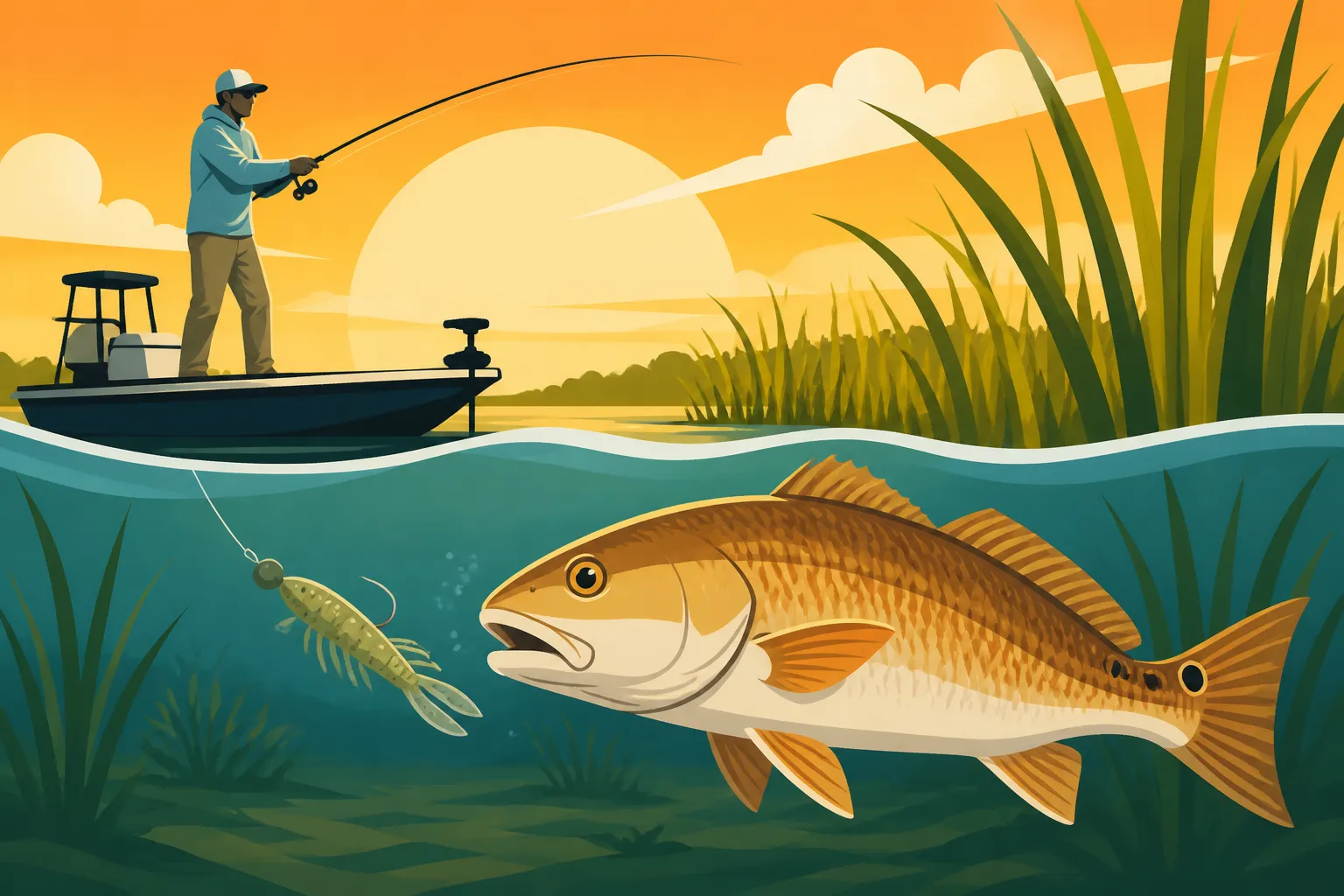
- Live Shrimp: These are arguably the most effective live bait for redfish. Fished under a popping cork, live shrimp mimic a struggling shrimp, triggering an aggressive strike. The "pop, pause" retrieve of the cork draws attention from a distance.
- Live Minnows/Mullet: Small live finger mullet or mud minnows, hooked through the lips, are excellent choices, especially when redfish are keying in on finfish. They can be free-lined, fished under a cork, or on a simple bottom rig.
Cut Bait: When redfish are sluggish or the water is murky, the strong scent of cut bait can be irresistible.
- Cut Mullet or Pogies: A fresh chunk of mullet or menhaden (pogies) on a bottom rig or a Carolina rig can be deadly. The scent trail travels far and often entices larger, less active fish. Many anglers find success leaving a piece of cut bait on the bottom near a current choke point during a strong outgoing tide. You can explore more options in our "Best Bait for Redfish" article.
Artificial Lures: Modern artificial lures are incredibly effective and offer the advantage of covering a lot of water quickly.
- Soft Plastics: These are probably the most versatile artificial lure for redfish. Paddle tails, grub tails, and shrimp imitations, rigged on a 1/8 to 1/4 ounce jig head, are phenomenal. Popular colors include 'new penny' (a copper brown), 'chartreuse,' 'salt and pepper,' and 'opening night' (clear with black and purple flakes). Many anglers stock up on Z-Man or Vudu Shrimp soft plastics, which are readily available on Amazon.
- Spoons: Gold or silver weedless spoons are fantastic for covering shallow, grassy flats. Their flash and wobble imitate fleeing baitfish. Cast them out and retrieve steadily, letting the spoon occasionally tick the grass.
- Topwater Lures: During low light conditions (dawn/dusk) or when redfish are actively feeding on the surface, topwater walkers (like Heddon Super Spook Jr. or Rapala Skitter Walk) or poppers can provide explosive strikes. These lures are incredibly exciting to fish, demanding precise casting and a rhythmic retrieve.
- Crab Imitations: When redfish are "tailing" in super shallow water, rooting for crabs, a weedless crab imitation soft plastic can be incredibly effective. Cast it gently past the fish and slowly crawl it in front of them.
Proven Techniques for Targeting Marsh Redfish
Once you've got your gear and bait sorted, it's time to talk strategy. Fishing the marsh effectively requires specific techniques that leverage the environment and redfish behavior.
Sight Fishing and Casting Strategies
Sight fishing for redfish in the marsh is one of the most thrilling and rewarding experiences in saltwater angling. It's like a hunting game, where stealth and precision are paramount. The ability to spot a fish, make an accurate cast, and watch it eat your lure is truly special. This is often covered in topics like "How to Sight Fish for Redfish on the Flats."
Patience and Stealth: The first rule of sight fishing is extreme stealth. Redfish in shallow water are incredibly wary. Approach quietly, whether by foot, kayak, or poling skiff. Minimize sudden movements, loud noises, and even shadows. Wear polarized sunglasses; they are absolutely essential for cutting glare and spotting fish or their subtle signs.
Spotting Redfish: Look for the tell-tale signs:
- Tails: The most obvious sign is a redfish's tail breaking the surface as it feeds head-down in shallow water, often rooting in the mud or grass.
- Wakes: A V-shaped wake moving across a flat indicates a cruising fish.
- Pushes: A bulge of water moving, usually signifying a fish pushing bait.
- Flashes: The glint of a redfish's scales as it turns in clear, shallow water.
- Mud Boils: Clouds of stirred-up mud can indicate a fish that was just feeding or spooked.
Accurate Casting: Once you spot a fish, your cast needs to be accurate and delicate. Cast beyond and past the fish, then retrieve the lure into its strike zone. A splashy, direct cast can easily spook a wary redfish. If the fish is moving, try to lead it, anticipating its path. Sometimes, a "drop shot" presentation, where the lure lands softly just a few feet in front of a tailing fish, can be irresistible. The ability to make accurate, quiet casts quickly is a skill that develops with practice.
Using Popping Corks and Bottom Rigs
While sight fishing is exciting, sometimes conditions don't allow for it, or the fish are holding in deeper areas within the marsh. That's when popping corks and bottom rigs shine.
Popping Corks: These are fantastic for blind casting in productive marsh areas, especially when you suspect redfish are around, but you can't see them. A popping cork creates a "chugging" or "popping" sound when you twitch your rod tip, mimicking the sound of shrimp or baitfish fleeing on the surface. This sound grabs the attention of nearby redfish.
- Rigging: Attach the popping cork to your main line. Below the cork, tie a 12-24 inch fluorocarbon leader (20-30 lb test) to a small swiveling jig head (1/8 to 1/4 oz) or a weedless hook with a live shrimp. The depth from the cork to the hook should be adjusted so your bait is just above any grass or structure.
- Retrieve: Cast your cork rig out and let it sit for a few seconds. Then, give a sharp, downward twitch of your rod tip to make the cork "pop." Let it sit again, allowing the bait to settle, then repeat. Vary the pauses and pops until you find what the fish prefer. This technique is especially effective for "Speckled Trout Fishing Techniques" as well, which often share the same marsh habitats.
Bottom Rigs: For redfish holding deeper in channels or when targeting less active fish with cut bait, a simple bottom rig is highly effective.
- Carolina Rig: This rig consists of a sliding egg sinker (1/2 to 1 oz, depending on current), followed by a bead (to protect the knot), a swivel, and then an 18-30 inch fluorocarbon leader tied to a strong circle hook (2/0 to 4/0, appropriate for your bait size). The sliding weight allows the fish to pick up the bait without feeling immediate resistance.
- Drop Shot Rig: While more commonly used for freshwater bass, a modified drop shot can be effective in specific marsh scenarios, especially around structure like docks or oyster shells where you want to keep your bait just off the bottom.
- Usage: Cast your bottom rig into deeper pockets, along channel edges, or near oyster beds. Allow it to sink to the bottom. Keep a relatively tight line to feel bites. This rig is perfect for presenting cut bait or live minnows. When using circle hooks, simply reel down until the line tightens, and the hook will set itself in the corner of the fish's mouth.
Kayak and Shallow-Draft Boat Fishing
The Mississippi marsh is practically built for kayaks and shallow-draft boats. These vessels offer unparalleled access to areas that larger, deeper-draft boats simply can't reach, and they do so with a crucial element: stealth. Our guide on "Kayak Fishing Techniques" offers more general insights, but let's focus on marsh specifics.
Access to Skinny Water: Many of the most productive redfish areas are incredibly shallow, sometimes less than a foot deep. A kayak or a poling skiff can glide silently over these flats, allowing you to get right into the heart of the action where redfish are feeding on shrimp and crabs in the grass. This deep access significantly increases your chances of encountering unpressured fish.
Stealth and Observation: The quiet nature of these smaller vessels is a massive advantage for sight fishing. You can approach fish without spooking them, often getting close enough for a perfect cast. The elevated position in a kayak or a poling platform on a skiff also improves your visibility, making it easier to spot subtle signs of redfish activity. You'll become a much better angler by observing fish in their natural environment.
Safety Considerations: While highly effective, remember safety when navigating the marsh in a kayak or small boat. Always check tide charts carefully to avoid getting stranded on a receding tide. Carry a paddle, plenty of water, a whistle, and a VHF radio or fully charged cell phone. Tell someone where you're going and when you expect to return. The marsh can be disorienting, so a GPS is also a valuable tool.
Tips for Maximizing Your Marsh Redfish Success
Even with the right gear and techniques, a few extra considerations can really put you over the top when chasing marsh redfish. It's about combining all your knowledge and adapting to the conditions.
Timing Your Trip for Optimal Conditions
As we discussed, the marsh is a dynamic place, and timing is everything. Fishing at the right moment can mean the difference between a few bites and a banner day.
Best Tides: Reiterate that the moving tides are paramount. The last two hours of the outgoing tide and the first two hours of the incoming tide are often peak feeding times as redfish move with the water. However, don't dismiss the high tide period entirely; it's prime for finding "tailing" redfish deep in the grass, requiring a stealthy approach. Always check a local tide chart for the specific area you plan to fish. You'll find that understanding a "Best Tide for Surf Fishing on the Mississippi Coast" can also apply here, as the same tidal principles govern fish movement.
Time of Day and Weather:
- Early Morning/Late Evening: Low light conditions often bring redfish into shallower water and increase their aggression, making topwater lures particularly effective.
- Overcast Days: Overcast conditions can keep fish active longer in shallow water, as they are less prone to being spooked by shadows or direct sunlight.
- After a Cold Front: This can be tricky. Redfish might be sluggish immediately after a strong cold front, retreating to deeper, more stable water. Focus on deeper channels, oyster beds, and areas with dark mud bottoms that absorb sunlight. They'll become more active as the water warms slightly. For similar species, consider "Best Time of Day to Catch Speckled Trout" as these fish often overlap habitats and react to conditions similarly.
Reading the Water and Spotting Productive Areas
One of the signs of an experienced marsh angler is their ability to "read the water"—interpreting the subtle cues that indicate where fish might be.
Structure and Current:
- Points and Corners: Any bend or point in a creek or bayou can create a current eddy, a perfect ambush point for redfish waiting for bait to be swept by.
- Oyster Reefs/Shell Beds: These are prime redfish habitat. They attract baitfish, shrimp, and crabs, and provide structure for redfish to hide and feed. Plus, the shells hold heat, making them attractive in cooler weather.
- Grass Lines: The edges of the Spartina grass provide cover and food. Look for openings, cuts, or irregularities in the grass line.
- Drains and Runoffs: As the tide falls, small ditches and cuts that drain water from the higher marsh flats into the main channels are excellent places to intercept redfish leaving the shallows.
Signs of Bait and Birds: Where there's bait, there are usually predators. Look for schools of mullet jumping, shrimp popping on the surface, or small baitfish flickering. Active baitfish are a huge indicator that redfish are likely in the area. Wading birds like egrets and herons feeding actively in shallow water can also signal the presence of bait.
Practicing Catch and Release and Conservation
As anglers, it's our responsibility to be good stewards of the environment and ensure healthy fish populations for future generations. Redfish are a prized sportfish, and practicing responsible angling is vital.
Respecting Regulations: Always be aware of the current "Mississippi Fishing Regulations Explained," specifically "Redfish Slot Limit on the Mississippi Gulf Coast" and "How Many Redfish Can You Keep in Mississippi?" These regulations are in place to protect the species and maintain a healthy ecosystem. Know the minimum and maximum size limits (slot limits) and the daily creel limits.
Handling Fish with Care:
- Minimize Fight Time: Bring the fish in as quickly as possible to reduce stress, especially in warmer water.
- Wet Hands: Always wet your hands before handling a fish to protect its slime coat, which is crucial for its health and disease resistance.
- Support the Fish: If you need to lift a redfish for a photo, support its body horizontally. Avoid holding large fish vertically by the jaw only, as this can damage their internal organs.
- Quick Release: If you're releasing a fish, do so gently and quickly. If it's sluggish, hold it upright in the water, facing into the current, until it regains its strength and swims away on its own.
By adhering to these practices, we can ensure that the thrill of catching a marsh redfish remains a vibrant part of Mississippi's fishing tradition.
Marsh Redfish Bait and Lure Comparison
To help you choose the best approach for different conditions, here's a quick comparison of common baits and lures for marsh redfish:
| Bait/Lure Type | Pros | Cons | Ideal Conditions | Target Activity |
|---|---|---|---|---|
| Live Shrimp | Highly effective, natural scent/movement, appeals to all reds. | Can be delicate, often requires a popping cork or careful rigging. | All conditions, especially moving tides & sight fishing. | Active feeding, cruising |
| Cut Mullet/Pogies | Strong scent trail, great for sluggish fish, attracts bigger reds. | Can be messy, less active presentation, attracts non-target species. | Murky water, slower currents, bottom fishing. | Seeking food, lethargic |
| Soft Plastic Jigs | Versatile, covers water, variety of colors/shapes, durable. | Requires good technique for presentation, no natural scent (unless added). | All conditions, jigging in channels, targeting edges. | Active to moderate |
| Weedless Spoons | Excellent for shallow, grassy flats; very weedless; good flash. | Less effective in deep water or without retrieve. | Shallow flats, clear to stained water, sunny days. | Chasing bait |
| Topwater Lures | Exciting strikes, covers wide area, great for low light. | Only effective when fish are willing to strike the surface. | Low light (dawn/dusk), calm water, clear conditions. | Aggressive feeding |
| Crab Imitations | Mimics natural prey perfectly, subtle presentation. | Very specific use for tailing fish, requires accurate casting. | Extreme shallow water, tailing fish, low tide. | Bottom feeding |
Disclaimer
Fishing conditions and regulations can change rapidly. Always consult the official Mississippi Department of Wildlife, Fisheries, and Parks (MDWFP) website or current regulations pamphlet before heading out on any fishing trip. This guide is for informational purposes only and does not constitute legal advice.