Redfish vs Black Drum Identification
There’s nothing quite as frustrating as reeling in a beautiful fish on the Mississippi Gulf Coast, only to second-guess yourself on what species you’ve actually caught. The difference between a redfish and a black drum can be subtle to the untrained eye, but misidentification can lead to costly fines or, worse, unintended harm to our precious fisheries. This guide is here to clear up the confusion, giving you all the visual cues and characteristics you need to confidently identify these two popular saltwater species.
The Frustration of Misidentification: Why Knowing the Difference Matters
We've all been there: you're out on the water, the bite is hot, and you pull in a fish that looks just like the picture in your head, but then a tiny doubt creeps in. "Is this a redfish, or is it a black drum?" It's not just about bragging rights or being able to correctly name your catch; there are some very real, practical reasons why understanding the distinctions between these two species is incredibly important for any angler in Mississippi. It truly impacts your entire fishing experience, from what you can legally keep to how you might prepare your meal later.
Legal Ramifications and Conservation Efforts
First and foremost, the legal side of things is a huge deal. Mississippi has specific regulations for different fish species, and those rules often include varying creel limits (how many you can keep) and size limits (how long the fish must be to keep it). For instance, redfish, also known as red drum, typically have a slot limit – meaning they must be within a certain size range to be legally harvested. This is often done to protect the younger fish so they can grow and spawn, and to protect the large, breeding-size 'bull' reds. If you accidentally keep a black drum thinking it's a redfish, or vice versa, and it doesn't meet the regulations for its species, you could be facing some serious fines. Nobody wants to ruin a great day on the water with a ticket!
Beyond the personal cost, there's a critical conservation aspect. Organizations like the Mississippi Department of Wildlife, Fisheries, and Parks (MDWFP) work tirelessly to manage fish populations sustainably. When anglers can correctly identify their catch, it helps ensure that everyone is adhering to the regulations designed to keep our fisheries healthy and thriving for future generations. Misidentifying a fish, especially when it leads to keeping an out-of-slot fish, undermines these vital efforts. It's about being a responsible steward of our natural resources. You can find all the specifics in the Mississippi Fishing Regulations Explained and Mississippi Fishing Creel and Size Limits guides. It’s always smart to have a quick reference guide handy, perhaps even one you can check on your phone, to avoid any mix-ups.
Culinary Quality and Angling Strategy
Let's be honest, a big part of why many of us fish is for the delicious meal at the end of the day. While both redfish and black drum are edible, their culinary qualities are quite different. Redfish are generally prized for their firm, flaky, white meat, especially the ones caught within the slot limit. They’re fantastic grilled, baked, or blackened. Many chefs and home cooks consider them a premium table fare. However, larger, older redfish can sometimes have a coarser texture and are often released.
Black drum, on the other hand, especially the larger ones, tend to have meat that's not quite as firm or white. They can sometimes be a bit wormy, particularly the really big ones, though this is mostly an aesthetic issue and doesn't affect safety. The smaller black drum (often called "puppy drum") are generally considered better eating, with firmer flesh similar to redfish. Knowing which is which helps you set expectations for your meal. If you’re targeting fish specifically for dinner, knowing the species helps you decide whether to keep or release.
From an angling perspective, knowing the difference can also influence your strategy. While they often inhabit similar areas, there are subtle preferences. Redfish are notorious for cruising shallow flats, grass beds, and oyster reefs, actively hunting shrimp, crabs, and baitfish. They’ll readily hit a well-placed artificial lure or live bait like shrimp or finger mullet. Black drum, conversely, are often found rooting around oyster beds, deeper channels, and structure, using their downward-pointing mouths and chin barbels to find crustaceans and mollusks on the bottom. While they will eat baitfish, they're more known for their bottom-feeding habits, making different rigging and bait choices potentially more effective. It's an important distinction if you're trying to target one over the other. If you're looking for more general info, our Mississippi Saltwater Fish Species Guide covers a broader range of what you might encounter.
Redfish Rundown: Key Characteristics to Spot
When you're trying to tell a redfish from a black drum, think of it like being a detective. You're looking for specific clues that are unique to each fish. Let's start with the famous redfish – a true icon of the Mississippi Gulf Coast.
Body Shape and Coloration
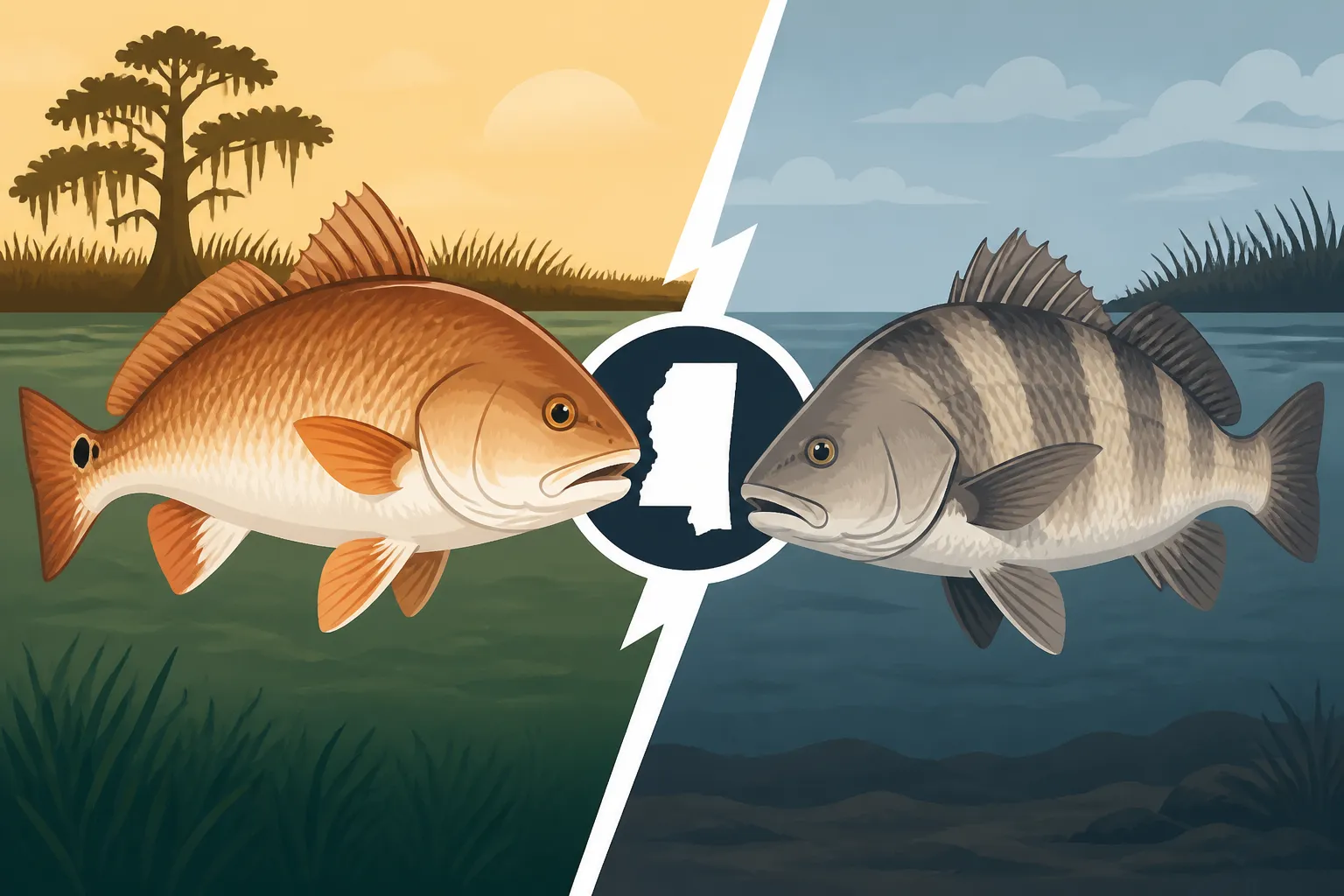
The most defining feature of a redfish (or red drum) is right there in the name: their coppery-red to bronze coloration. This color can vary quite a bit depending on their habitat and diet. Fish caught in clear, shallow grass flats might be lighter and brighter, almost a rosy bronze, while those from deeper, muddier waters can be a darker, almost brick-red hue. It's a gorgeous fish, no matter the shade.
Their body shape is streamlined and elongated, with a somewhat rounded, robust middle section that tapers nicely towards the tail. They have a fairly large head with a slightly sloped profile from the forehead down to the mouth. One of the absolute dead giveaways, the "Aha!" moment for identification, is the distinctive black spot (or spots) on their tail. Almost every redfish will have at least one prominent black spot, usually on the upper part of the tail fin, right near the base. Sometimes they have several, and very rarely, you might even catch one without any spots, but that's an exception, not the rule. These spots are thought to mimic eyes, potentially confusing predators.
Think about it like this: if you've got a coppery-red fish with a prominent black dot on its tail, you're almost certainly looking at a redfish. You can find excellent visual guides on resources like Amazon, often bundled with fishing gear or in waterproof fish identification cards, which can be super helpful when you're out on the water trying to confirm your catch. For more specific insights on where to find these beauties, check out Redfish Fishing on the Mississippi Coast.
Mouth, Scales, and Fin Details
Now let's dive into the finer points. A redfish's mouth is terminal or slightly subterminal, meaning it's located at the very front of the head or just slightly below it. It's angled somewhat downward, but still very much forward-facing, perfect for snatching up shrimp, crabs, and baitfish that are swimming or scurrying along the bottom or through the water column. The lips are relatively thick.
Their scales are large, rough, and feel very substantial to the touch. You'll notice this immediately if you run your hand against the grain. The fins are well-developed and sturdy. The dorsal fin is typically spiny in the front section, transitioning to a softer rayed section further back. The tail fin (caudal fin) is typically broad and powerful, which gives them that incredible burst of speed when they hit a lure or try to make a run.
When you hold a redfish, you'll feel its power and robustness. Young redfish, often called "puppy drums" (confusingly, as black drum also have "puppy drum" stages), are a fantastic fighting fish on light tackle. Larger redfish are absolute brutes. Knowing these characteristics helps you not only identify them but also appreciate their unique adaptations. Our guide on Redfish Size on the Mississippi Coast can give you an idea of what to expect when you hook into one of these impressive fish.
Black Drum Breakdown: What Sets Them Apart
Now, let's turn our attention to the black drum. While they share some family resemblance with redfish, they have several distinct features that, once you know them, make identification much easier. You’ll quickly learn to tell the difference, especially when you’re looking at your catch side-by-side with a picture on your phone or in a guidebook.
Distinctive Body Features and Pigmentation
The black drum typically has a deeper, more rounded, and somewhat humpbacked body compared to the more elongated redfish. This "hump" is particularly noticeable in larger specimens, giving them a more robust and less streamlined appearance. While their name suggests they are black, their coloration can actually vary quite a bit. They are often dark gray or silvery-gray, sometimes with a bronze or brassy sheen, and can even appear almost black, especially when pulled from deeper, muddier waters. What's really interesting is that juvenile black drum often have distinct vertical black bars or stripes on their sides, which fade as they mature. This is a crucial detail, as these juvenile black drum are sometimes confused with Speckled Trout Fishing on the Mississippi Coast by newcomers, or even with juvenile redfish if the redfish's spot isn't immediately obvious.
Another tell-tale sign that you’ve got a black drum is the presence of several whisker-like barbels under their chin. These aren’t just for show; they’re highly sensitive organs that the fish uses to feel and taste for food items buried in the sand or mud. Redfish do not have these prominent barbels. If you see whiskers, it's a black drum. Period.
Their overall appearance is more rugged, almost prehistoric, compared to the sleek look of a redfish. They are built for grubbing along the bottom, not for chasing down fast-moving prey in open water. Even a quick search on Amazon for fish identification charts will show you clear diagrams highlighting these barbels, making it easier to confirm your identification on the boat or dock.
Mouth Structure, Scales, and Unique Barbels
The mouth of a black drum is distinctly inferior, meaning it points downwards and is located entirely on the underside of the head. This is perfectly adapted for their bottom-feeding lifestyle, allowing them to suck up shellfish, crabs, and worms from the substrate. They have powerful, crushing plates in their throats that can easily pulverize oyster shells, which is why you often find them hanging around oyster reefs.
Their scales are generally smaller and less prominent than those of a redfish, and while still coarse, they don't have the same rough feel. The fins are similar in structure to redfish, with spiny and soft-rayed dorsal sections, but the overall impression is one of bulk and strength rather than speed.
But truly, the most undeniable characteristic, besides the body shape, is those chin barbels. There are usually multiple pairs of these fleshy filaments, and they are quite noticeable. You can't miss them once you know what to look for. And as for their "drum" name? These fish can actually produce a distinct drumming or croaking sound by vibrating muscles against their swim bladder. This sound is often heard during spawning season and can be quite loud when you’re out on the water. It’s a unique characteristic that further sets them apart from redfish, which do not produce such sounds.
Side-by-Side Comparison: A Quick Reference Guide
Sometimes, the best way to grasp the differences is to see them laid out side-by-side. Imagine you’ve caught two fish, and you're holding them up, scrutinizing every detail. This section will help you quickly compare the defining characteristics of redfish and black drum, so you can make an accurate identification every time.
Visual Cues at a Glance
Let's break down the most important visual identifiers into a simple, easy-to-read table. This is the kind of information that’s invaluable to have memorized or printed out when you’re out on the water.
| Feature | Redfish (Red Drum) | Black Drum |
|---|---|---|
| Coloration | Coppery-red to bronze; lighter in clear water | Silvery-gray to dark gray/black; sometimes brassy |
| Body Shape | Elongated, streamlined, robust | Deeper body, often humpbacked, more rounded |
| Tail Spots | One or more prominent black spots on the tail base | Generally no distinct black spots on the tail (juveniles may have vertical bars) |
| Mouth | Terminal or slightly subterminal; forward-facing | Inferior (downward-pointing); on the underside of head |
| Barbels | Absent (no whiskers) | Present (multiple whisker-like barbels on chin) |
| Scales | Large, rough | Smaller, less prominent |
| Juvenile Markings | Black spots develop early | Distinct vertical black bars, fade with age |
| Sound | Generally silent | Can make a drumming/croaking sound |
This table is your quick cheat sheet. If you're debating between the two, just run through this list. The presence of barbels, the mouth position, and the tail spot(s) are often the quickest ways to distinguish them. Consider purchasing a laminated fish identification card from a reputable outdoor retailer or even Amazon; these often feature similar comparison tables and clear photos that are perfect for quick reference on your boat or pier.
Behavioral Differences and Habitat Preferences
While both species are often found in similar saltwater environments along the Mississippi Gulf Coast, their primary feeding methods lead them to slightly different niches within those habitats. Understanding these tendencies can also give you a clue about what you might have hooked.
Redfish are active predators. They love to cruise shallow flats, estuaries, and bayous, especially those with oyster reefs, submerged grass beds, and marshy shorelines. They’ll often be found near structure like docks, jetties, or fallen trees, ambushing bait. You might see their tails "tailing" out of the water as they root for crabs in super-shallow water. They're opportunistic feeders and will strike a variety of baits, both live and artificial. Anglers often target them by casting spoons, soft plastics, or topwater lures, as well as live shrimp or mullet. Best Bait for Redfish provides more details on what tempts them.
Black drum, on the other hand, are primarily scavengers and bottom feeders. They tend to congregate in deeper channels, around bridges, pilings, and especially over oyster beds, using those barbels to forage. They’re less likely to be found tailing in super shallow water and more likely to be found on the bottom, often in schools, methodically working an area for buried crustaceans and mollusks. They typically prefer natural baits presented on the bottom, such as shrimp, pieces of blue crab, or cut bait. While they can be caught on artificials, it's far less common than with redfish, as their mouth and feeding style aren't geared for chasing and striking lures in the same way. When you hook a black drum, you often feel a heavy, steady pull, as they aren't as prone to the same explosive runs as a redfish.
Both species are important to the ecosystem and the angling community. By understanding their unique characteristics and habits, you can become a more effective and responsible fisherman. Whether you're chasing the bronze flash of a redfish or the stubborn pull of a black drum, knowing exactly what's on the end of your line adds to the satisfaction of the catch. For general information on species in the area, check out the Mississippi Saltwater Fish Species Guide.
Practice Makes Perfect: Learning in the Field
Identifying fish quickly and accurately is a skill, and like any skill, it improves with practice. The more you're out on the water, observing, catching, and scrutinizing your catches, the better you'll become. Don't get discouraged if you're not an expert overnight – even seasoned anglers sometimes have to double-check.
Tips for On-the-Water Identification
The best place to learn is in their natural habitat. Here are some practical tips to hone your identification skills while fishing:
- Carry a Reference Guide: This might sound obvious, but having a waterproof, laminated fish identification card or a reliable app on your phone (downloaded for offline use, just in case!) is incredibly helpful. You can find these readily available on Amazon or at local tackle shops. Being able to compare your catch to a clear photo and description in real-time is the best way to confirm.
- Observe Closely, Don't Rush: When you land a fish, take a moment before you unhook it (especially if you plan to release it). Look at all the features we've discussed: the body shape, the color, the mouth, the presence or absence of barbels, and those critical tail spots. Turn the fish over if you need to inspect the mouth.
- Take Photos: A good, clear photo of your catch can be invaluable. Not only does it serve as a great memory, but if you're unsure, you can review it later or even ask a more experienced angler for their opinion. Make sure to get different angles, especially of the head, mouth, and tail.
- Learn from Others: Don't be afraid to ask questions. If you're fishing with a buddy who's more experienced, ask them to point out the key differences when you catch either species. Observing how they handle and identify fish can teach you a lot. Even talking to staff at local bait and tackle shops can provide valuable insights; they see these fish all the time.
- Focus on Key Distinctions: When you're learning, don't try to remember every single detail at once. Focus on the most obvious differences: the barbels, the mouth position, and the tail spots. Once you master those, the other details will fall into place.
Being prepared with knowledge and tools, such as the right fishing license (check out Mississippi Fishing License Guide for details) and the ability to distinguish your catch, makes for a much more confident and enjoyable fishing trip.
What to Do If You're Still Unsure
Let's face it, sometimes despite your best efforts, you might still be genuinely unsure about a fish's identity, especially if it's a juvenile or has unusual markings. In these situations, it's always best to err on the side of caution.
- Release the Fish: If you can't confidently identify a fish and are unsure of its legal status (size, creel limit), the safest and most responsible action is to gently release it. It's far better to let a fish go than to risk a fine or contribute to overharvesting. This is particularly important for species with complex regulations, such as Mississippi Redfish and Speckled Trout Limits.
- Consult Regulations: Have a copy of the current Mississippi fishing regulations easily accessible. This could be a physical pamphlet, a PDF on your phone, or a dedicated app. If you have time and a clear signal, you can often find state regulations online. These regulations will clearly list the size and creel limits for both redfish and black drum, as well as any other specific rules. Check for guides like Mississippi Fishing Season Dates and Limits for general information.
- Ask an Expert: If you're at a public pier or boat ramp, there might be other anglers around who can help. Often, folks are happy to share their knowledge. Just remember to be polite and respect their space.
- Use a Fish ID App: Many mobile apps are designed specifically for fish identification. Some even use image recognition technology. While not always perfect, they can be a useful tool when you're stumped. Again, make sure to consider apps that work offline, as cell service isn't always reliable out on the water.
The goal isn't just to catch fish, but to fish responsibly and enjoy the incredible marine resources Mississippi has to offer. Understanding the nuances between species like redfish and black drum is a big part of that responsibility and will undoubtedly enhance your angling adventures.
Disclaimer
This article is for general informational purposes only and does not constitute professional advice. Laws, prices and regulations vary by location and change over time. Consult a qualified professional for guidance on your specific situation.