How to Identify a Spotted Bass
Have you ever reeled in a beautiful bass from a Mississippi lake, admired its fight, and then paused, wondering if it was a largemouth, a smallmouth, or something else entirely? Many anglers, from seasoned veterans to excited beginners, grapple with telling the difference between black bass species, especially the often-confused spotted bass. This guide is here to untangle that confusion, providing you with clear, practical identification tips so you can confidently know exactly what you’ve caught, helping you adhere to regulations and enhance your fishing knowledge.
Why Spotted Bass Identification Matters for Mississippi Anglers
Knowing your bass species isn't just about showing off your expertise; it's genuinely crucial for several reasons when you're out fishing the abundant waters of Mississippi. Mistakes can lead to issues, while accuracy can greatly improve your success and enjoyment.
Understanding Regulations and Creel Limits
One of the most immediate and impactful reasons to identify your catch correctly is to stay on the right side of the law. Mississippi has specific regulations for different bass species. For instance, Mississippi Black Bass Regulations might outline varying daily creel limits or size restrictions for largemouth bass compared to spotted bass. You don't want to accidentally keep a bass that's undersized for its species or exceed the limit, only to find yourself facing a conversation with a game warden. These rules are put in place to ensure healthy fish populations, and as responsible anglers, it's our job to respect them. Imagine heading home with what you think are five legal largemouth, only to find out you've got a couple of spotted bass mixed in, and the limit for those was different. That kind of mix-up is exactly what we want to avoid.
Conservation and Sustainable Fishing
Beyond the legalities, accurate identification plays a vital role in conservation efforts. Different bass species thrive in different habitats and react differently to fishing pressure. By knowing what you're catching, you contribute to better data for wildlife agencies like the Mississippi Department of Wildlife, Fisheries, and Parks (MDWFP). This data helps them make informed decisions about stocking, habitat management, and regulation adjustments. When you accurately report your catches, or simply release what needs to be released because you know its species, you're directly participating in the stewardship of Mississippi's fisheries. This ensures that future generations can enjoy the same fantastic fishing opportunities we have today.
Improving Your Fishing Strategy
Believe it or not, knowing the difference between a spotted bass and a largemouth can actually make you a better angler. Each species has its own preferred habitats, feeding behaviors, and even fighting styles. Spotted bass, for example, often prefer deeper, clearer waters and rocky structures more akin to smallmouth bass, whereas largemouth might be tucked tight into dense cover like lily pads or submerged timber. If you're consistently catching one species over another, understanding its identity allows you to refine your lure selection, presentation, and even your approach to a particular body of water. Perhaps you need to switch from a Texas-rigged worm in heavy cover to a drop shot rig on offshore humps if you're targeting spotted bass specifically. Understanding these nuances, often found in specialized guides available on platforms like Amazon, can really elevate your game.
Key Features to Look for: Dissecting the Spotted Bass
Alright, let's get down to brass tacks. How do you tell a spotted bass apart from its more famous relatives? It often comes down to a few key, distinct features that, once you know them, become surprisingly easy to spot.
The Jawline Test: A Classic Identifier
This is often the first and easiest test, and it's a classic for a reason. Grab that bass gently but firmly, and look at its mouth. For a spotted bass, when its mouth is closed, the upper jaw (or maxillary bone) does not extend past the back of its eye. It will typically end directly under the middle or back of the eye, but crucially, not beyond it.
Compare this to a largemouth bass, where the jawline distinctly extends past the rear edge of the eye, sometimes significantly so. If you're in doubt, gently hold the fish and visually mark where the back of the eye is and where the jaw ends. This single characteristic will eliminate a lot of guesswork right off the bat. It's a quick field check that almost always works.
The Tongue Patch: A Definitive Clue
This is perhaps the most definitive way to identify a spotted bass, and it's something many anglers overlook. Gently open the bass's mouth and look at its tongue. A spotted bass will almost always have a small, rough patch of teeth on its tongue, often called a "tooth patch." It feels like sandpaper.
Neither a largemouth nor a smallmouth bass will have this patch of teeth on their tongue. If you find one, you've got a spotted bass. This feature is so reliable that if you're ever truly unsure after the jawline test, this is your tie-breaker. You can lightly run your finger across the tongue (carefully, of course!) to feel for the roughness. This unique characteristic is a biological hallmark for the species.
Body Markings and Coloration: More Subtle Cues
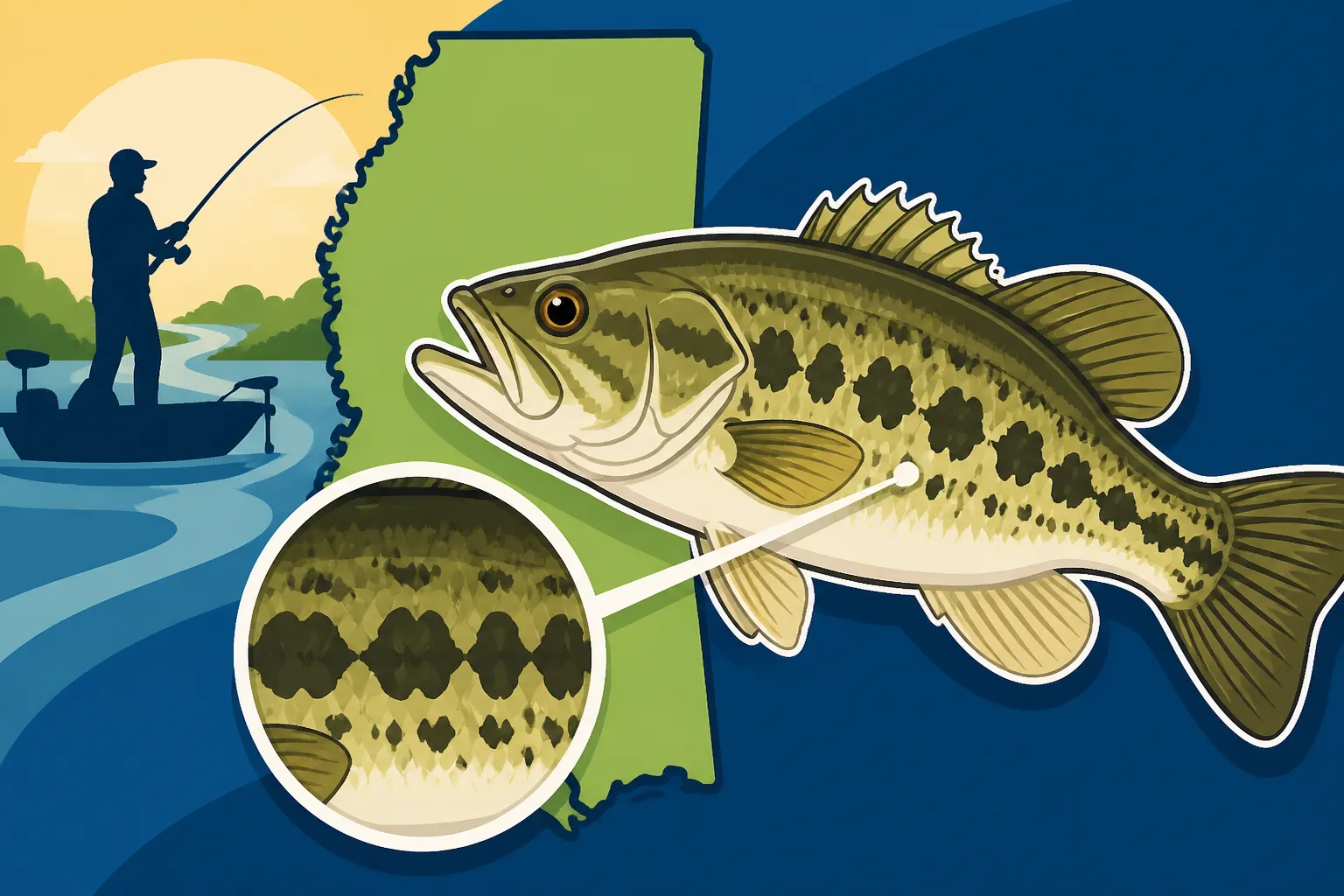
While not as definitive as the jawline or tongue patch, body markings and coloration can offer supporting evidence. Spotted bass typically have a noticeable pattern of small, dark spots arranged in rows below their prominent lateral line. These spots are usually more pronounced than the splotchy, irregular blotches you might see on a largemouth.
Their overall body color can vary depending on water clarity and habitat, ranging from greenish-brown to olive. However, they generally lack the distinct horizontal band that's often prominent on largemouth bass, especially younger ones. Instead, you'll see those clear, distinct rows of spots. Think of it like comparing a leopard's spots to a tiger's stripes – one has clear, individual dots, the other has more merged, irregular patterns.
The Scales on the Cheek: A Hidden Detail
Here's a more nuanced detail that can help, especially when you're looking at your Bass Identification Guide for Mississippi Anglers. Gently feel the scales on the cheek of the bass, located behind its eye and below its gill plate. On a spotted bass, the scales in this area will feel rough, much like the scales on the rest of its body.
For a largemouth bass, these scales tend to be noticeably smaller and smoother to the touch, often appearing almost absent in comparison. This isn't a "first line of defense" identification method, but when combined with the jawline and tongue patch, it can provide an extra layer of confirmation. It's the kind of detail that experienced anglers pick up on over time, and it becomes a useful addition to your identification toolkit.
Comparing Spotted Bass to Its Cousins: Largemouth and Smallmouth
Since spotted bass often share waters and can be confused with other popular black bass species, a direct comparison is incredibly helpful. Let's break down the key differentiators between them. Understanding these subtle differences is key to not only identifying your catch but also understanding its behavior and where to find more of its kind.
Spotted Bass vs. Largemouth Bass: The Most Common Confusion
This is where most of the mix-ups happen. You're reeling in a solid fish, it fights hard, and your first thought is usually "largemouth!" But often, especially in certain Mississippi lakes, it could be a spotted bass.
The primary difference, as we discussed, is the jawline. A largemouth's jaw extends past the back of its eye, while the spotted bass's jaw ends at or before the back of the eye. This is hands down the most reliable visual cue. Next, remember the tongue patch: spotted bass have it, largemouth bass do not.
In terms of appearance, largemouth often have a distinct, often broken, dark horizontal stripe or series of blotches along their sides. Spotted bass, as their name suggests, have those distinct rows of small black spots below their lateral line, rather than a solid stripe. The body shape can also be a subtle hint; largemouth tend to be a bit more "chunky" or football-shaped, especially when mature, while spotted bass can sometimes appear a bit more streamlined. If you’re ever curious about Largemouth Bass Fishing in Mississippi, knowing these distinctions is your first step.
Here's a quick comparison table:
| Feature | Spotted Bass | Largemouth Bass | Smallmouth Bass |
|---|---|---|---|
| Jawline | Ends at or before the back of the eye. | Extends distinctly past the back of the eye. | Ends at or before the back of the eye. |
| Tongue | Has a rough patch of teeth (tooth patch). | Smooth, no tooth patch. | Smooth, no tooth patch. |
| Body Markings | Rows of small, dark spots below lateral line. | Prominent, often broken, horizontal dark stripe/blotches. | Vertical bars or tiger stripes; generally mottled. |
| Cheek Scales | Large and rough to the touch. | Smaller and smoother to the touch. | Large and rough, similar to body scales. |
| Coloration | Greenish-brown to olive, distinct spots. | Dark green to lighter green, often camouflaged. | Brown to bronze, darker vertical bars. |
| Body Shape | Streamlined, often torpedo-shaped. | Robust, more "football" shaped. | Streamlined, very muscular. |
| Habitat | Clearer, rocky streams, deep reservoirs. | Heavy cover, weeds, timber, shallow water. | Clear, cool rocky rivers & deep lakes. |
Spotted Bass vs. Smallmouth Bass: Less Common, Still Important
While you're less likely to confuse a spotted bass with a smallmouth in many parts of Mississippi, especially given the differing typical habitats, it's still good to know the distinctions, particularly if you're fishing waters that bridge those environments.
Both spotted bass and smallmouth bass share the characteristic of having a jawline that does not extend past the back of the eye. This is where the tongue patch becomes your absolute hero: smallmouth bass do not have a tooth patch on their tongue, unlike the spotted bass.
Visually, smallmouth bass tend to be bronze, brown, or golden-brown in color, often with distinct vertical bars or "tiger stripes" on their sides, rather than the spotted bass's horizontal rows of spots. Their eyes are also often redder. Smallmouths also prefer colder, clearer, often current-driven waters like rocky rivers and deep, clear lakes, which is a bit different from the spotted bass's broader habitat preferences. You can delve into more detail on Largemouth Bass vs Smallmouth Bass Differences for an even deeper dive into these comparisons.
Habitat and Behavior Clues for Spotted Bass
Beyond their physical appearance, understanding where spotted bass like to hang out and how they behave can give you powerful clues for identification, and more importantly, for catching them.
Preferred Waters in Mississippi: Where to Find Them
Spotted bass, often called "spots" by local anglers, are incredibly adaptable, but they do have preferences. In Mississippi, you'll often find them thriving in large reservoirs and rivers with clear to moderately stained water. They show a particular fondness for areas with rocky bottoms, gravel points, submerged humps, and standing timber. Unlike largemouth that might hug dense weed beds, spotted bass are more comfortable in open water near structure, often suspending over deeper points or schooling along channel swings.
Lakes like Ross Barnett Reservoir, Grenada Lake, and Sardis Lake all have good populations of spotted bass, though their presence might be overshadowed by the more numerous largemouth in some areas. They also do well in the larger river systems. If you're fishing a clear, deep lake and hitting rocky ledges or deep brush piles, and you're catching bass that fight a little differently, it’s highly probable you've found a school of spots. They often feed on smaller baitfish and crawfish, so understanding their diet can also help with lure selection. Getting a detailed topographic map, perhaps an Amazon purchase, can highlight these prime structural elements where spots often congregate.
Unique Fighting Style: How They Behave on the Line
This might sound a bit subjective, but experienced anglers will tell you that spotted bass have a distinct way of fighting compared to largemouth. When you hook a spotted bass, especially a decent-sized one, expect a strong, determined fight. They tend to make long, powerful runs and will often stay deep, trying to pull away from you with head shakes and bulldogging maneuvers. They don't typically jump as much as a largemouth, but their endurance and power are impressive for their size.
A largemouth, while also a strong fighter, is much more prone to acrobatic jumps and thrashing on the surface. They’ll often try to throw the hook with violent head shakes. A smallmouth, on the other hand, is known for its incredibly hard, short, and powerful runs, often fighting like a fish twice its size. If you've just brought a bass to the boat that felt like it was trying to dig to China the whole way, staying deep and pulling hard, it very well might be a spotted bass. Learning the tell-tale fighting patterns can give you an educated guess before you even get the fish in hand. If you're looking to target them more, understanding Bass Fishing Techniques for Mississippi Anglers can give you an edge.
It's clear that correctly identifying the spotted bass in Mississippi's waters is more than just a trivial detail; it's a fundamental aspect of responsible and successful angling. By paying close attention to key features like the jawline, the presence of a tooth patch on the tongue, and specific body markings, you can confidently distinguish them from largemouth and smallmouth bass. This knowledge not only helps you adhere to How Many Bass Can You Keep in Mississippi? and other regulations but also empowers you to refine your fishing techniques and contribute to the conservation of our cherished fisheries. So, the next time you're out on a beautiful Mississippi lake, and you feel that familiar tug on your line, you’ll be ready to identify your catch with precision and pride, perhaps even with a new field guide bought from Amazon to confirm.
Disclaimer
This article is for general informational purposes only and does not constitute professional advice. Laws, prices and regulations vary by location and change over time. Consult a qualified professional for guidance on your specific situation.