Fishing Rules on the Mississippi-Alabama State Line
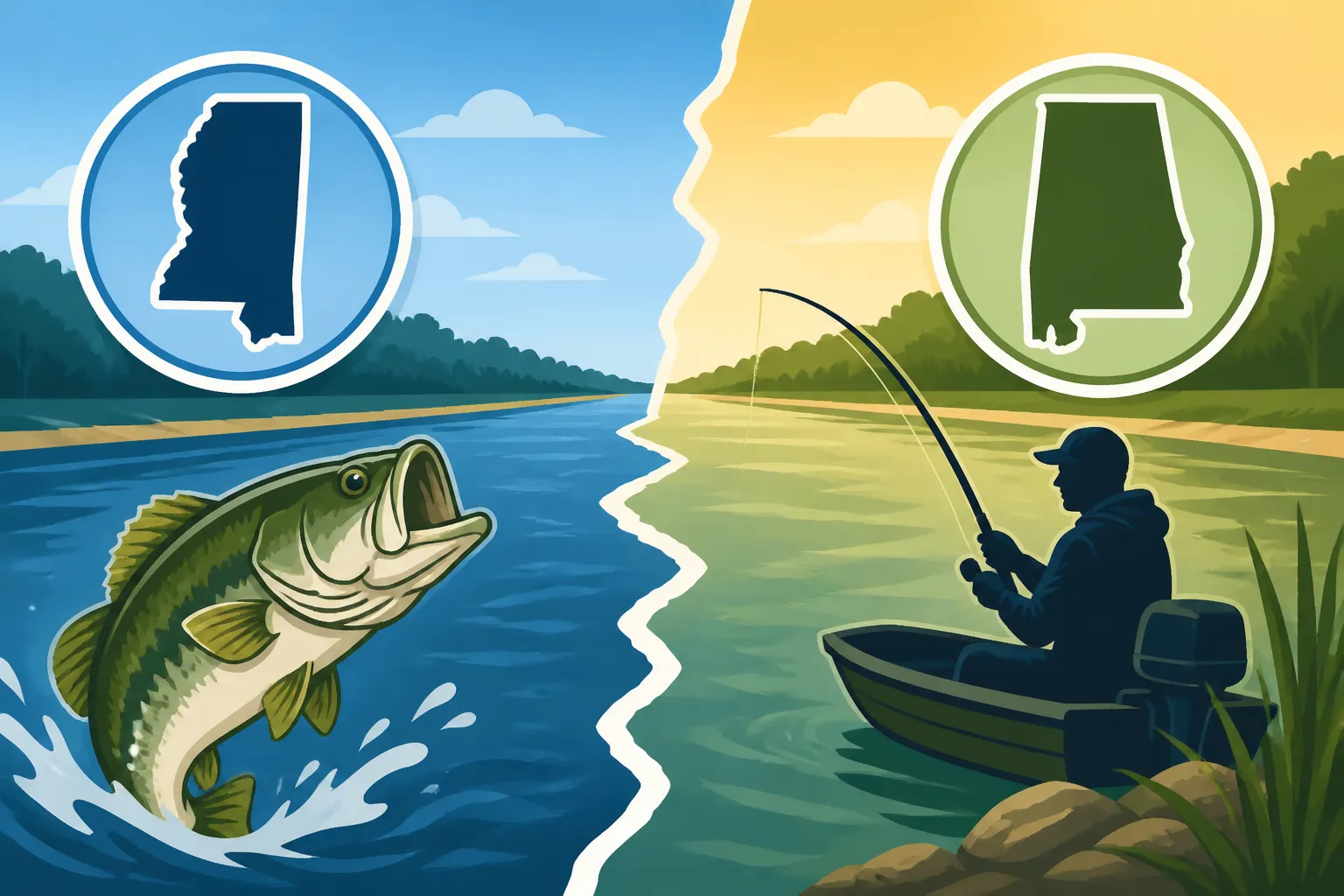
It can be incredibly frustrating trying to figure out which fishing rules apply when you’re casting a line right on the edge of two different states. One minute you're thinking you're legal, the next you're wondering if you just crossed an invisible line and are now technically breaking the law in another state! This guide is here to untangle the complexities of fishing regulations along the Mississippi-Alabama state line, helping you understand exactly what you need to know to enjoy your time on the water without worry.
Navigating the Nuances of Border Water Agreements
Fishing the border between Mississippi and Alabama might seem like a regulatory minefield, but it's often more straightforward than you'd expect, thanks to agreements between state wildlife agencies. However, the biggest mistake anglers make is assuming a blanket rule applies everywhere. It's crucial to understand that these agreements are specific and usually apply only to designated shared waters, not the entirety of each state's waters. This is where many folks get tripped up, thinking their Mississippi license covers them deep into an Alabama bayou that isn't considered "shared."
Understanding Reciprocal Licensing for Shared Waters
The good news for anglers who enjoy the productive waters where Mississippi meets Alabama is that there are often reciprocal agreements in place regarding fishing licenses. For instance, if you're a resident of Mississippi and hold a valid Mississippi fishing license, you are generally allowed to fish in the shared marine and estuarine waters that form the common boundary between the two states, and vice versa for Alabama residents. This means you don't necessarily need two resident licenses if you're sticking to the defined shared zones. It's a lifesaver for folks who live near the border and frequently cross over for their fishing adventures.
However, and this is a big "however," this reciprocity typically only applies if you are a resident of one of those two states. If you're a nonresident visiting from, say, Louisiana or Florida, you'll still need a nonresident license. And here's the kicker: a nonresident license from either Mississippi or Alabama usually grants you permission to fish the shared border waters. So, if you bought a Mississippi Nonresident Fishing License Guide and already have that in hand, you should be good to go in the shared parts of the Mississippi-Alabama border. It simplifies things for tourists who might only be in the region for a short trip, but always double-check the latest regulations as these agreements can sometimes be tweaked.
Defining the Mississippi-Alabama Border Waters
When we talk about "border waters," we're primarily looking at the Mississippi Sound, the various bayous, and lower river systems that flow into it along the shared boundary. This includes areas around Grand Bay, the mouth of the Pascagoula River, and the Escatawpa River where it forms part of the state line. It’s not just an arbitrary line on a map; specific geographical areas are designated as shared. These are typically tidal waters where fish species, particularly popular saltwater species like redfish and speckled trout, move freely between state jurisdictions.
It’s vital to remember that these reciprocal agreements do not mean your Mississippi license is valid in every creek, lake, or pond within Alabama, nor is an Alabama license valid in every piece of water in Mississippi. If you venture beyond the expressly defined shared waters and into clearly delineated "state-specific" territory, you absolutely need that state's license. Always carry a reliable map, or even better, a GPS-enabled marine chart that clearly shows the state line. Many anglers find maps and waterproof charts useful, and you can often find excellent options on Amazon to help you visualize these boundaries. For a full rundown on what you need, check out the Mississippi Saltwater Fishing License Guide if you plan to hit the Gulf Coast.
Key Differences in Regulations Beyond Licensing
While reciprocal licensing for shared waters offers convenience, it's a common misconception that all other fishing rules magically align. That's simply not true! Each state maintains its own set of detailed regulations regarding creel limits, size limits, fishing seasons, and even permissible gear. This is where anglers can really run into trouble if they aren't diligent. Imagine catching a limit of speckled trout that's perfectly legal by Mississippi standards, only to find out you're over the limit or they're undersized by Alabama's rules if you were technically in their waters.
Creel and Size Limits for Popular Species
This is arguably the most critical area where Mississippi and Alabama regulations can diverge, even within shared waters. For instance, while you might be fishing for redfish and speckled trout in the Mississippi Sound, the daily bag limit or the minimum size for keeping those fish might be different depending on which state's jurisdiction applies to the specific spot you're fishing. It's not uncommon for states to adjust these limits based on their own stock assessments and conservation goals.
Let's take a hypothetical scenario: You're drift fishing in Grand Bay, catching some beautiful speckled trout. You have a valid Mississippi license. The Mississippi limit might be 15 fish per person with a 14-inch minimum length. But if, for some reason, the state line cuts right through your drift and you catch a few fish on the "Alabama side" where the limit is 10 fish and a 16-inch minimum, those fish could be considered illegal in Alabama even with your reciprocal license. It sounds nitpicky, but enforcement officers on either side are just doing their jobs. Always be aware of the more restrictive rule when fishing border areas, or better yet, make sure you know exactly which state's rules apply to your immediate location. For more details on species limits, consider reading about Mississippi Redfish and Speckled Trout Limits.
| Species (Common in MS-AL Border Waters) | Mississippi Regulations (Example) | Alabama Regulations (Example) | Notes |
|---|---|---|---|
| Speckled Trout | 15 fish/person; 14" minimum | 10 fish/person; 15" minimum | Use the more restrictive rule if unsure of exact location. |
| Redfish | 5 fish/person; 18"-30" slot | 3 fish/person; 16"-26" slot | Slots can vary by region/zone within each state. |
| Flounder | 10 fish/person; 12" minimum | 5 fish/person; 14" minimum | Check seasonal closures for flounder gigging. |
| Red Snapper (Federal Waters) | Federal limits apply, state often mirrors for state waters | Federal limits apply, state often mirrors for state waters | Highly variable season; check both states' specific announcements. |
| King Mackerel | 2 fish/person; 24" fork length | 3 fish/person; 24" fork length | Federal limits often supersede state for migratory species. |
Disclaimer: The above table provides hypothetical examples of regulations for illustrative purposes only. Always consult the official Mississippi Department of Wildlife, Fisheries, and Parks (MDWFP) and Alabama Department of Conservation and Natural Resources (ADCNR) for the most current and accurate regulations before fishing.
Fishing Seasons and Gear Restrictions
Beyond the daily limits, fishing seasons can also vary. While many popular species are open year-round, certain species might have specific closed seasons or restrictions during spawning periods that differ between the two states. For example, specific areas might have seasonal closures for certain types of gear or even for particular species like red snapper, which often has a very short, highly regulated season in federal waters, but states also set their own rules for state waters. It's a complex dance.
Furthermore, gear restrictions are another area of divergence. Some states might have stricter rules on the number of rods you can use, the type of hooks, or the use of certain bait. While generally similar for recreational rod-and-reel fishing, if you engage in more specialized techniques like trotlining, jug fishing, or even bowfishing, you absolutely must consult both states' regulations for the specific border area. Imagine getting cited for using an illegal bait type or having too many lines in the water just because you assumed one state's rules applied everywhere. It's a quick way to turn a relaxing day into a costly headache. It’s always a good idea to consult the Mississippi Fishing Season Dates and Limits to avoid any surprises.
What Happens If You Don't Follow Border Rules
Ignoring or misunderstanding the fishing rules along the Mississippi-Alabama state line isn't just a minor oversight; it can lead to some pretty significant consequences. Enforcement officers from either state have jurisdiction in these shared waters, and they are well within their rights to issue citations, levy fines, and even confiscate gear or catches if you're found to be in violation. Nobody wants their relaxing day on the water to end with a hefty fine or a court appearance, especially if it could have been easily avoided.
Penalties for License Violations
The most common infraction in border waters is often a license violation. This could be anything from not having a license at all to having an expired one, or mistakenly believing your license from a non-border state covers you. If you're caught fishing without a proper license, or without the correct reciprocal understanding, you could face fines that range from a couple hundred dollars to much more, depending on the severity and whether it's a repeat offense. This includes cases where you might have a Mississippi license but are clearly fishing in non-reciprocal Alabama waters without their state's license.
In addition to monetary fines, there could be administrative penalties such as points on your fishing record, or in some extreme cases, suspension of your fishing privileges. Enforcement officers are trained to identify these situations and will not hesitate to act. It's far cheaper and less stressful to simply buy the correct license upfront than to deal with the fallout of a violation. If you're a nonresident and plan to fish beyond the shared waters into specific Mississippi territory, getting a Mississippi Nonresident Annual Fishing License Cost might be a good idea.
Fines for Creel and Size Limit Violations
Another common issue arises from differing creel and size limits. If you're found with more fish than allowed (over the creel limit) or fish that are smaller than the legal minimum size (undersized), you can expect significant fines. These fines are often assessed per fish in violation, meaning that if you have several undersized redfish or too many speckled trout, the costs can add up very quickly. In some cases, officers might also confiscate your entire catch for the day.
For example, if the Alabama limit for flounder is 5 fish and 14 inches, but you have 7 flounder, 3 of which are 13 inches, caught in Alabama waters, you could be cited for both being over the limit and possessing undersized fish. This isn't just a slap on the wrist; these violations are taken seriously to protect fish populations and ensure sustainable fishing for everyone. Always err on the side of caution, and if you're unsure, it's better to release a questionable fish than to risk a fine. Understanding Mississippi Fishing License Penalties and Fines can help you grasp the potential repercussions.
Essential Gear and Planning for Border Fishing Success
Fishing across state lines, even with reciprocal agreements, demands a bit more preparation than just heading to your local spot. To truly enjoy your time on the water and avoid any legal hassles, a thoughtful approach to gear and trip planning is absolutely essential. It’s not just about what lures to throw, but how you’ll navigate the rules and stay safe.
Equipping Your Boat with Navigational Aids
If you’re fishing from a boat in the Mississippi Sound or other border waters, reliable navigational equipment is your best friend. A modern GPS unit, especially one with detailed marine charts, can clearly show you where the state lines lie. This is invaluable for avoiding accidental incursions into non-reciprocal waters or areas with stricter regulations. Many anglers install marine electronics from brands like Garmin or Humminbird, which often have highly detailed mapping capabilities. Ensure your charts are updated, as subtle boundary definitions can sometimes be clarified or adjusted.
Beyond GPS, always have a physical backup map, ideally a waterproof one. Electronics can fail, and having a paper chart can literally save your trip, both from a navigational and a regulatory standpoint. You can find excellent marine charts on Amazon that cover the Mississippi-Alabama coastal areas. These charts not only show depths and navigation markers but often delineate state boundaries, making it easier to stay on the right side of the law. Also, remember to comply with Mississippi Boat Fishing Regulations for general safety and equipment requirements.
Pre-Trip Planning and Research
Before you even launch your boat or head to the bank, dedicate some time to thorough research. Start by visiting the official websites for both the Mississippi Department of Wildlife, Fisheries, and Parks (MDWFP) and the Alabama Department of Conservation and Natural Resources (ADCNR). Look specifically for sections on inter-state agreements or border water regulations. These sites are the authoritative sources for the most up-to-date information.
Print out or save screenshots of the relevant regulations, especially those pertaining to license reciprocity, creel limits, and size limits for the species you plan to target. Keep these readily accessible, perhaps in a waterproof bag, along with your physical fishing license and photo ID. A little preparation goes a long way. Sometimes, even making a quick call to the enforcement divisions of both agencies to confirm specific details can be incredibly helpful. This due diligence ensures that when you're out on the water, your focus can be entirely on the fish, not on legal worries.
Disclaimer
The information provided in this guide is for general informational purposes only and is not intended as legal advice. Fishing regulations in Mississippi and Alabama are subject to change, and it is the angler's sole responsibility to consult the most current official regulations published by the Mississippi Department of Wildlife, Fisheries, and Parks (MDWFP) and the Alabama Department of Conservation and Natural Resources (ADCNR) before fishing.