Can I Use My Mississippi License to Fish in Louisiana?
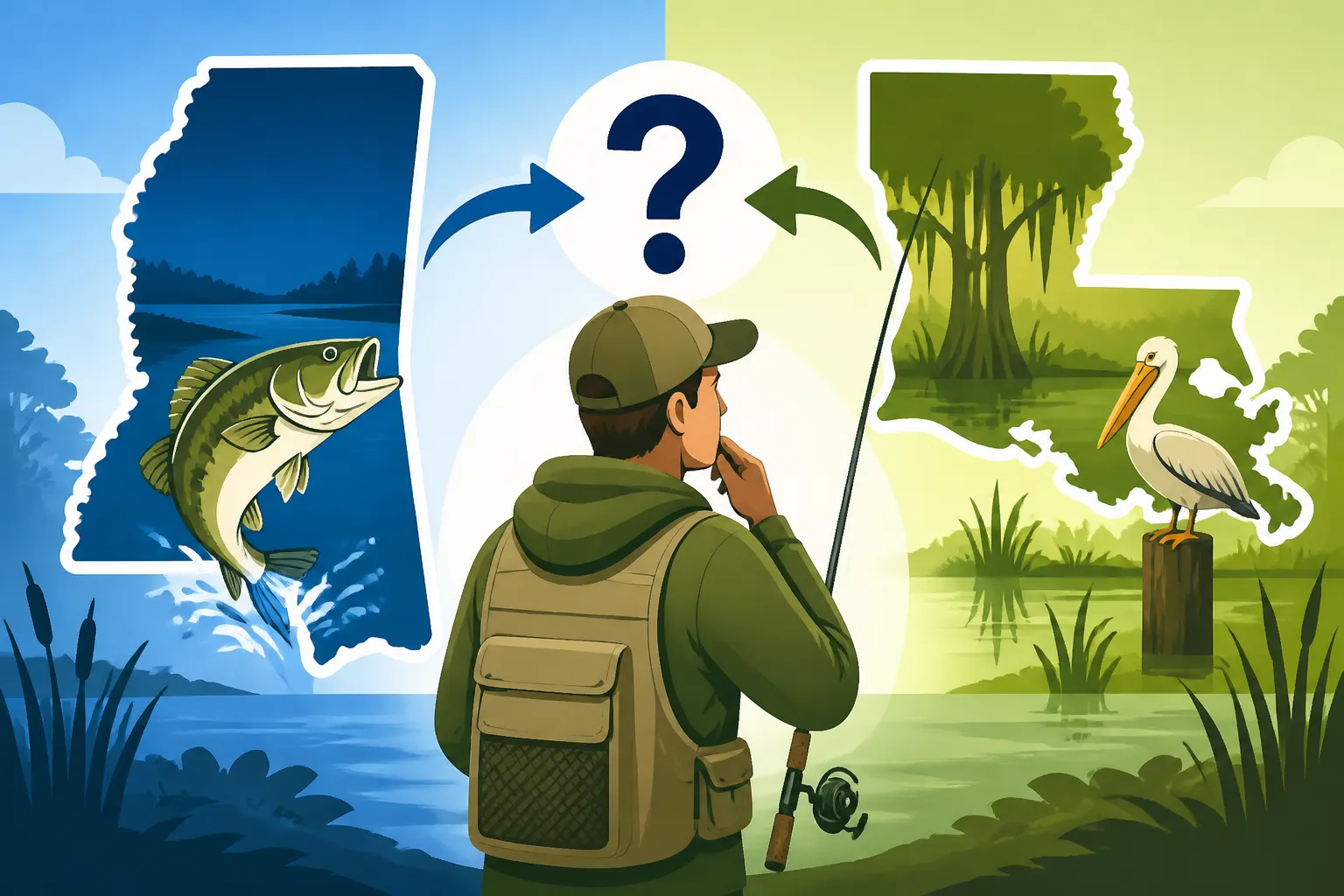
It's a common dilemma for passionate anglers: you're enjoying a fantastic fishing trip in Mississippi, perhaps just a stone's throw from the Louisiana state line, and the thought pops into your head – "Could I just hop over and cast a line in Louisiana with my current license?" The waters can look so invitingly similar, and the fish certainly don't recognize state borders. This guide will meticulously break down the rules and realities of using your Mississippi fishing license across state lines, particularly in our neighboring state of Louisiana, and help you navigate the nuanced regulations to ensure your fishing adventures stay fun and legal.
The General Rule for State Fishing Licenses
When it comes to fishing licenses, the fundamental principle across the United States is that each state governs its own natural resources within its borders. This means that a fishing license issued by the Mississippi Department of Wildlife, Fisheries, and Parks (MDWFP) is primarily valid for fishing within the geographical confines of Mississippi. It's a system designed to fund conservation efforts, fisheries management, and enforcement within that specific state.
Why Licenses Are State-Specific
Think of it this way: the fees you pay for your Mississippi Fishing License Guide contribute directly to maintaining Mississippi's lakes, rivers, and coastal waters. This includes stocking programs, habitat restoration, scientific research, and the salaries of the game wardens who ensure fair play. Louisiana has its own distinct challenges and initiatives, funded by its own license sales. Therefore, simply holding a Mississippi license doesn't automatically grant you permission to fish in Louisiana's interior waters, such as Lake Pontchartrain or Toledo Bend Reservoir, just as a Louisiana license wouldn't cover your bass fishing trip on Ross Barnett Reservoir. It's about respecting the jurisdictional boundaries and contributing to the conservation efforts of the state you're actively fishing in. This can be a real point of frustration for anglers who live near a state line, feeling like they need to buy two sets of licenses just to pursue their hobby freely.
The Concept of Reciprocity in Border Waters
However, there's a crucial exception to this state-specific rule, and it's where things get interesting for anglers living near a state line: reciprocal agreements. To ease the burden on sportsmen and women who live in border communities or frequently fish waters that straddle state lines, some states enter into formal agreements that allow a fishing license from one state to be valid in specific, clearly defined border waters of the neighboring state. These agreements are usually forged to simplify regulations and promote cross-border recreational activities, recognizing the unique geographical realities. It's not a blanket pass, though; these agreements are very specific and often come with their own set of conditions, which we'll explore in detail for Mississippi and Louisiana.
Navigating Mississippi-Louisiana Border Water Fishing Rules
This is where the rubber meets the road for our question: can your Mississippi license work in Louisiana? The short answer is: yes, but only in very specific, designated border waters, and under certain conditions. Mississippi and Louisiana have established reciprocal agreements for portions of the shared waterways that form their boundary.
The Mississippi River and Pearl River Agreements
The most prominent border waters between Mississippi and Louisiana are sections of the mighty Mississippi River and the scenic Pearl River. These are the key areas where a reciprocal agreement can potentially allow you to fish with your Mississippi license in waters that technically fall on the Louisiana side, or vice-versa.
-
Mississippi River: For the Mississippi River, the reciprocal agreement generally covers the main stem of the river that forms the boundary between the two states. This means that if you possess a valid Mississippi fishing license, you can fish the main channel and its immediately adjacent waters on both the Mississippi and Louisiana sides of the river, without needing an additional Louisiana license. This is incredibly convenient for river anglers who might drift from one side to the other while chasing catfish or white bass. However, it's vital to understand this does not extend to tributaries, oxbow lakes, or backwater areas that are entirely within Louisiana's land boundaries. If you venture into a bayou or lake that's clearly removed from the main river channel and entirely within Louisiana, your Mississippi license won't cut it. You'd need a Mississippi Nonresident Fishing License Guide to understand if you need a Louisiana non-resident license for those specific situations.
-
Pearl River: Similar provisions apply to portions of the Pearl River that delineate the state line. Anglers with a valid Mississippi license can fish the main channel of the Pearl River along the shared border. Just like with the Mississippi River, this agreement simplifies things for those who might be fishing from a boat and crossing the invisible state line multiple times. Again, isolated oxbows, flood-plain lakes, or any body of water entirely within the land boundaries of Louisiana would typically require a Louisiana license. The Pearl River Fishing Guide details specific areas and access points that are popular for fishing, and it's always wise to double-check the latest regulations for border water specifics.
Specifics and Limitations of Border Water Reciprocity
While reciprocal agreements are a fantastic convenience, they are not a free pass. It's absolutely critical for anglers to understand the precise boundaries and conditions.
-
Geographical Limits: The reciprocal agreement generally applies to the main stem or main channel of the boundary waters. This means bays, bayous, impoundments, or lakes that are entirely within one state, even if they're close to the border river, are usually excluded. For example, if you launch your boat on the Mississippi River but then navigate deep into a large Louisiana oxbow lake or bayou system, you would typically need a Louisiana fishing license. Always err on the side of caution and consult official maps or agency websites.
-
Species and Creel Limits: Even within reciprocal waters, it's possible for certain species-specific regulations, such as creel limits or size limits, to default to the rules of the state whose side of the border you are predominantly fishing on, or sometimes even the more restrictive of the two. While the license might be reciprocal, the Mississippi Fishing Regulations Explained will detail Mississippi's rules, and you'll need to be aware of Louisiana's as well. For instance, Louisiana might have a different slot limit for bass than Mississippi, and if you're fishing on the Louisiana side of the river, you might be subject to their rules.
-
Fishing Gear Restrictions: Similarly, allowable fishing methods, types of gear (e.g., trotlines, jug fishing), or even the number of poles you can use might differ. It's paramount to be aware of both states' regulations when fishing border waters. Before heading out, consider a quick check on the Louisiana Department of Wildlife and Fisheries (LDWF) website in addition to the MDWFP site. A waterproof map, perhaps one you can find on Amazon that clearly delineates state lines on these rivers, can be a great investment.
-
Proof of Residency: For residents, you'll need to carry proof of residency for the state that issued your license. For non-residents, you would typically have purchased a non-resident license for either Mississippi or Louisiana. If you're fishing under a reciprocal agreement, you must present your valid license from your home state upon request by a game warden from either Mississippi or Louisiana.
It's a nuanced dance, and while the spirit of these agreements is to make fishing easier, the onus is always on the angler to know and follow the rules.
Understanding Reciprocal Agreements and Their Limitations
Reciprocal agreements, while beneficial, are not always static, nor are they universal across all bordering states or all types of fishing. It's crucial to approach these with a clear understanding that they are specific, not general.
Why Reciprocal Agreements Exist
These agreements are typically negotiated at the state agency level – between the MDWFP and the LDWF in this case – to solve practical problems for anglers. Imagine living in Natchez, Mississippi, and wanting to fish the Mississippi River. Without a reciprocal agreement, every time your boat drifted even slightly into Louisiana waters, you'd technically need a Louisiana license, which is impractical and frustrating. By creating these shared zones, both states acknowledge the fluidity of the waters and the shared interest in promoting recreational fishing while still maintaining control over their resources. These agreements often specify not only the geographical limits but also what types of licenses are covered (e.g., recreational only, not commercial).
What's Not Covered by Reciprocity
It's just as important to understand what these agreements don't cover.
- Interior Waters: As mentioned, any lake, river, or pond that is entirely within the landmass of Louisiana and does not form a state boundary is not covered. If you decide to take a road trip to fish for monster sac-au-lait (crappie) in Louisiana's interior lakes, your Mississippi license will be invalid, and you'll need to purchase a Louisiana non-resident license. This also applies if you're exploring the lower stretches of the Pearl River that flow solely through Louisiana before reaching the Gulf.
- Coastal Waters/Gulf of Mexico: While the lower Pearl River does eventually flow into the Mississippi Sound, the general reciprocal agreement for the boundary rivers does not extend into the open waters of the Gulf of Mexico or the vast estuarine systems of the Louisiana coast. If you plan on saltwater fishing off the Louisiana coast, even just a short trip from Mississippi's coastal areas, you will definitively need a Louisiana saltwater fishing license. The Mississippi Saltwater Fishing License Guide covers what you need for Mississippi's coastal waters, but that license won't help you catch redfish and speckled trout near Grand Isle, Louisiana.
- Hunting Licenses: These agreements are typically specific to fishing. A Mississippi hunting license, for example, would never be valid for hunting in Louisiana. They are entirely separate regulatory domains.
- Changes in Agreements: These agreements are not set in stone forever. They can be reviewed, modified, or even terminated by either state. While rare, it's why the advice to "always check current regulations" is so consistently given. What was true five years ago might have a subtle but critical change today.
Why This Matters to You
Getting caught without the proper license, even if it's an honest mistake due to border water confusion, can lead to significant headaches. You could face fines, confiscation of your catch or gear, and even the loss of your fishing privileges. It's simply not worth the risk. Understanding these nuances saves you from potential legal trouble and ensures you're contributing to the conservation efforts of the waters you're enjoying.
How to Ensure You're Compliant and Avoid Penalties
Nobody wants their peaceful fishing trip to turn into a legal ordeal. Here are the actionable steps you can take to make absolutely certain you're legal and compliant, whether you're fishing right on the Mississippi-Louisiana border or venturing deeper into Louisiana's territory.
Consult Official State Wildlife Agencies
This is, without a doubt, your best and most reliable source of information.
- Mississippi Department of Wildlife, Fisheries, and Parks (MDWFP): Their website (www.mdwfp.com) is a treasure trove of information. Look for sections on "Regulations," "Licenses," or "Border Water Agreements." They often have dedicated pages or PDFs that specifically outline reciprocal agreements with neighboring states. You can also call their headquarters or a regional office to speak directly with a representative who can clarify specific situations.
- Louisiana Department of Wildlife and Fisheries (LDWF): Similarly, the LDWF website (www.wlf.louisiana.gov) will have detailed information on their licensing requirements, regulations, and any reciprocal agreements with Mississippi. It's wise to cross-reference information from both states' websites to ensure complete accuracy.
Before any trip, especially if you're planning to fish anywhere near a state line, spend a few minutes on these sites. It’s far better than guessing.
When in Doubt, Buy a Non-Resident License
If you've checked the regulations and you're still uncertain, or if you plan to fish any water in Louisiana that is not explicitly covered by a reciprocal agreement (e.g., an interior lake, a coastal bay), the safest and most straightforward solution is to purchase a non-resident Louisiana fishing license.
- Ease of Purchase: Non-resident licenses for Louisiana can be purchased online through the LDWF website, at many tackle shops, sporting goods stores like those you might find on Amazon, or even Walmart locations in Louisiana. Many states also offer short-term non-resident licenses, such as a 1-day or 3-day option, which might be perfect for a quick cross-border trip without committing to an annual license. For instance, if you're a tourist visiting the area, understanding Mississippi Fishing License Requirements for Tourists is key, and the same principle applies to Louisiana.
- Peace of Mind: The cost of a non-resident license is a small price to pay for the peace of mind it brings. You won't have to worry about accidentally drifting into non-reciprocal waters or facing a game warden with an invalid license.
Consequences of Fishing Without the Correct License
The penalties for fishing without a valid license can range from a minor inconvenience to a serious legal headache. The specifics can vary, but generally, expect the following:
- Fines: You will almost certainly be issued a citation with a monetary fine. The amount can vary depending on the specific state and the nature of the violation. These fines can often be significantly higher than the cost of simply buying the correct license upfront. To understand potential repercussions, you can look into What Happens If You Fish Without a License in Mississippi? as an example.
- Confiscation: Game wardens have the authority to confiscate your fishing gear, your boat, and your catch if you are found to be fishing illegally. This can be a substantial loss, especially for anglers with expensive equipment.
- Loss of Privileges: Depending on the severity and frequency of the offense, you could face a temporary suspension or permanent revocation of your fishing privileges in that state, and sometimes even in reciprocal states.
- Court Appearances: For more serious violations, you might be required to appear in court, adding legal fees and time away from your activities.
The takeaway is clear: always ensure you have the appropriate license for the waters you intend to fish. A small investment in a license or a quick check of the regulations can save you a lot of trouble and expense in the long run.
A Handy Reference for Border Water Fishing
To summarize the key points regarding Mississippi and Louisiana border water fishing:
| Feature | General Mississippi Waters | General Louisiana Waters | Mississippi River (Border Section) | Pearl River (Border Section) |
|---|---|---|---|---|
| MS License Valid? | Yes | No | Yes (reciprocal) | Yes (reciprocal) |
| LA License Needed? | No | Yes | No (if MS licensed) | No (if MS licensed) |
| Applies to Interior Lakes? | N/A | Yes | No | No |
| Applies to Gulf/Coast? | No (need MS Saltwater) | Yes (need LA Saltwater) | No | No |
| Always Check Specifics? | Yes | Yes | Absolutely | Absolutely |
| Relevant Agencies | MDWFP | LDWF | MDWFP & LDWF | MDWFP & LDWF |
In conclusion, while your Mississippi fishing license is a golden ticket for angling throughout the Magnolia State, it doesn't automatically grant you access to all of Louisiana's enticing waters. However, thanks to sensible reciprocal agreements, you can often use your Mississippi license in the specific border sections of the Mississippi River and Pearl River. Always do your homework, consult official sources like the MDWFP and LDWF, and when in doubt, invest in a non-resident Louisiana license. This diligence ensures your fishing experience is not only productive but also entirely legal and stress-free.
Disclaimer
The information provided in this guide is for general informational purposes only and is not intended as legal advice. Fishing regulations and reciprocal agreements are subject to change. Always consult the official websites of the Mississippi Department of Wildlife, Fisheries, and Parks (MDWFP) and the Louisiana Department of Wildlife and Fisheries (LDWF) or contact them directly for the most current and accurate information before engaging in any fishing activities.